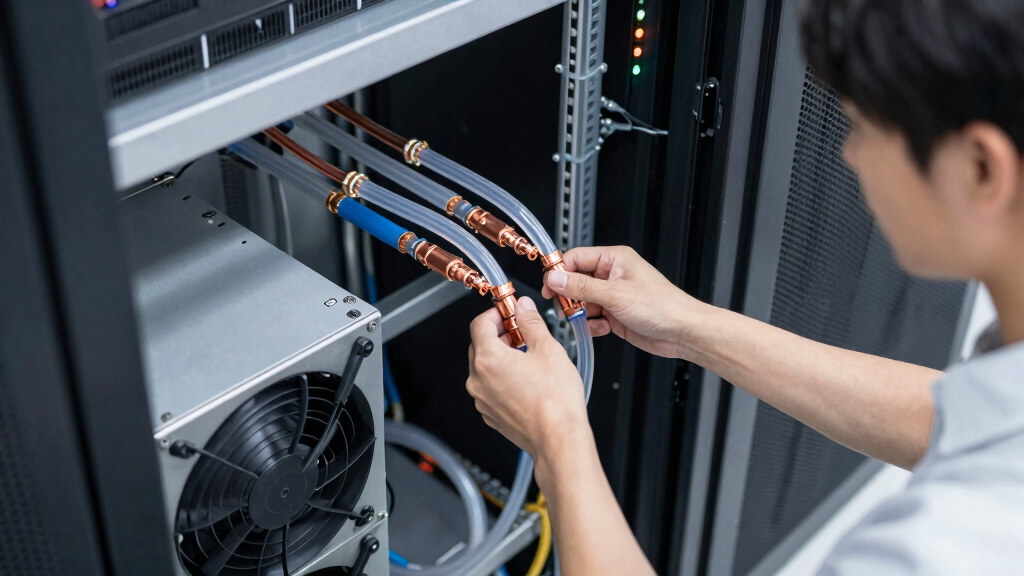

📊 Full opportunity report: Liquid vs Air Cooling for 24/7 Inference Rigs on ThorstenMeyerAI.com — validation score, market gap, and execution plan.

Get the little things that make your day delivered free with Prime
- Fast, free delivery on millions of items
- Prime Video, Amazon Music and more included
- Member-only deals all year
TL;DR
For most 24/7 AI inference rigs, air cooling offers greater reliability, lower cost, and quieter operation than liquid AIOs. Liquid cooling is advantageous mainly for high thermal headroom or space constraints.
For continuous AI inference systems running 24/7, air cooling generally outperforms liquid AIO cooling in reliability, cost, and noise levels, according to experts and recent testing.
Most AI inference rigs operate unattended for long periods, making reliability a key factor in cooling choice. Air coolers, such as dual-tower designs like the Noctua NH-D15, feature no moving parts besides fans, which are easily replaceable and have a lifespan of years. In contrast, AIO liquid coolers rely on a sealed loop with a pump that typically lasts 5-7 years; its failure can render the entire cooling system inoperable. Additionally, coolant permeation over time can reduce effectiveness, and leaks, though rare, pose risks to other components. Cost-wise, high-end air coolers deliver comparable performance to mid-range AIOs at a fraction of the price, with lower total cost of ownership over the system’s lifespan. Noise levels are often lower in quality air coolers under sustained load, as pumps in AIOs produce a continuous hum. Maintenance for air coolers involves dust removal and occasional thermal paste reapplication, whereas AIOs require monitoring for pump failure and potential leaks. Performance-wise, a high-end air cooler can dissipate around 200-250W, suitable for most workstation CPUs, whereas a 360mm AIO can handle up to 360W, making it better suited for high thermal headroom scenarios.Liquid vs air
for a 24/7 inference rig.
For an always-on machine the question isn’t “which cools better” — it’s which one still works in three years without you thinking about it. That reframing makes air the default for most rigs. Answer three questions in Part 2 to find yours.
- Nothing to fail — fan swaps in minutes
- Lasts a decade+; lower total cost
- Quieter floor — no pump hum (~40–45 dBA)
- Trivial maintenance — wipe & repaste
- Tall — can block RAM, dumps heat in case
- Best headroom — ~360W TDP sustained
- Compact block — fits tight cases, clears RAM
- Exports heat out the radiator & room
- Pump fails at 5–7 yrs; replace whole unit
- Costs 2–3× more over its life; pump hum
- You run it 24/7 and want set-and-forget.
- Your CPU is mainstream-to-high-end (or power-capped).
- A big tower fits your case.
- You value lower cost and a quieter floor.
- Your CPU is too hot for air under sustained all-core load.
- A big tower won’t fit (compact / multi-GPU case).
- You need to export heat out of a warm room.
- RAM clearance is tight.
Why Reliability and Cost Matter for Always-On AI Systems
Choosing the right cooling method impacts the long-term stability, maintenance costs, and noise environment of a 24/7 AI inference rig. Air cooling’s simplicity and durability make it the preferred option for unattended operation, reducing downtime and repair costs. Liquid cooling, while offering superior thermal headroom, introduces potential points of failure that could compromise system uptime over years of continuous use. For organizations deploying inference systems at scale, these factors influence total cost of ownership and operational reliability.
As an affiliate, we earn on qualifying purchases.
Long-Term Cooling Considerations for AI Workstations
Traditional gaming and enthusiast guides often emphasize peak temperature and benchmark performance, which are less relevant for AI inference rigs running continuously. The industry has shifted toward understanding reliability and maintenance in long-term deployments. While high-performance AIOs gained popularity for their thermal capacity, recent evaluations highlight the importance of durability for systems expected to run non-stop for years. Manufacturers’ warranties reflect this, with AIOs typically warrantied for 5–6 years, whereas quality air coolers often last much longer with minimal maintenance. The debate has intensified as more organizations seek cost-effective, reliable solutions for AI workloads that demand consistent operation without interruption.
"For set-and-forget inference rigs, air cooling’s reliability and simplicity make it the safest choice over liquid AIOs."
— Thorsten Meyer, AI cooling expert
As an affiliate, we earn on qualifying purchases.
Remaining Questions on Long-Term Liquid Cooler Durability
While modern AIOs are considered reliable today, questions remain about their lifespan beyond 5–7 years of continuous operation, especially regarding coolant permeation and pump wear. The frequency and impact of leaks over extended periods are also not fully documented in real-world deployments. Additionally, the performance degradation over time, if any, and maintenance requirements are still being studied.
high performance air cooler for workstation
As an affiliate, we earn on qualifying purchases.
As an affiliate, we earn on qualifying purchases.
Future Developments in Cooling for AI Inference Systems
Research is ongoing into more durable liquid cooling solutions, including refillable or sealed-loop designs with longer lifespans. Manufacturers may introduce enhanced warranties or monitoring features to detect pump wear or coolant loss early. Meanwhile, the industry will likely continue to favor air cooling for its proven reliability, especially as high-performance air coolers evolve to match or exceed the thermal capacity of larger AIOs in typical inference workloads.
reliable liquid cooling system for PC
As an affiliate, we earn on qualifying purchases.
As an affiliate, we earn on qualifying purchases.
Key Questions
Is liquid cooling necessary for 24/7 AI inference rigs?
Not necessarily. For most workloads, high-quality air coolers provide sufficient thermal capacity, greater reliability, and lower long-term costs.
How long do AIO liquid coolers typically last?
Most are warrantied for 5–6 years, but their effective lifespan may be shorter due to pump wear and coolant permeation, especially under continuous operation.
What are the main failure points of liquid cooling systems?
The pump, seals, and tubing are the primary components that can fail or degrade over time, potentially causing leaks or reduced cooling performance.
How does noise compare between air and liquid cooling?
High-quality air coolers often operate more quietly under sustained load than AIOs, which have a continuous pump hum adding to fan noise.
Can I upgrade my cooling system later if needed?
Yes, but replacing an AIO may involve significant effort and cost, whereas upgrading or maintaining air coolers is generally simpler and cheaper.
Source: ThorstenMeyerAI.com
Halloween Picks
halloween
As an affiliate, we earn on qualifying purchases.