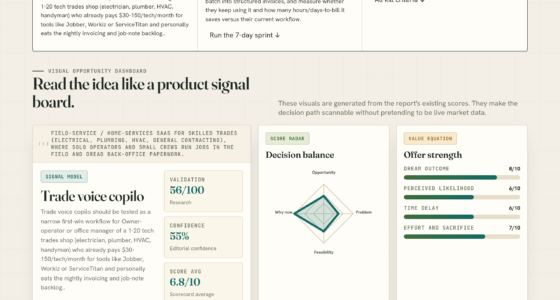
📊 Full opportunity report: What Voice AI Can Do For A Trade Business Front Office on IdeaNavigator AI — validation score, market gap, and execution plan.

Get the little things that make your day delivered free with Prime
- Fast, free delivery on millions of items
- Prime Video, Amazon Music and more included
- Member-only deals all year
TL;DR

A proposal from IdeaNavigator AI outlines a narrow use for voice AI in plumbing, HVAC and electrical businesses: answer calls, collect job details, schedule appointments and escalate emergencies. The proposed five-shop, one-month pilot has not been reported as completed, so its booking results, reliability and economics remain unverified.
IdeaNavigator AI has outlined a proposed voice-AI service for plumbing, HVAC and electrical businesses that miss customer calls while owners are working on jobs. The system would answer calls, collect the issue, address and urgency, book appointments and route emergencies to a person, but the proposal describes a product to test—not a service with demonstrated results.
The proposed tool is aimed at owner-operators who cannot reliably pick up while under a sink, on a roof or otherwise occupied. Its intended first use is structured call intake, rather than handling every customer-service task. A natural-sounding voice would ask what work is needed, where the customer is located and how urgent the problem is.
After collecting those details, the system would place an appointment in the business calendar or connect to trade-service platforms such as ServiceTitan or Jobber. It would also text the owner a call summary and transfer emergency calls to a live person. These are proposed capabilities; no integration tests, booking totals or performance figures are included in the proposal.
The suggested business model combines a flat monthly fee per phone line with a charge for each booked job. IdeaNavigator AI recommends forwarding after-hours calls for five shops over one month, then counting jobs booked that owners say they otherwise would have missed and comparing their value with each shop’s average ticket. The proposal does not report that this test has begun or provide pricing.
What Voice AI Can Do for a Trade Business Front Office
IdeaNavigator AI proposes a phone assistant for plumbing, HVAC and electrical businesses. Its capabilities and business value remain unverified because the proposed pilot has no reported results.
What the system would handle
The proposed scope is structured call intake while owners are busy on jobs.
Ask what work is needed, where the customer is, and how urgent the issue is.
Place an appointment in a business calendar or a platform such as ServiceTitan or Jobber, then text the owner a call summary.
Transfer emergency calls to a live person; the proposal does not explain how urgency would be judged.
Who it is for
The idea targets owner-operators who may miss calls while working at a job site.
Capture service requests
Answer calls when the owner is occupied and collect the issue, address and urgency.
Route urgent needs
The proposed system would pass emergencies to a person instead of leaving them in a routine booking queue.
Arrange appointments
Bookings could help capture missed opportunities, but an appointment is not necessarily completed, paid work.
How the pilot would be judged
IdeaNavigator AI suggests forwarding after-hours calls and tracking whether the service brings in work owners believe they would otherwise have missed.
Evidence still missing
The proposal describes a test, not demonstrated performance.
| Question | What is reported |
|---|---|
| Has the pilot started? | No start or participating businesses are reported. |
| How reliable are bookings and handoffs? | No booking accuracy or emergency-transfer results. |
| What does it cost? | A monthly fee per phone line plus a booked-job fee is suggested; no prices are given. |
| Does it integrate and pay off? | No integration tests, operating costs or completed-job results are provided. |
Capturing Calls While Crews Work
For a small trade business, a missed call can mean a prospective customer contacts another contractor. An automated answering line could give an owner a way to capture requests while working, without stopping a job to answer every call. Whether that translates into more completed work is still a question for testing: an appointment booked by software is not necessarily a job the business can take, complete or collect payment for.
The idea also puts the proposed tool in a practical, measurable category. Rather than asking whether voice AI can replace a front office generally, the pilot would focus on after-hours calls and count bookings that owners believe they would otherwise have lost. That could help businesses compare the service’s cost with the value of work it brings in, provided the trial records the calls, bookings and costs consistently.
Emergency routing and calendar integration would matter as much as the voice itself. A system that sounds natural but sends urgent plumbing or heating problems into a routine appointment queue could create operational risks. The proposal’s live escalation step recognizes that some calls need a person, though it does not spell out how urgency would be judged or who would be available to take transfers.
Products Worth Considering

Philips Sonicare DiamondClean Smart 9500 Electric Toothbrush, Pink, with 2 Brush Heads

Hyperice Hypervolt Go 3 Lightweight Percussion Massage Gun with Carry Case

Withings Body Comp Smart Scale with Body Composition and Visceral Fat Analysis, Black
As an affiliate, we earn on qualifying purchases.
A Narrow Test for Voice AI
The proposal says voice AI reached a reliability threshold for structured intake calls in 2025–2026, and argues that automated answering could cost less than a human answering service. Those are claims in the proposal, not independently documented findings here; it provides no benchmark, cost comparison or evidence across different systems and call types.
Its suggested scope is deliberately limited to a trade business’s front-office phone line. The system would gather a few repeatable details, arrange a booking and notify the owner, while handing off emergencies. This differs from an open-ended claim that AI can run a service company or replace staff. The proposal places the idea in the home-services front-office software market and names existing scheduling products as possible destinations for appointments.
The proposed validation method is a one-month trial across five shops, focused on calls received after hours. That would be an initial test, not proof that the approach works across the wider trades market. Results could vary with call volume, the kind of work offered, local demand and each business’s capacity to take new jobs.
Pilot Results Still Unreported
The proposal does not identify a product launch, participating businesses or a completed trial. It also gives no figures for call-answer rates, booking accuracy, customer satisfaction, emergency-transfer success, software integration or operating costs. The claim that voice AI became reliable enough for structured intake in 2025–2026 is not accompanied by test data or a definition of reliability.
It is also unclear how a system would handle callers who describe a problem imprecisely, request work outside a shop’s service area or need immediate help. The proposal does not specify whether businesses could set appointment availability and job types, what happens when calendars are full, or how customer information would be stored. Its pricing model is a suggestion, not a published offer, and no evidence establishes that booked-job fees would be worthwhile for either the business or provider.
Measure Bookings and Handoffs
The next step proposed by IdeaNavigator AI is a one-month pilot with five shops, forwarding their after-hours calls to the system. A useful evaluation would distinguish calls answered from appointments booked, and bookings from jobs ultimately completed. It would also record how often emergency calls are transferred successfully and whether the calendar entries and text summaries are accurate.
No start date, participating companies or results have been announced in the material provided. Until a pilot reports those details, the service’s claimed affordability and ability to recover otherwise-missed jobs remain unverified. The proposal’s suggested comparison is the value of jobs attributed to the system against each shop’s average ticket and the service’s eventual price.
Source: IdeaNavigator AI
Key Questions
What would the proposed voice-AI tool do?
It would answer calls, ask about the job and its location and urgency, book an appointment in a business calendar or a platform such as ServiceTitan or Jobber, and text the owner a summary. The proposed system would transfer emergencies to a live person.
Who is the service intended for?
The proposal targets owner-operators at plumbing, HVAC and electrical businesses who may miss calls while working at a job site.
Has the tool been tested with trade businesses?
No test results are provided. IdeaNavigator AI proposes forwarding after-hours calls for five shops over one month, but does not say that the pilot has started.
How would the service charge businesses?
The suggested model is a monthly fee for each phone line plus a fee for each booked job. No prices or evidence about the model’s profitability are provided.
What remains unknown about its performance?
Booking accuracy, call volume handled, emergency escalation, customer response, calendar integration, cost and completed-job results are all unreported. The proposal also does not provide evidence for its claim about voice-AI reliability in 2025–2026.
Source: IdeaNavigator AI