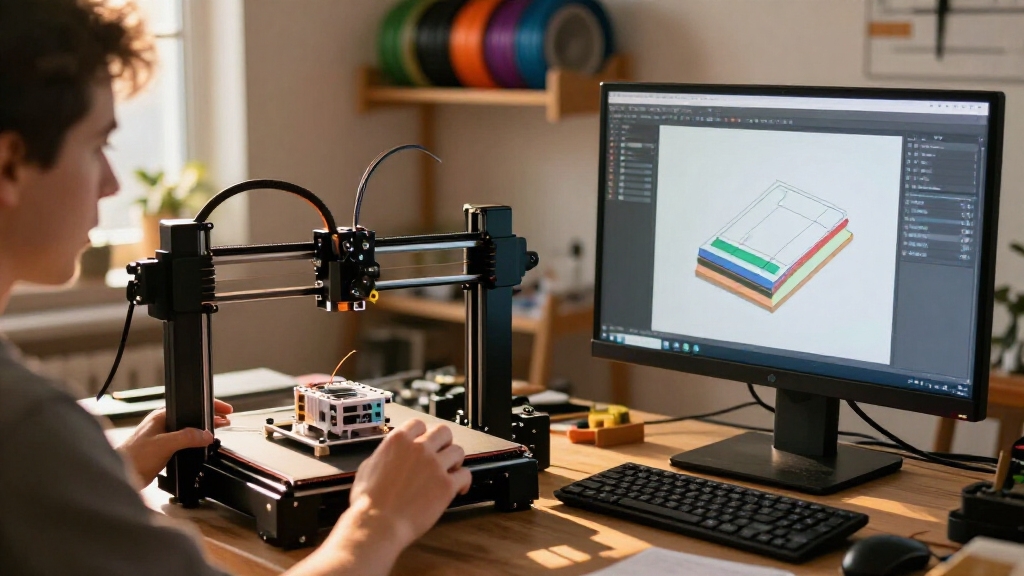
🔍 Read the full analysis: How To Tell Useful AI Features From Hype In 3D Printing on ThorstenMeyerAI.com

Get the little things that make your day delivered free with Prime
- Fast, free delivery on millions of items
- Prime Video, Amazon Music and more included
- Member-only deals all year
TL;DR
AI has practical uses in 3D printing, especially generative design and camera-based detection of printing errors, but the source material does not support treating AI output as ready-to-use without review. Text-to-CAD remains research, and load-bearing or safety-critical parts still need human checks and physical tests.
A November 29 report from ThorstenMeyerAI.com says AI can already help design parts and monitor some 3D prints, but it cannot yet turn a text prompt into a dependable part without human review. The distinction matters because errors in a printed component can affect whether it fits, carries a load or performs safely: the report says testing and engineering checks remain necessary, especially for parts with real-world consequences.
The report traces AI’s role through four stages: design, checking, printing and production. Its strongest example is generative design, in which an engineer specifies requirements such as loads, connection points and areas that must remain clear, and software proposes a shape. The report cites NASA Goddard Space Flight Center engineer Ryan McClelland’s work on “evolved structures,” which uses topology optimisation to remove material that contributes little to carrying loads.
For a bracket for the EXCITE balloon telescope, the report says two engineers took two days to produce a conventional design. McClelland’s paper describes the AI-assisted version as requiring about 30 minutes for one engineer to encode requirements, followed by about an hour of computing. Those figures describe the specific example, not a general time saving for every part. The supplied source cuts off before giving the final design’s measured performance, so its weight or stiffness result cannot be verified from the material provided.
AI can also monitor a printer while it is running. The report points to a University of Cambridge system that used a camera to detect and correct common nozzle errors during material-extrusion printing. It characterises text-to-CAD as research rather than a dependable production tool, and stresses that generated code or a plausible-looking model does not establish that a part is dimensionally or mechanically sound.
From idea to printed part: where AI looks over your shoulder
The orange marker shows where AI helps today. The last word still belongs to a real test.
Design: you set the loads, bolts and keep-out zones. The software proposes the shape.
Check: simulation predicts how the part bends. Only a real test shows how strong it is.
Print: a camera next to the nozzle spots common errors and corrects them during the print.
Every step: AI guesses from patterns. For parts that carry weight, people still test.
Where AI Can Save Design Time
For engineers, the demonstrated design workflow may reduce the time needed to explore shapes that satisfy a defined set of constraints. For people using home printers, camera-based monitoring could help flag visible print problems while a job is underway. The report cautions that monitoring should act as a second pair of eyes, not a guarantee that a print will succeed.
The practical limit is that software works from the requirements it receives. A missed load, bolt, clearance or access need can produce a design that looks convincing but is wrong for its intended use. That risk matters most when a component bears weight, protects people or is intended for flight. The report says those parts still call for human review and physical testing, rather than relying on an AI-generated shape or a printer camera alone.
Products Worth Considering

Oura Ring 5 Smart Ring – Silver, Size 9

Philips Sonicare DiamondClean Smart 9500 Electric Toothbrush with 2 Brush Heads, Pink

Levoit Core 400S-P Smart Air Purifier for Large Rooms
As an affiliate, we earn on qualifying purchases.
From CAD Model to Printed Part
The report follows the usual production sequence: a designer creates a dimensioned model in computer-aided design (CAD); engineers check its behaviour, often using simulation; a slicer divides it into layers and generates machine instructions; then the printer builds the object layer by layer. A failed print may require changes and another attempt. AI tools can enter at different points in this sequence, but they do not replace the whole workflow.
The examples focus partly on material extrusion, the nozzle-based method widely used by personal and commercial printers, as described by the US National Institute of Standards and Technology. The report also notes that NASA has a standard for printed flight hardware and that AI-designed parts still undergo conventional stress analysis and testing. It raises legal boundaries as well: according to the source, purely AI-made output does not receive US copyright, and only humans can be named as inventors. Those points are presented as relevant constraints, not a full account of intellectual-property law.
What the Examples Do Not Prove
The supplied material does not include the end of its account of the EXCITE bracket example, including the final comparison of the AI-assisted design’s weight or stiffness. It also gives no detailed test results, error rates or operating limits for the Cambridge printer-monitoring system. The examples therefore support describing these as specific applications, but not claiming that they will perform equally well across printers, materials and part types.
The report does not identify a text-to-CAD system that can reliably produce a safety-ready part from a sentence, nor does it provide a timetable for one. Legal statements about copyright and inventorship are brief and should not be treated as legal advice. It remains unclear how quickly these tools will reach routine consumer use or how their performance will be evaluated across more demanding manufacturing settings.
Testing Remains the Next Step
For now, the report’s practical guidance is to use AI as assistance within an established design and printing process. Users can check early printer layers themselves, review generated designs against the full set of engineering requirements and test finished parts for their intended use. For components that carry weight or protect people, physical testing and qualified human review remain the stated next steps, not optional confirmation after an AI result.
The source provides no announced product launch, regulatory change or future release date. Further evidence will depend on published testing and clear performance data for particular tools, machines and materials. Until then, claims about AI-designed or AI-monitored printing should be judged against what was actually tested, rather than a general promise that AI can make a part reliably.
Key Questions
Can AI design a 3D-printed part today?
AI-assisted generative design can propose shapes when an engineer supplies constraints such as loads, connection points and areas to avoid. The report does not say that a generated design is ready to use without engineering review and testing.
Can AI monitor a 3D printer while it works?
The report cites a University of Cambridge camera-based system that detected and corrected common nozzle errors during material-extrusion printing. It does not provide error rates or establish that the system works across all printers and materials.
Is text-to-CAD ready for safety-critical parts?
The report describes text-to-CAD as research, not a tool that can yet be trusted to produce a dependable part from a prompt. A model or code that runs does not by itself prove the resulting part is correct or safe.
Do AI-designed parts still need testing?
Yes. The report says parts that carry real loads or have safety implications still need human checks and physical tests. It notes that NASA’s AI-designed parts undergo stress analysis and testing.
Source: ThorstenMeyerAI.com