📊 Full opportunity report: Purchase order exception tracker for small manufacturers on IdeaNavigator AI — validation score, market gap, and execution plan.

Get the little things that make your day delivered free with Prime
- Fast, free delivery on millions of items
- Prime Video, Amazon Music and more included
- Member-only deals all year
TL;DR
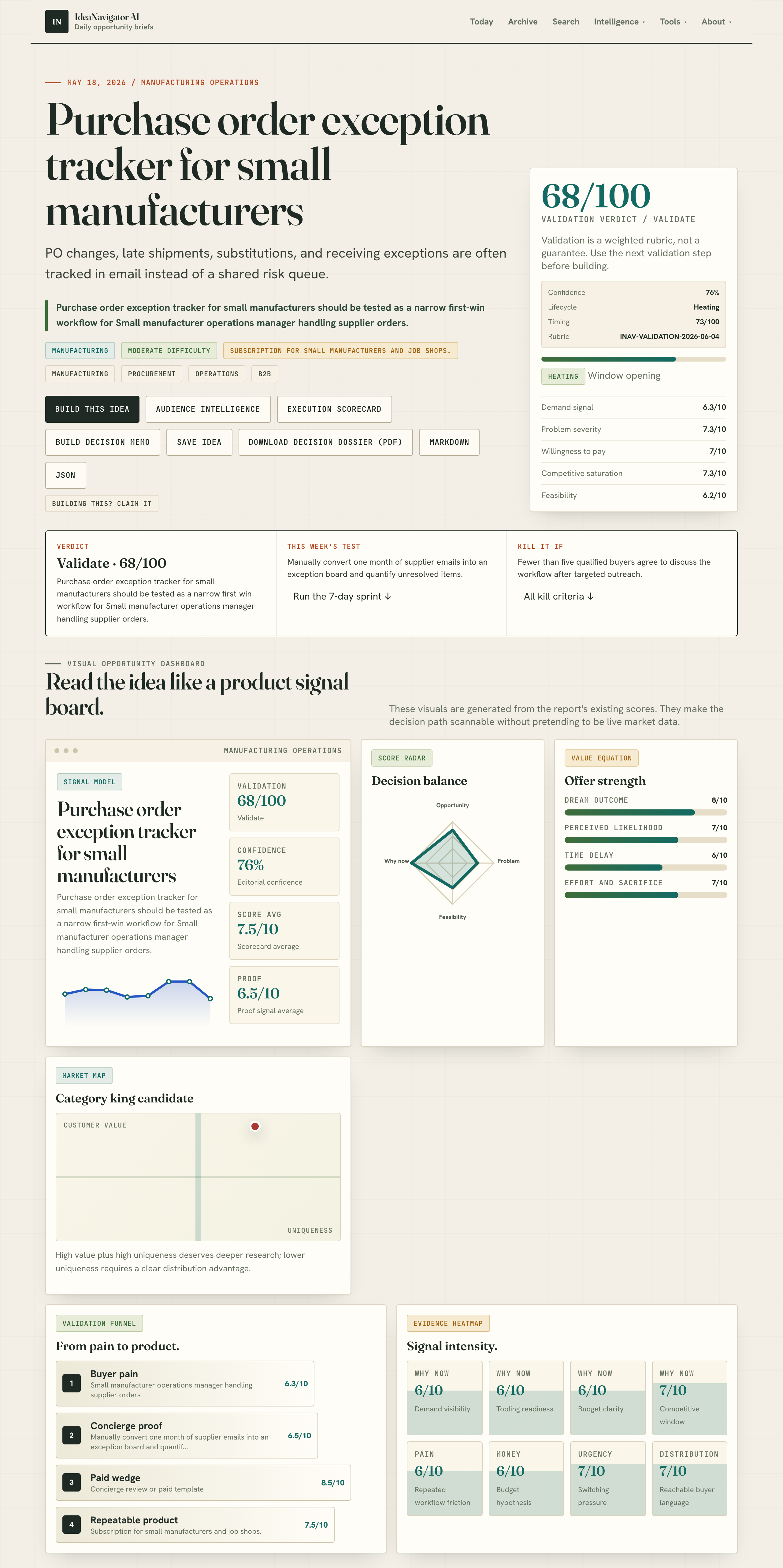
A pilot program for a purchase order exception tracker tailored for small manufacturers is launching. It aims to streamline exception handling and reduce costs during supply disruptions. Validation involves converting email data into the tracker to measure unresolved issues.
Small manufacturer operations managers will soon test a new purchase order exception tracker designed to improve handling of supplier issues such as late shipments and substitutions, addressing a key pain point exacerbated by recent supply volatility.
The initiative involves developing a minimal viable product (MVP) — an exception board that records supplier, purchase order details, issue type, owner, next action, and customer-impact notes. This tool aims to replace the current reliance on email tracking, which is often inefficient and fragmented.
The project is targeted at small manufacturers and job shops, with the goal of streamlining exception management processes. Validation will occur by manually converting one month of supplier emails into the exception board to quantify unresolved issues and assess the tool’s effectiveness.
Why a Purchase Order Exception Tracker Matters for Small Manufacturers
This development could significantly reduce operational costs for small manufacturers by providing a shared, transparent platform to track and resolve supply issues more efficiently. As supply chain disruptions increase, the ability to handle PO exceptions swiftly becomes critical for maintaining customer satisfaction and operational continuity.
Implementing such a tool aligns with broader industry efforts to digitize supply chain management, especially for small players with limited resources. Success could lead to wider adoption, improving resilience across the manufacturing sector.
Products Worth Considering

Fitbit Charge 6 Activity Tracker with Heart Rate Monitoring, GPS, Google Apps, and Sleep Analysis

Withings Sleep Under-Mattress Sleep Tracking Pad

Oura Ring 5 – Silver, Size 10 – Fitness and Sleep Tracker
As an affiliate, we earn on qualifying purchases.
Supply Chain Challenges Drive Need for Better Exception Management
Small manufacturers often manage supplier issues through email correspondence, which can lead to delays and unresolved problems. Recent supply volatility has heightened the need for more structured exception handling, prompting interest in digital solutions. The concept of an exception tracker has been discussed as a way to centralize and streamline issue resolution, but this is among the first efforts to test a dedicated tool specifically for small manufacturers.
The MVP approach aims to validate whether a simple, focused platform can effectively improve exception management compared to current email-based practices.
“The opportunity is to create a shared exception board that captures all supplier issues in one place, reducing delays and miscommunication.”
— an anonymous researcher
Uncertainties Around Implementation and Effectiveness
It is not yet clear how quickly small manufacturers can adopt the exception tracker or whether it will significantly reduce unresolved issues compared to current email tracking. The pilot’s success depends on user engagement and the accuracy of manual data conversion, which may vary.
Next Steps in Developing and Validating the Exception Tracker
The initial testing phase will involve converting existing supplier emails into the exception board over one month. Results will inform whether the tracker effectively reduces unresolved issues and if it warrants broader deployment. Further development may include automation features based on feedback.
Key Questions
How will the success of the exception tracker be measured?
Success will be assessed by comparing the number of unresolved issues before and after using the tracker during the validation period.
Will small manufacturers need extensive training to use the new tool?
The MVP is designed to be simple, with minimal training required, focusing on ease of adoption for small operations teams.
Is this solution intended to replace existing supply chain management systems?
It is intended as a targeted, lightweight tool to improve exception handling specifically for PO issues, complementing existing systems.
When will wider rollout occur if the pilot is successful?
A timeline has not yet been announced; further testing and validation results will determine the next steps.
Will the tracker integrate with other manufacturing management software?
Integration plans are not yet specified; initial focus is on validating the core functionality.
Source: IdeaNavigator AI