
📊 Full opportunity report: When One Agent Isn’t Enough: Claude Now Builds Its Own Team of Agents on the Fly on ThorstenMeyerAI.com — validation score, market gap, and execution plan.

Get the little things that make your day delivered free — and shop member deals
- Fast, free delivery on millions of items
- Access to Prime Big Deal Days deals on October 6–7
- Prime Video, Amazon Music and more included
TL;DR
Anthropic’s Claude has introduced a new feature called dynamic workflows, allowing it to create and manage its own team of specialized agents during task execution. This development aims to improve performance on complex, high-value tasks by overcoming limitations of single-agent approaches.
Anthropic’s Claude has introduced a new feature called dynamic workflows, enabling the model to build and coordinate its own team of specialized agents on the fly. This development addresses limitations of single-agent operation in complex or high-stakes tasks, potentially transforming how AI handles multi-faceted projects.
The feature allows Claude to generate small JavaScript programs that orchestrate multiple subagents with distinct roles, such as dispatchers, specialists, and reviewers. These subagents can operate in isolated workspaces, with flexible model selection and the ability to pause and resume workflows. The system is designed for complex tasks that require division of labor, parallel processing, or adversarial review, which single-agent approaches often struggle with.
According to Anthropic, this capability is built into Claude’s latest iteration, Claude Opus 4.8, and is triggered via a command or keyword like “ultracode.” The approach is inspired by traditional team management strategies, such as routing work, parallel execution, and independent verification, but applied within an AI context. The feature is more resource-intensive, suitable mainly for high-value, complex projects.
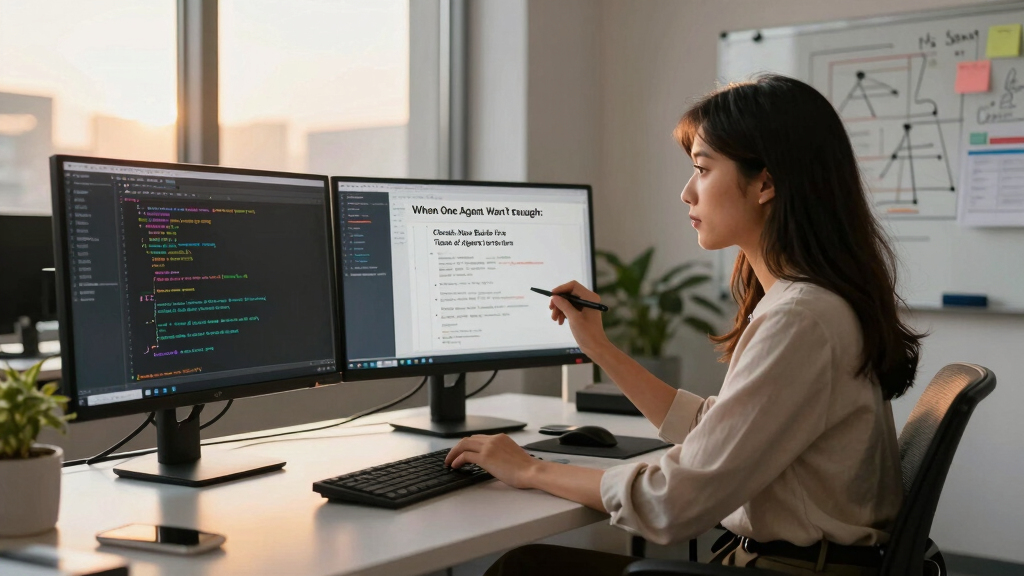
When one agent isn’t enough: Claude now builds its own team on the fly
Skills package what you know; loops decide how far you delegate over time. Dynamic workflows are the third axis — within a single task, Claude writes its own harness and assembles a temporary team of subagents. Think of it as Claude drawing an org chart for one job.
The shift is from prompting a worker to commissioning a team — more output, more cost, and a manager’s judgment required. Reach for a workflow when a task is big, parallel, adversarial, or judgment-heavy — and when you can feel a single agent getting lazy, grading its own homework, or losing the plot. Bound it (token budgets, pilot first) — workflows can spawn hundreds of agents and burn far more tokens. For everything else, don’t hire five people to change a lightbulb.
Implications for AI Performance in Complex Tasks
This innovation could significantly enhance AI’s ability to handle multifaceted, long-term projects by reducing common failure modes like goal drift and self-bias. It enables AI to simulate a collaborative team, improving accuracy, consistency, and reliability in high-stakes environments. For organizations, this means more trustworthy AI outputs in areas like research, software development, and compliance.
As an affiliate, we earn on qualifying purchases.
Evolution of Multi-Agent AI Workflows
Previous efforts in AI workflow management focused on static or manual multi-agent setups, often requiring extensive coding or engineering. Anthropic’s recent advancements, including the release of Claude Opus 4.8, introduce dynamic, self-assembling workflows that adapt to the task at hand. This builds on earlier concepts like orchestration patterns (classify-and-act, fan-out-and-synthesize, etc.) but automates and personalizes them within the AI model itself.
The move reflects a broader trend toward more autonomous and adaptable AI systems, capable of managing complex projects without constant human oversight. It also addresses known issues where single agents underperform in long or adversarial tasks, such as incomplete work, bias, or loss of focus.
“Claude’s ability to write and execute its own orchestration code marks a new step toward autonomous AI teams, especially for complex, high-value tasks.”
— Thorsten Meyer, AI researcher at Anthropic
JavaScript programming for AI orchestration
As an affiliate, we earn on qualifying purchases.
As an affiliate, we earn on qualifying purchases.
Unanswered Questions About Workflow Scalability
It is still unclear how well these dynamic workflows perform in real-world, large-scale deployments and how they compare to traditional static setups. Details about resource consumption, latency, and robustness under different workloads are not yet fully available. Additionally, the limits of automation—such as potential errors in workflow generation—remain to be tested in diverse scenarios.
As an affiliate, we earn on qualifying purchases.
Next Steps for Adoption and Testing
Anthropic plans to release further documentation and case studies demonstrating how organizations can implement and benefit from dynamic workflows. Expect ongoing testing in real-world applications, with potential updates to improve efficiency and safety. Monitoring how users adapt to and leverage this feature will be key to understanding its full impact.
As an affiliate, we earn on qualifying purchases.
Key Questions
What is a dynamic workflow in Claude?
A dynamic workflow is a self-generated, programmable orchestration of multiple subagents that work together to complete complex tasks, created and managed by Claude itself in real time.
When should I consider using this feature?
It is best suited for high-value, complex projects requiring division of labor, multiple perspectives, or verification, rather than simple or quick tasks.
Does this increase resource use or costs?
Yes, dynamic workflows are more resource-intensive due to the orchestration of multiple agents and higher token consumption, making them suitable mainly for critical projects.
Are there risks associated with autonomous workflows?
Potential risks include errors in workflow generation and coordination, which Anthropic is actively working to mitigate through testing and safety measures.
Source: ThorstenMeyerAI.com
Halloween Picks
halloween
As an affiliate, we earn on qualifying purchases.