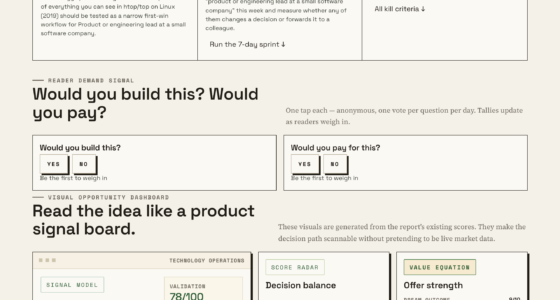

📊 Full opportunity report: IdeaNavigator AI: One Evidence-Mined Idea a Day on ThorstenMeyerAI.com — validation score, market gap, and execution plan.

Get the little things that make your day delivered free — and shop member deals
- Fast, free delivery on millions of items
- Access to Prime Big Deal Days deals on October 6–7
- Prime Video, Amazon Music and more included
TL;DR
IdeaNavigator AI autonomously generates and scores one software idea daily based on real-world complaints from online sources. It aims to improve product success by starting with demand signals rather than hunches. The system runs on a single Mac mini, emphasizing low cost and high discipline in idea validation.
IdeaNavigator AI has started publicly publishing one software idea daily, generated entirely through an autonomous pipeline that mines real complaints from online sources and scores each idea based on evidence before any development begins.
The system, built to turn genuine user frustrations into fully-scoped software ideas, operates on a single Mac mini, producing two ideas daily but shipping one. It scans complaint-rich platforms like App Store reviews, Hacker News, GitHub issues, and Stack Overflow to identify unmet needs, then scores each idea from 0 to 100 and assigns a verdict: Build, Validate, Research, or Rethink.
This approach aims to invert traditional idea generation, which often relies on brainstorming and hunches, by starting from proven demand signals. The scoring helps prevent costly investments in ideas that lack real evidence of market need, effectively reducing the risk of building the wrong product.
The AI’s process is fully autonomous, from idea creation to publication, running on a single computer, which keeps operational costs low and emphasizes the importance of disciplined filtering over volume.
IdeaNavigator AI — one evidence-mined idea a day
Idea generation is cheap; validation is the bottleneck. Mine real complaints, scope an idea, score it 0–100 — and let the verdict tell you when not to build.
Verdict: Validate. Promising — but a high score is a prior, not a proof. The point of the gauge is the verdicts that say not yet.
Independent commentary, produced with AI assistance under human editorial oversight. The views are the author’s own and may change. IdeaNavigator AI generates, mines and scores ideas via automated pipelines; scores and verdicts are programmatic priors that may contain errors or bias and are not validated demand — verify independently before building. As an Amazon Associate the author earns from qualifying purchases; pages may contain affiliate links. Product and company names are trademarks of their respective owners; mention does not imply endorsement.
Impact of Evidence-Driven Idea Generation on Software Development
This development could significantly shift how startups and product teams validate ideas, prioritizing demand signals over intuition. By systematically reducing the risk of building unwanted products, it may lower failure rates and improve resource allocation in software development. The autonomous nature of the pipeline demonstrates a move toward more efficient, data-driven decision-making in product innovation, potentially influencing industry practices.
As an affiliate, we earn on qualifying purchases.
Background on Idea Validation and AI Innovation in Product Development
Traditionally, many software failures stem from building products based on hunches rather than proven demand, with idea validation being an expensive bottleneck. The startup ecosystem is littered with ideas that seemed promising but lacked real user evidence. Recent advances in AI and data mining have enabled more systematic approaches to identifying genuine user frustrations, leading to innovations like IdeaNavigator AI.
Previously, idea validation involved extensive market research and user testing, often delaying or discouraging innovation. The emergence of autonomous pipelines that mine online complaints and score ideas in real-time represents a new approach aimed at reducing these costs and risks.
As an affiliate, we earn on qualifying purchases.
Unconfirmed Aspects of System Effectiveness and Adoption
It remains unclear how well IdeaNavigator AI's ideas perform in real market tests, and whether its scoring reliably predicts successful products. The long-term impact on startup failure rates and industry adoption are still to be determined. Additionally, the system's ability to adapt to different markets and evolving complaints is still being observed.
As an affiliate, we earn on qualifying purchases.
Next Steps for Validation and Industry Integration
The developers plan to monitor the market performance of ideas validated through the system, gather user feedback, and refine the scoring algorithms. They also intend to expand the sources of complaints and improve the trend analysis component. Industry adoption will depend on demonstrating that ideas generated and scored by AI lead to successful products and lower failure rates.
As an affiliate, we earn on qualifying purchases.
Key Questions
How does IdeaNavigator AI find its software ideas?
It mines online complaints from platforms like app reviews, Hacker News, GitHub issues, and Stack Overflow to identify genuine user frustrations and unmet needs.
What does the scoring system indicate?
The 0–100 score reflects the strength of the evidence supporting an idea, with higher scores suggesting a higher likelihood that the idea addresses a real demand. The system also provides a verdict: Build, Validate, Research, or Rethink.
Is this approach guaranteed to produce successful products?
No, the score is an evidence-based prior, not a proof. It helps prioritize ideas for further validation but does not guarantee market success.
Will this system replace human product managers?
Not necessarily. It aims to assist by reducing the risk of building the wrong product, but human judgment remains essential for strategic decisions and execution.
How can startups benefit from IdeaNavigator AI?
Startups can use the system to identify high-potential ideas based on real demand signals, saving time and resources by focusing on validated problems rather than assumptions.
Source: ThorstenMeyerAI.com
Fall Picks
fall essentials
As an affiliate, we earn on qualifying purchases.