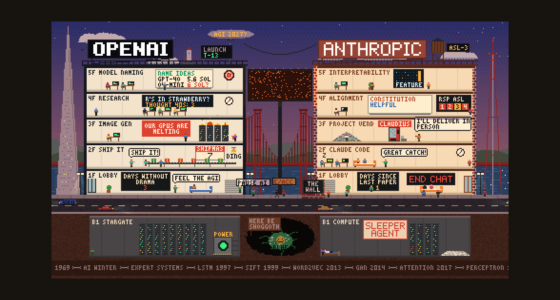

🔍 Read the full analysis: Inside The AI Tower: Twelve Rooms Of Safe And Controlled AI Deployment on ThorstenMeyerAI.com

Get the little things that make your day delivered free with Prime
- Fast, free delivery on millions of items
- Prime Video, Amazon Music and more included
- Member-only deals all year
TL;DR
The AI Tower introduces twelve distinct rooms, each demonstrating safe, controlled methods for deploying AI systems. This development aims to improve transparency and safety in AI use, but some technical limitations and implementation challenges remain.
Thorsten MeyerAI.com has launched the AI Tower, a new framework comprising twelve distinct rooms designed to demonstrate safe, controlled deployment of artificial intelligence systems. This initiative aims to address ongoing concerns about AI safety, transparency, and responsible use, providing users and developers with practical, accessible environments to experiment with AI functionalities.
The AI Tower is part of the third installment in the ‘Inside AI’ series, following previous explorations of AI museums and engine rooms. It operates entirely within a browser, accessible on phones, tablets, and computers, with no sign-up, cookies, or tracking involved. Each of the twelve rooms tackles a specific aspect of AI deployment, from retrieval-based answering from personal documents to building custom assistants without programming skills.
According to the developers, the Tower aims to serve as an educational and testing platform, allowing users to understand the capabilities and limitations of AI systems in a controlled setting. For example, the ‘Archive Desk’ demonstrates how retrieval-augmented generation (RAG) works, fetching relevant passages from user documents before generating answers. The ‘Hiring Desk’ shows how prompts can be crafted to guide AI behavior effectively.
While the platform emphasizes safety and transparency, experts note that AI systems still face technical challenges. For instance, the retrieval process can still produce incorrect or poorly sourced answers, as highlighted by a 2024 Stanford study indicating a 17-33% error rate in legal research tools employing similar methods. The developers advise users to verify AI responses by checking the provided sources.
Inside AI · Field Guide 03
Inside the AI Tower: Twelve Rooms for Safer AI
A browser-based framework turns responsible AI deployment into a hands-on tour—showing how to guide, ground, test, and verify AI systems while making their limits visible.
Announced · March 2024Each room explores a distinct deployment task in a controlled learning environment.
Use on phones, tablets, and computers—without sign-up, cookies, or tracking.
“Explore AI’s capabilities while understanding its limitations.”
Step inside the rooms
The Tower presents a set of focused demonstrations. Two named rooms illustrate how retrieval and prompt design shape AI behavior.
Archive Desk
Retrieve relevant passages from personal documents before generating an answer.
Hiring Desk
Explore how carefully written prompts can guide an assistant’s behavior.
Custom Assistant
Build without code using a role description, documents, and instructions.
Grounding
Connect answers to supplied material and make the evidence easier to inspect.
Instructions
Set clear boundaries for what an AI system should do and how it should respond.
Testing
Try an assistant in a controlled setting before considering deployment.
Verification
Check cited sources and confirm that an answer is supported by the material.
Transparency
See how prompts, context, and retrieval influence the answer that appears.
Human Oversight
Keep people involved when interpreting outputs and making consequential decisions.
Limits
Recognize uncertainty, incomplete data, and tasks that need expert judgment.
Risk Review
Consider safety, bias, and misuse as part of responsible system design.
Deployment
Connect the lessons to safer implementation in real workflows.
How a controlled workflow works
The Tower’s educational approach makes key deployment choices tangible, while leaving room for people to question the output.
Define the job
Describe the assistant’s role, task, and boundaries.
Provide context
Supply relevant documents and instructions for the task.
Test in context
Try the system and inspect how it uses the supplied material.
Verify before use
Check sources, correct errors, and keep human oversight in the loop.
Safety needs more than a demo
A structured environment can teach good habits, but it cannot remove the underlying limits of AI systems.
Clearer, more informed use
Hands-on examples can help people understand prompts, source material, transparency, and verification—and encourage deliberate adoption.
Reliability beyond the room
Retrieval can miss or misread information. Performance at large scale and in unpredictable real-world settings remains unproven.
Reported error range: A 2024 Stanford study highlighted this range for legal research tools using similar retrieval methods. It is a caution about the broader approach, not a measured result for the AI Tower. Always verify answers against cited sources.
From understanding to deployment
The Tower is the third part of the Inside AI series, extending earlier explorations of AI’s inner workings and ethical questions.
Expansion, feedback, and standards
Developers plan to grow the framework and use feedback to refine both its interface and safety features.
Specialized rooms
Potential topics include legal information, medical information, and customer service.
Learn from users
Feedback may help improve the experience and strengthen practical safeguards.
Inform wider practice
Organizations and policymakers will watch how transparent, verifiable methods develop.
Questions from the hallway
Use the Tower to learn and experiment; treat its outputs as material to review, not as a substitute for judgment.
What is the AI Tower for?
It offers a controlled environment for learning about AI deployment, with an emphasis on safety, transparency, and responsible use.
Can I build an assistant without coding?
Yes. Provide a job description, documents, and instructions, then test the custom assistant before deployment.
What are its main limitations?
Answers can be wrong or weakly sourced. Scalability and performance in unpredictable real-world settings remain open challenges.
Could it shape AI regulation?
Its principles may inform discussion of standards focused on transparency, user control, and verifiability.
What is planned next?
More specialized rooms, user feedback, and broader adoption of safe deployment practices.
How should I treat an answer?
Check the cited sources and confirm that they support the response, especially for consequential decisions.
Implications for Safe and Transparent AI Use
The AI Tower’s structured approach offers a practical way to improve AI safety and transparency, critical issues as AI becomes more integrated into daily life and business. By illustrating best practices in a hands-on environment, it helps users understand the potential and limits of AI tools, fostering responsible adoption. However, technical limitations remain, such as the risk of AI misreading data or generating incorrect responses, underscoring the need for ongoing oversight and development.
This initiative could influence how organizations implement AI, encouraging safer deployment strategies and better user understanding. It also highlights the importance of clear prompts, limits, and verification processes, which are essential for trustworthy AI applications. Nonetheless, the platform’s effectiveness depends on user awareness of its constraints and the continued evolution of AI technology.
AI safety and deployment training kits
As an affiliate, we earn on qualifying purchases.
As an affiliate, we earn on qualifying purchases.
Evolution of Controlled AI Deployment Frameworks
The concept of controlled AI environments has gained prominence amid growing concerns over AI safety, bias, and misuse. Earlier efforts included specialized testing labs, regulatory guidelines, and industry standards. The ‘Inside AI’ series, now in its third part, builds on this foundation by providing accessible, practical tools for everyday users and developers to experiment with AI in safe settings.
The ‘Museum’ and ‘Engine Room’ components previously introduced in the series laid the groundwork for understanding AI’s inner workings and ethical considerations. The AI Tower expands this by offering a comprehensive, interactive platform that simulates real-world deployment scenarios while maintaining strict safety controls. This approach aligns with broader industry trends emphasizing transparency, user empowerment, and risk mitigation in AI development.
While some critics argue that such frameworks may create a false sense of security, supporters see them as essential stepping stones toward more robust, trustworthy AI systems. The initiative reflects a growing consensus that responsible AI deployment requires both technological safeguards and user education.
“The AI Tower is designed to be a safe space where users can explore AI’s capabilities while understanding its limitations. Our goal is to foster responsible use through transparency and hands-on learning.”
— Thorsten Meyer, Lead Developer at MeyerAI
As an affiliate, we earn on qualifying purchases.
Technical Limitations and Future Challenges
While the AI Tower demonstrates promising approaches, several uncertainties remain. The accuracy of retrieval-based answers can still be compromised, with errors arising from misinterpretation or incomplete data. The platform’s ability to scale effectively for complex, large-scale deployments is also untested. Furthermore, it is unclear how well these controlled environments will translate into real-world, uncontrolled settings where AI systems face unpredictable inputs and ethical dilemmas.
Experts caution that technical improvements are necessary to reduce errors and enhance reliability. Additionally, the long-term impact of such frameworks on AI governance and regulation remains to be seen, as policymakers and industry leaders debate standards and safety protocols.
retrieval augmented generation (RAG) AI tools
As an affiliate, we earn on qualifying purchases.
As an affiliate, we earn on qualifying purchases.
Next Steps for Broader Adoption and Development
Developers plan to expand the AI Tower by adding more rooms addressing specific use cases, such as legal advice, medical information, and customer service. They also intend to incorporate user feedback to improve the interface and safety features. Industry stakeholders are watching to see how these controlled environments influence broader AI deployment practices and regulatory discussions.
In the near term, expect increased experimentation by organizations seeking safe ways to integrate AI into their workflows. Regulatory bodies may also reference the Tower’s principles in developing guidelines for responsible AI use. Continued research will focus on reducing errors, enhancing explainability, and establishing standards for trustworthy AI systems.
As an affiliate, we earn on qualifying purchases.
Key Questions
What is the purpose of the AI Tower?
The AI Tower aims to provide a safe, controlled environment where users and developers can learn about, test, and understand AI deployment practices, focusing on safety, transparency, and responsible use.
Can I build my own AI assistant using the Tower?
Yes, the platform allows users to create custom assistants without programming by providing a job description, documents, and instructions, which are then tested before deployment.
What are the main limitations of the AI Tower?
Technical challenges include the potential for incorrect or poorly sourced answers, limited scalability for complex tasks, and the gap between controlled environments and unpredictable real-world scenarios.
How might this influence AI regulation?
The principles demonstrated by the Tower could inform future AI safety standards and regulations, emphasizing transparency, user control, and verifiability in deployment practices.
What is the next development phase for the AI Tower?
Future plans include expanding the number of rooms with specialized use cases, integrating user feedback, and fostering broader industry adoption of safe AI deployment frameworks.
Source: ThorstenMeyerAI.com
NFL season / tailgating Picks
team gear
As an affiliate, we earn on qualifying purchases.