📊 Full opportunity report: What Makes A Storefront Marketplace Useful For Small Communities? on IdeaNavigator AI — validation score, market gap, and execution plan.

Get the little things that make your day delivered free — and shop member deals
- Fast, free delivery on millions of items
- Access to Prime Big Deal Days deals on October 6–7
- Prime Video, Amazon Music and more included
TL;DR
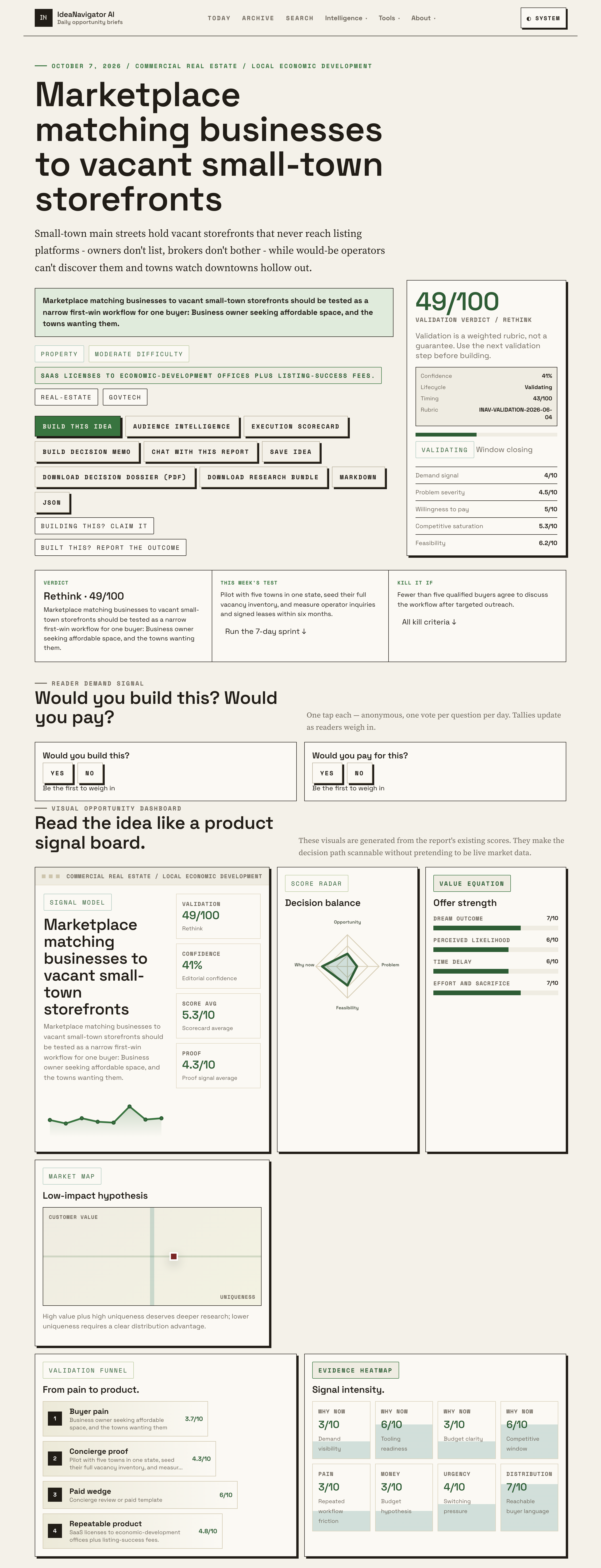
IdeaNavigator AI proposes testing a marketplace that lists vacant small-town storefronts and connects them with business operators. The suggested pilot would cover five towns in one state and track inquiries and signed leases over six months; no pilot results or operating marketplace are reported.
IdeaNavigator AI’s proposal outlines a marketplace to connect owners of vacant small-town storefronts with business operators looking for affordable space, and recommends a five-town pilot to test whether the service generates inquiries and signed leases. The proposal addresses a discovery problem for both sides, but it provides no evidence that the marketplace has launched or that its approach has produced results.
According to IdeaNavigator AI’s proposal, towns and property owners would be able to post storefront listings with photos, size, rent and available incentives. Operators would browse by town profile and foot-traffic data, and prospective matches would be referred to a local economic-development office. The proposal says grant programs could be attached to referrals where available.
IdeaNavigator AI describes the intended users as business owners seeking affordable space and towns trying to attract them. Its proposed business model combines software licenses sold to economic-development offices with fees tied to successful listings. These are suggested features and revenue sources, not reported services or established income.
To test the concept, IdeaNavigator AI recommends selecting five towns in one state, compiling each town’s full inventory of vacant storefronts and measuring operator inquiries and signed leases over six months. The proposal identifies no participating towns, platform operator, launch date, budget or results.
Connecting Listings to Local Support
A searchable inventory could help address an information gap described in IdeaNavigator AI’s proposal: storefronts may be vacant without appearing on commercial listing platforms, while entrepreneurs may not know which properties or incentives are available. If listings are complete and current, a shared marketplace could make it easier for operators to compare locations and for towns to respond to interest.
The proposed referral to local development offices could also connect a property search with grant information and local assistance, rather than treating a storefront as an isolated listing. For towns, the practical test is whether that process leads to viable businesses taking leases, not simply whether the platform attracts browsing or inquiries.
That distinction matters to small communities weighing how to use staff time or public funds. A pilot measuring signed leases, as IdeaNavigator AI suggests, could offer a more direct indication of whether the service helps fill vacancies. Results would still depend on listing quality, the suitability of available spaces and whether interested businesses can afford to operate there.
small town storefront listing platform
As an affiliate, we earn on qualifying purchases.
As an affiliate, we earn on qualifying purchases.
The Proposed Main Street Gap
IdeaNavigator AI’s proposal centers on storefronts that are vacant but not listed through familiar commercial real estate channels. It says some owners do not post listings and brokers may not take on smaller-town properties, leaving business operators with limited ways to discover available spaces. The proposal provides no count of affected properties or data showing how common the problem is.
IdeaNavigator AI cites renewed interest in small-town commercial space following remote-work migration, alongside grants available through economic-development offices, as reasons to test the idea. These points are part of the proposal’s rationale; it supplies no figures, grant program names or evidence of increased demand. The proposed marketplace is framed as a targeted workflow for matching prospective businesses with towns seeking new businesses, rather than as a broad commercial property platform.
As an affiliate, we earn on qualifying purchases.
Demand and Lease Outcomes
Demand for the service remains unverified. IdeaNavigator AI’s proposal provides no data on how many owners would submit listings, how many operators would use the platform, or whether towns already have complete vacancy records. It also offers no evidence that potential tenants would find rents, property conditions and financing workable.
The proposed model leaves operational questions open: who would verify listings and foot-traffic figures, how often information would be updated, and what counts as a successful listing for fee purposes. The proposal also does not identify which grants would be attached to referrals, whether applicants would qualify, or how licensing or success fees would be funded. No pilot commitments or six-month findings are reported.
local economic development software
As an affiliate, we earn on qualifying purchases.
As an affiliate, we earn on qualifying purchases.
A Five-Town Pilot Test
IdeaNavigator AI recommends recruiting five towns in one state, gathering a complete inventory of vacant storefronts and running the matching process for six months. The proposal names operator inquiries and signed leases as measures. These could help distinguish attention to listings from actual property take-up, though it does not specify a comparison group or how leases would be attributed to the marketplace.
The proposal identifies no launch schedule, participating communities or implementation partner. Until a pilot is carried out and its results are reported, the marketplace remains an idea to test rather than a demonstrated solution to small-town storefront vacancies.
Source: IdeaNavigator AI proposal
As an affiliate, we earn on qualifying purchases.
Key Questions
What would the proposed marketplace do?
IdeaNavigator AI’s proposal describes a service that would list vacant small-town storefronts and connect prospective business operators with property owners and local economic-development offices. Proposed listings would include photos, size, rent and available incentives.
Has the marketplace launched?
No launch is reported in IdeaNavigator AI’s proposal. It recommends testing the concept through a five-town pilot.
How would the proposed pilot measure success?
IdeaNavigator AI suggests tracking operator inquiries and signed leases over six months after compiling storefront vacancy inventories in five towns in one state.
How might the service make money?
IdeaNavigator AI’s proposal suggests software licenses for economic-development offices and fees when listings lead to successful outcomes. It does not report customers, prices or revenue.
What is still unknown?
The proposal reports no pilot participants or results, and demand from property owners and operators has not been established. Details about listing verification, grant eligibility and fee arrangements are also unspecified.
Source: IdeaNavigator AI
Halloween Picks
halloween
As an affiliate, we earn on qualifying purchases.