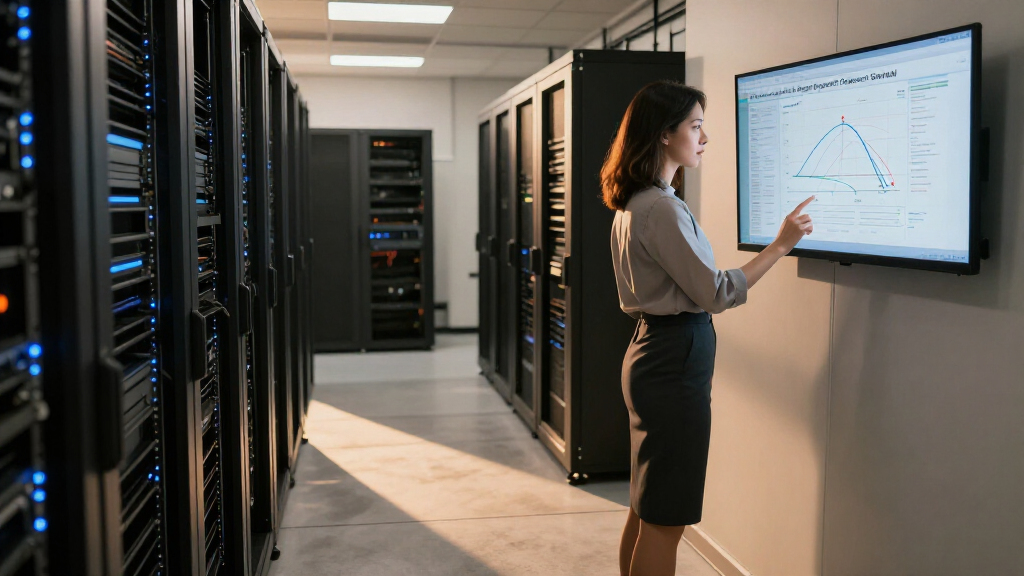
🔍 Read the full analysis: What Could Halt AI’s Rapid Progress In 2027? A Compute Shortfall on ThorstenMeyerAI.com

Get the little things that make your day delivered free with Prime
- Fast, free delivery on millions of items
- Prime Video, Amazon Music and more included
- Member-only deals all year
TL;DR
A November 18 scenario analysis by Thorsten Meyer argues that AI could accelerate sharply in 2027 as models help develop more capable models, then slow when compute supply becomes a constraint. The article presents this as a conditional scenario, not a forecast: METR’s measured software-task results show rapid gains, but the trend depends on the fit used, and its public time-horizon page stopped being actively updated in September 2026.
Thorsten Meyer’s November 18 scenario analysis argues that AI progress could accelerate in 2027 as systems contribute more to developing later systems, then slow when chips, data-center capacity and power limit how much computing can be added. The article presents this as a conditional scenario, not a confirmed forecast; the available evidence does not establish that a sixfold acceleration or a 2027 compute ceiling will occur.
The scenario has several links: AI systems take on more coding and experimentation involved in building AI; that work speeds up successive development; and progress eventually runs into physical limits that software alone cannot remove. Meyer describes a later, slower phase in which automation of physical research and production could expand capacity. Each link remains uncertain, and the article tests the argument against public measurements and counterarguments rather than treating the outcome as settled.
One data point is METR’s 80% time horizon, an estimate of the length of software tasks an AI agent can complete reliably. In the figures reported by Meyer, the measure rose from 0.89 minutes for GPT-4 in March 2023 to 185.9 minutes—about three hours and six minutes—for an early Claude Mythos Preview in April 2026. These are task-suite results, not a direct measure of general intelligence or all workplace tasks.
The timing changes sharply with the selected trend. Meyer says his fit to METR data from 2024 onward implies a doubling every 3.4 months and crosses a 16-hour horizon in January 2027. A fit beginning in 2019 instead implies a 6.4-month doubling time and reaches that point in June 2028. The article also reports that its hyperbolic fit performed poorly in backtests, cautioning against extrapolating the most dramatic curve.
Why Compute Could Set the Pace
If AI systems become much better at helping build their successors, development could speed up faster than ordinary yearly product cycles suggest. But a faster research loop does not automatically mean faster deployment across companies or the wider economy. The scenario’s central point is that software progress may eventually depend on physical infrastructure: advanced chips, data-center buildings and reliable electricity.
Meyer cites US data-center construction running at an annual rate of $96.5 billion in September 2026, compared with $50.7 billion a year earlier. That is evidence of large construction activity, not proof that enough usable compute or power will be available when needed. The analysis cites Epoch AI’s view that power could become the first scaling constraint and that new power supply can take three to five years after a decision to build.
The distinction matters for workers and businesses. The article cites estimates that 18% of US firms used AI in a business function in late 2025 and early 2026, while 2% reported AI-related job cuts. Those figures do not establish what adoption or job effects will be in 2027. They do underline that advances in model capability and changes in employment are separate developments.
Products Worth Considering

Withings BPM Vision Blood Pressure Monitor

Hyperice Hypervolt 3 Percussion Massage Gun with Heated Head and Carry Case

Philips Sonicare DiamondClean 9300 Electric Toothbrush, 2 Brush Heads, Black
As an affiliate, we earn on qualifying purchases.
What METR’s Measure Captures
METR is a nonprofit that evaluates frontier AI agents. Its time horizon estimates the duration of tasks, measured by human expert completion time, at which an agent is predicted to succeed at a specified reliability. The 80% horizon is the task duration at which a system succeeds four times out of five. It is a useful way to track performance on a defined set of tasks, but it is not a general-purpose clock for AI progress.
The task set is concentrated in software engineering, machine learning and cybersecurity. METR has cautioned that its tasks are cleaner and more clearly specified than much economically valuable work. It has also said measurements above 16 hours are unreliable with the current task suite; for tasks taking human experts at least eight hours, human completion times were measured for only five of 31 tasks, with the rest estimated.
There is also a data limitation: METR marked its public time-horizon page as no longer actively updated on September 8, 2026, according to Meyer. The article cites METR’s estimate that Anthropic is improving models on well-specified tasks at around twice its earlier rate, while noting that METR said it would not be surprised by a rate of 1.3 or three times. That is below the article’s proposed sixfold acceleration, which would be needed for a year of progress at the old pace to arrive in two months.
Meyer also points to OpenAI’s GPT-6.2 Astra as the first externally released OpenAI model to meet the company’s “High” threshold for AI self-improvement. That classification is a company-defined signal, not independent confirmation that AI development has entered a runaway cycle. Meyer disclosed that the article was researched and drafted with AI assistance, including Anthropic’s Claude, and said Anthropic, OpenAI and METR did not review or sponsor it.
“Measurements above 16 hrs are unreliable with our current task suite.”
— METR, as quoted in Meyer’s article
Where the 2027 Scenario Could Break
The analysis does not establish that AI will reach a defined level of superintelligence in 2027, that model development will speed up sixfold, or that compute will become the binding constraint that year. The projection depends on how past results are fitted: starting the trend in 2024 produces a substantially earlier threshold than starting in 2019. METR’s task limitations and the end of active updates to its public page add uncertainty.
Other parts of the chain are also unsettled. A stronger result on software tasks does not prove that AI can improve every part of AI research at the same rate. Nor does a company’s self-improvement rating show that systems are independently accelerating the entire development process. The article offers the possibility of a slower physical automation loop, but does not establish when robotics, factories or automated labs could add meaningful capacity.
It is also unclear how much data-center construction will become usable compute, how quickly grid connections and new power supply can be delivered, or whether efficiency improvements could offset some capacity constraints. The employment and business-adoption figures cited are historical snapshots, not forecasts of the effects of a 2027 shift.
Signals to Watch Through 2027
Meyer’s analysis points readers toward measurable developments rather than a single prediction date: updated, independently described evaluations of AI agents; evidence that AI systems are taking on more of the work of model development; and results that test whether task performance keeps improving beyond the existing measurement limits. Future benchmarks will need clear task definitions and reliability levels to make comparisons meaningful.
Infrastructure is another test. Data-center construction, access to advanced chips, grid connections and new electricity supply will show whether investment is turning into operational capacity. The article cites a three-to-five-year period for new power supply after a decision to build, but actual timelines and available capacity remain project-specific.
Readers should treat 2027 as the scenario’s test window, not a deadline on which the evidence already agrees. The central question is whether AI-assisted development gains persist, and whether physical capacity expands quickly enough to support them. Until those signals are clearer, both a sharp acceleration and a compute-driven slowdown remain possibilities rather than confirmed outcomes.
Key Questions
Is the article predicting that AI will reach superintelligence in 2027?
No. Meyer presents a scenario, not a confirmed forecast. He also notes that there is no agreed definition of artificial superintelligence and focuses on the proposed development and compute mechanisms instead.
What does METR’s 80% time horizon measure?
It estimates the length of tasks, measured by human expert completion time, at which an AI agent is predicted to succeed four times out of five. METR’s suite mainly covers software engineering, machine learning and cybersecurity, so it should not be read as a measure of performance across all work.
Why do the projected dates differ?
The date depends on which historical results are used to fit the trend. Meyer reports that a fit beginning in 2024 reaches a 16-hour horizon in January 2027, while one beginning in 2019 reaches it in June 2028. These are extrapolations, not measured future results.
What could limit AI progress if models keep improving?
The scenario identifies chips, data-center buildings and electricity as possible constraints. The article cites a view that power may be the first bottleneck, but the timing and severity of any shortfall are not established.
What evidence would make the scenario more convincing?
Relevant signals would include reliable updated evaluations showing continued gains on longer tasks, evidence that AI systems are materially speeding up model development, and data showing whether new infrastructure is becoming usable compute. No single measure cited in the article confirms the full scenario.
Source: ThorstenMeyerAI.com