
📊 Full opportunity report: How To Plan Home Improvements For A Backyard ADU on IdeaNavigator AI — validation score, market gap, and execution plan.

Get the little things that make your day delivered free — and shop member deals
- Fast, free delivery on millions of items
- Access to Prime Big Deal Days deals on October 6–7
- Prime Video, Amazon Music and more included
TL;DR
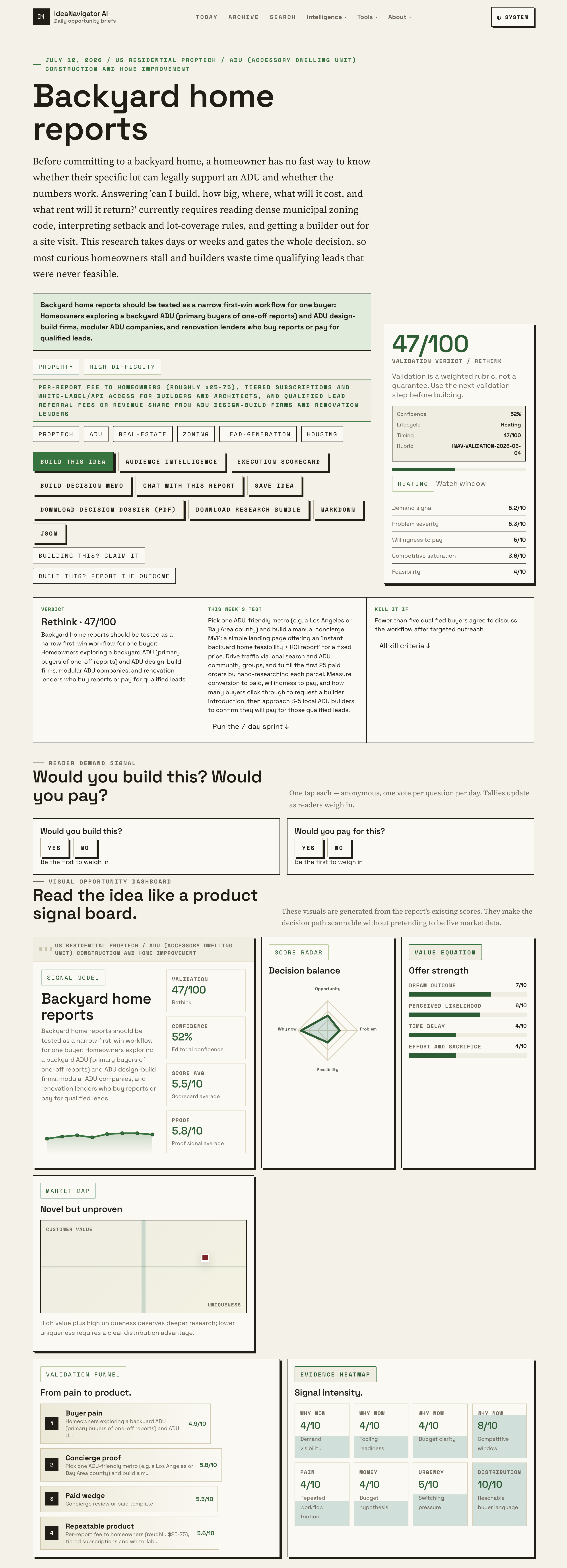
A new analysis from IdeaNavigator AI proposes paid per-address ‘backyard home reports’ that tell homeowners whether their lot can legally support an ADU and what the economics look like. The opportunity is driven by surging ADU permitting in California and maturing parcel-data tools, but it remains a business concept requiring validation rather than a proven service.
A newly published product analysis proposes instant per-address ADU feasibility reports — paid PDF documents that tell homeowners whether their specific lot can legally support a backyard accessory dwelling unit, how big it can be, what it will cost to build, and what rent it might return. According to the analysis by IdeaNavigator AI, answering those questions today takes days or weeks of zoning research and a builder site visit, a bottleneck that stalls most curious homeowners before they ever commit to a project.
The analysis identifies two customer groups. The primary buyers are homeowners exploring a backyard ADU, who would purchase one-off reports at an estimated price of $25 to $75. The secondary buyers are ADU design-build firms, modular ADU companies, and renovation lenders, which would pay for tiered subscriptions, white-label or API access, and qualified lead referrals.
The proposed product works by ingesting county parcel data — lot boundaries, lot size, and existing building footprint — and testing the lot against state ADU law plus a hand-curated set of local zoning rules. The output would cover allowed ADU types, maximum size, setback and lot-coverage constraints, a buildable-area estimate, a realistic build-cost band, and projected rental income based on local rent comparables. A ‘connect me with a vetted ADU builder’ button would capture lead-generation revenue from firms willing to pay for pre-qualified prospects.
The recommended validation path is deliberately small: launch in one ADU-friendly metro, such as a Los Angeles or Bay Area county, with a simple landing page offering the report at a fixed price. The first 25 paid orders would be fulfilled by hand-researching each parcel, measuring conversion rates, willingness to pay, and how many buyers click through to request a builder introduction. Only after that would the concept be pitched to three to five local ADU builders to confirm demand for paid leads.
Why ADU Feasibility Bottlenecks Matter
The analysis argues that feasibility research is the single gate blocking the entire ADU decision. A homeowner who wants to know ‘can I build, how big, where, what will it cost, and what rent will it return?’ currently must read dense municipal zoning code, interpret setback and lot-coverage rules, and schedule a builder site visit. According to the analysis, most curious homeowners stall at this stage, and builders waste time qualifying leads that were never feasible in the first place.
If per-address reports work as described, they would compress that research from days or weeks into minutes, giving homeowners a go/no-go answer before spending money on design or site visits, and giving builders a filter that screens out unbuildable lots. The report estimates that ADUs now represent roughly one in five new housing units produced in California, so even modest improvements in early-stage screening could affect a large volume of projects.
The Regulatory Wave Behind the Idea
California legalized accessory dwelling units statewide beginning in 2016 and has loosened the rules nearly every year since, according to the analysis. Other states and cities are following suit. Permitting activity has surged: the analysis cites Los Angeles County alone permitting more than 45,000 ADUs in 2023.
Two additional developments are described as making the timing work. First, a persistent US housing shortage estimated in the millions of units keeps pressure on jurisdictions to expand ADU-friendly rules. Second, parcel and zoning datasets have matured, and LLM-based code parsing now makes it practical to interpret dense municipal zoning text at scale — the technical foundation an instant report service would depend on.
What the Analysis Has Not Proven
The entire concept is unvalidated. No product has been built, no customers have been acquired, and the pricing, conversion rates, and lead-referral demand are all projections rather than measured results. The analysis itself frames the idea as a hypothesis to be tested with a manual concierge MVP and 25 hand-fulfilled orders.
Several practical questions remain open. It is unclear how accurate LLM-based or hand-curated zoning interpretations would be across the many jurisdictions within even a single county, or who bears liability if a report wrongly tells a homeowner their lot is buildable. The analysis does not state how the build-cost bands and rental income projections would be sourced or updated, nor whether lenders and regulators would treat such reports as sufficient for underwriting. Willingness to pay among homeowners — the revenue foundation of the model — has not been tested.
The Recommended Validation Sequence
If an operator follows the analysis’s playbook, the next steps are concrete: pick one ADU-friendly metro, publish a landing page offering a fixed-price feasibility report, and drive traffic through local search and ADU community groups. The first 25 orders would be fulfilled manually to measure conversion to paid, willingness to pay, and click-through to builder introductions.
Only after those numbers exist would the concept be taken to three to five local ADU builders to confirm they will pay for qualified leads. If that holds, the proposed expansion path is tiered subscriptions and white-label access for builders and architects, followed by additional counties with hand-curated rule sets. As of publication, none of these steps has been executed, and the timeline for any launch is unspecified.
Source: IdeaNavigator AI
Key Questions
What is a backyard ADU feasibility report?
According to the IdeaNavigator AI analysis, it would be a paid PDF that analyzes a specific property address and reports whether an accessory dwelling unit is legally allowed, the maximum size, setback and lot-coverage constraints, a buildable-area estimate, an estimated build-cost range, and projected rental income.
How much would one of these reports cost?
The analysis estimates a per-report fee to homeowners of roughly $25 to $75, with separate subscription, white-label, and lead-referral revenue from builders, architects, and lenders. These figures are projections, not tested prices.
Why is ADU feasibility research considered a bottleneck?
Determining whether a lot can support an ADU today requires reading municipal zoning code, interpreting setback and lot-coverage rules, and arranging a builder site visit — a process the analysis says takes days or weeks and causes most homeowners to abandon the idea before starting.
Has this product been built or tested?
No. The analysis describes an opportunity and a validation plan, including a manual concierge MVP in one California metro with 25 hand-fulfilled paid orders. No launch, customer data, or builder partnerships have been announced.
How big is the ADU market opportunity?
The analysis cites Los Angeles County permitting more than 45,000 ADUs in 2023 and ADUs representing roughly one in five new housing units in California, within a national housing shortage estimated in the millions of units.
Source: IdeaNavigator AI
NFL season / tailgating Picks
team gear
As an affiliate, we earn on qualifying purchases.