📊 Full opportunity report: Retirement Care Planner on IdeaNavigator AI — validation score, market gap, and execution plan.

Get the little things that make your day delivered free with Prime
- Fast, free delivery on millions of items
- Prime Video, Amazon Music and more included
- Member-only deals all year
TL;DR
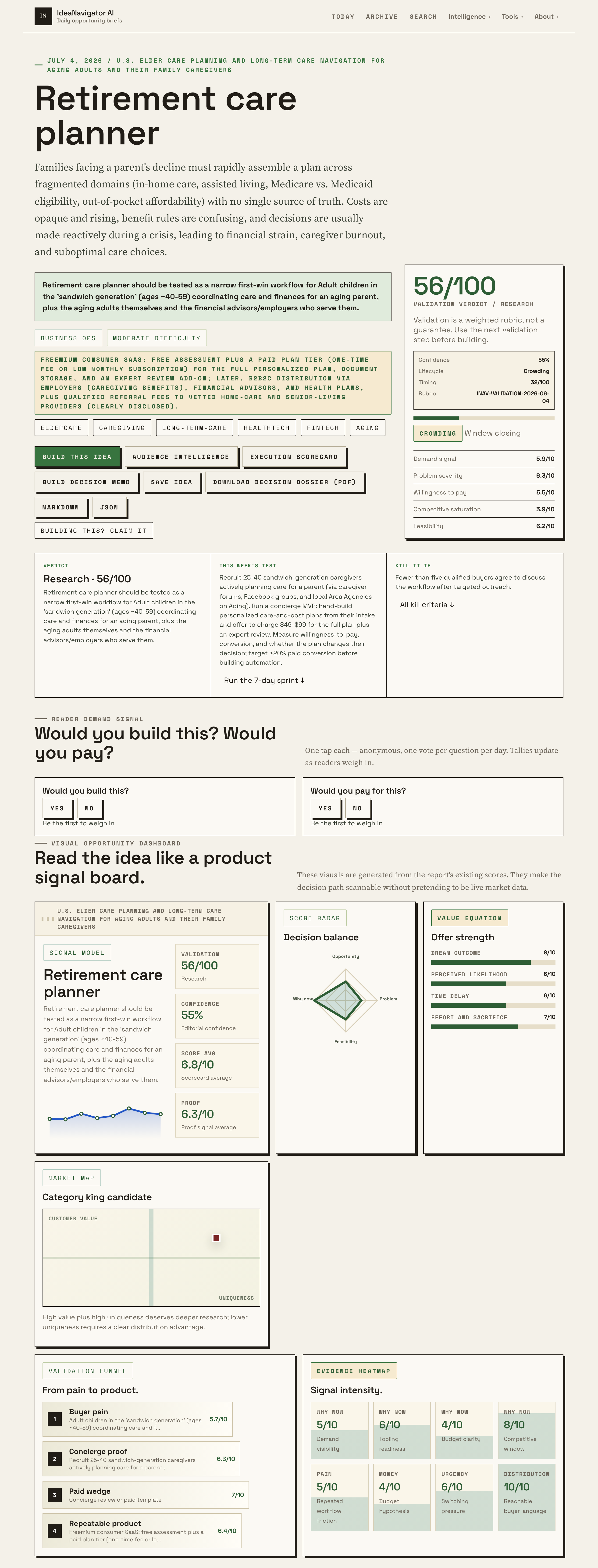
A new web-based retirement care planner is in pilot testing, aiming to assist middle-aged caregivers in creating personalized care and cost plans for aging parents. The tool addresses fragmentation, rising costs, and decision-making complexity in elder care.
A new retirement care planner web app is being tested as a targeted solution for middle-aged caregivers in the ‘sandwich generation’ to coordinate care and finances for aging parents. The tool aims to simplify complex decision-making amid rising costs and fragmented healthcare options, addressing an urgent need in the U.S. elder care market.
The retirement care planner is designed for families facing a parent’s decline, providing a personalized care and cost plan based on a brief intake of health, location, finances, and family situation. It will generate localized cost comparisons for in-home care, assisted living, and nursing homes, along with explanations of Medicare and Medicaid eligibility, affordability projections, and a prioritized action checklist with vetted local providers.
This initiative is currently in a pilot phase, recruiting 25-40 caregivers through forums, Facebook groups, and local agencies. The MVP involves a manual, personalized plan creation, with a fee ranging from $49 to $99, to measure willingness to pay and impact on decision-making. The goal is to validate the model before automating and scaling the service. The MVP involves a manual, personalized plan creation, with a fee ranging from $49 to $99, to measure willingness to pay and impact on decision-making. The goal is to validate the model before automating and scaling the service.
Why a Retirement Care Planner Matters Now
This development addresses a critical gap in elder care planning, where families often make reactive decisions during crises, leading to financial strain and caregiver burnout. As the U.S. approaches a demographic peak with over 73 million Americans aged 65+ by 2030, the demand for structured, accessible guidance grows. The rising costs of long-term care—median assisted living at $6,200/month and nursing homes at approximately $115,000 annually—make affordability a pressing concern. An effective planning tool could help families make informed choices, reduce financial and emotional stress, and improve care outcomes, marking a significant shift in elder care navigation.
As an affiliate, we earn on qualifying purchases.
Background and Market Need for a Care Planning Solution
Currently, families face fragmented and opaque elder care options, with benefit rules and costs often confusing and reactive decision-making common. The market for elder care planning is underserved, with no widely adopted digital solutions tailored for middle-aged caregivers managing aging parents. The rising costs and demographic pressures have heightened urgency, prompting interest in structured, user-friendly tools. The pilot testing of this retirement care planner aims to validate a scalable model that could transform elder care decision-making in the U.S.
“Families need a clear, personalized way to navigate the complex landscape of elder care options and costs, especially as expenses continue to rise.”
— an anonymous researcher
assisted living cost comparison book
As an affiliate, we earn on qualifying purchases.
As an affiliate, we earn on qualifying purchases.
Uncertainties About Adoption and Effectiveness
It is not yet clear how many families will adopt the tool at scale or whether the MVP will significantly influence their care decisions. The effectiveness of manual plan creation in the pilot phase will be evaluated before automation, and user willingness to pay remains an open question. Additionally, the impact on actual care choices and financial outcomes has yet to be confirmed through broader testing.
Medicare Medicaid guide for seniors
As an affiliate, we earn on qualifying purchases.
As an affiliate, we earn on qualifying purchases.
Next Steps for Validation and Scaling
The pilot program will continue to recruit participants, gather feedback, and measure willingness-to-pay, with plans to refine the app based on user input. Success metrics include at least 20% paid conversion and evidence that the plans influence decision-making. After validation, the developers intend to automate the process, expand outreach, and explore partnerships with employers, financial advisors, and health plans to scale the service nationally.
As an affiliate, we earn on qualifying purchases.
Key Questions
How does the retirement care planner determine costs and care options?
The planner uses public benchmark data to compare costs across local providers for in-home care, assisted living, and nursing homes, combined with eligibility explanations and affordability projections based on user input.
Who is the target user for this tool?
The primary users are middle-aged adults in the ‘sandwich generation’ who are actively planning care for an aging parent, as well as the aging adults themselves and their financial advisors or employers.
What is the current stage of development for the retirement care planner?
The tool is in a pilot testing phase, with manual plan creation from a small sample of users. The goal is to validate the model before automating and scaling the service.
Will this tool be available for free?
The initial MVP involves a paid plan, with a fee of $49 to $99 for full personalized plans and expert reviews. Future models may include freemium options or B2B partnerships.
How might this impact elder care decision-making?
If successful, the tool could help families make more informed, timely decisions, reduce financial surprises, and lessen caregiver burnout by providing clear guidance and local provider links.
Source: IdeaNavigator AI
Evergreen bestsellers Picks
bestsellers
As an affiliate, we earn on qualifying purchases.