
📊 Full opportunity report: IEP Negotiation Simulator: Practice Runs For Real Meetings on IdeaNavigator AI — validation score, market gap, and execution plan.

Get the little things that make your day delivered free with Prime
- Fast, free delivery on millions of items
- Prime Video, Amazon Music and more included
- Member-only deals all year
TL;DR
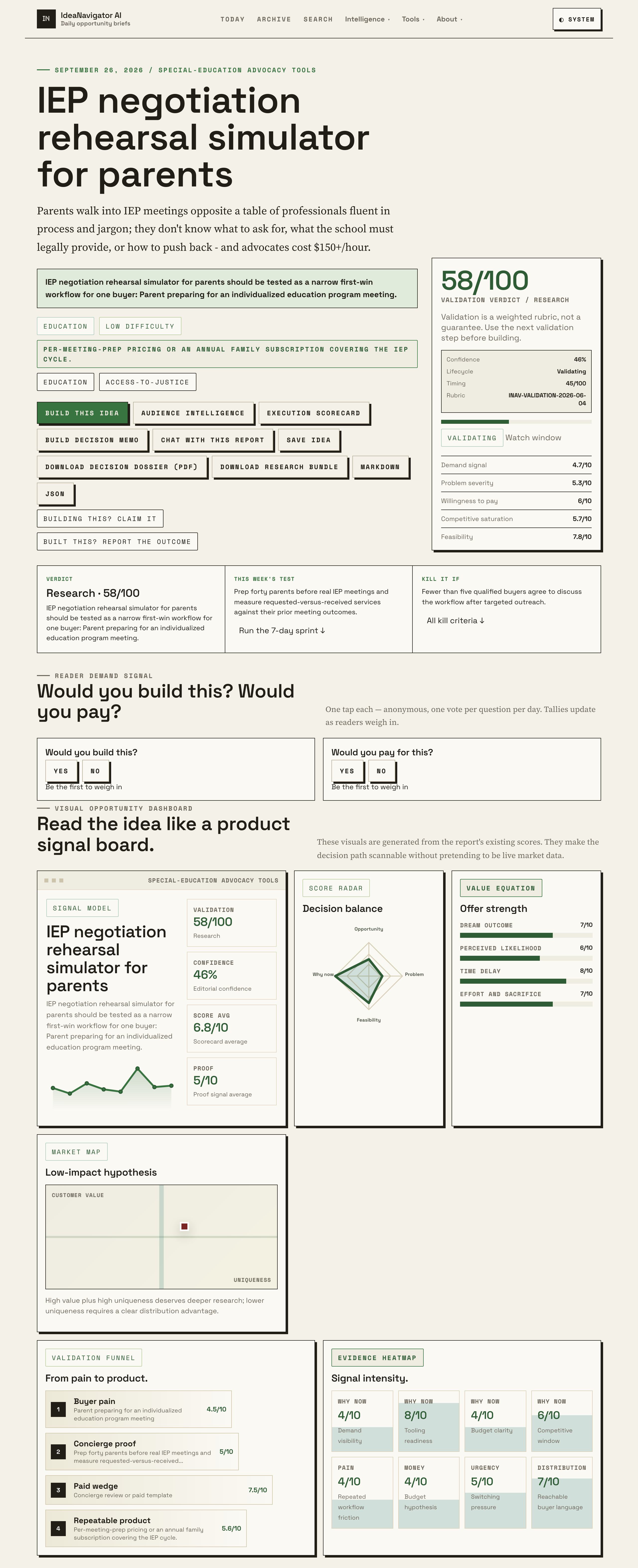
IdeaNavigator AI has published a product concept for an AI-driven IEP negotiation rehearsal simulator that would help parents prepare for special education meetings through document analysis, plain-language entitlement explanations, and role-play with realistic pushback. The proposal is untested, with validation suggested through preparing forty parents and comparing outcomes.
IdeaNavigator AI has published a product concept for an IEP negotiation rehearsal simulator — an AI-powered tool that would let parents of children with disabilities rehearse individualized education program meetings before attending the real ones. The proposal responds to a power imbalance the concept identifies: parents routinely sit across from school professionals fluent in special-education process and jargon, while professional advocates charge $150 or more per hour. No working product has been built or tested yet.
According to the concept document, the simulator would target a single narrow user: a parent preparing for an IEP meeting. The envisioned workflow has three stages. First, the parent uploads the child’s current IEP and evaluation reports. The tool would then explain the family’s entitlements in plain language and generate a request list with legal grounding for each item. Finally, it would role-play the meeting itself, including realistic pushback from a simulated school team, repeating until the parent can hold their positions under pressure.
The timing rationale, as the concept lays it out, rests on two trends: large language models can now simulate a realistic multi-party meeting well enough for rehearsal, and special-education identification rates continue to climb while district resources tighten, which the proposal argues makes meetings more adversarial.
The suggested business model is either per-meeting-prep pricing or an annual family subscription covering the full IEP cycle. The identified market category is special-education advocacy tools.
Why Parents May Want Rehearsal
IEP meetings determine what services, accommodations, and placement a child with a disability receives — outcomes with long-running academic and financial consequences for families. The concept argues that parents often do not know what to ask for, what the school is legally required to provide, or how to respond when a district declines a request. If a rehearsal tool worked as described, it could reduce dependence on paid advocates, whose $150+/hour rates put them out of reach for many families. However, these are claims in a concept document, not demonstrated results; no outcome data exists yet.
The State of Advocacy Tools
The proposal sits within a growing category of special-education advocacy tools aimed at helping families navigate the Individuals with Disabilities Education Act (IDEA) process — from document organizers to meeting-prep checklists. The concept’s specific contribution would be combining document analysis, plain-language legal explanation, and adversarial role-play into a single preparation workflow. It belongs to a broader wave of LLM-based role-play applications that use conversational AI to simulate high-stakes conversations, such as interview practice and negotiation training, applied here to a domain where the counterparty is a school district team.
What Is Untested So Far
No product exists yet, and no outcome data has been collected. The proposed validation — preparing forty parents and measuring requested-versus-received services against their prior meeting outcomes — is described as a plan, not a completed study. Several questions remain open: whether an AI simulation can accurately model how a specific district’s team behaves; whether the tool’s legal grounding would be reliable enough for parents to rely on; how documents containing sensitive child evaluation data would be stored and protected; and whether per-meeting or subscription pricing would be affordable to the families the concept says are priced out of advocacy. The claim that meetings are becoming more adversarial is presented as context by the proposal and is not independently verified in the document.
Validation Before a Build
The concept document positions the simulator as a narrow first-win workflow for a single buyer, meaning the next step in its own framework is validation rather than full product development: recruiting roughly forty parents ahead of real IEP meetings, running them through the preparation workflow, and comparing the services they request and receive against their previous meeting outcomes. Whether any team takes up the concept, and whether that validation occurs, is not yet known. If results were positive, the document suggests expansion would follow the annual IEP cycle with a family subscription model.
Source: IdeaNavigator AI
Key Questions
Does the IEP meeting simulator exist yet?
No. It is a product concept published by IdeaNavigator AI. No working version has been built or tested.
How would the simulator work if built?
A parent would upload the current IEP and evaluation reports; the tool would explain entitlements in plain language, generate a legally grounded request list, and then role-play the meeting with realistic pushback until the parent can hold their positions.
How would the concept be validated?
The proposed method is to prepare forty parents before real IEP meetings and measure requested-versus-received services against each family’s prior meeting outcomes. This has not been done.
What would it cost?
The concept suggests either per-meeting-prep pricing or an annual family subscription covering the IEP cycle. No prices are specified, though the document cites professional advocates charging $150 or more per hour as the cost baseline.
Is an AI simulation a substitute for legal advice or a professional advocate?
The concept does not claim that it is. Reliability of the tool’s legal grounding is untested, and families facing disputes may still need qualified advocates or attorneys.
Source: IdeaNavigator AI
NFL season / tailgating Picks
team gear
As an affiliate, we earn on qualifying purchases.