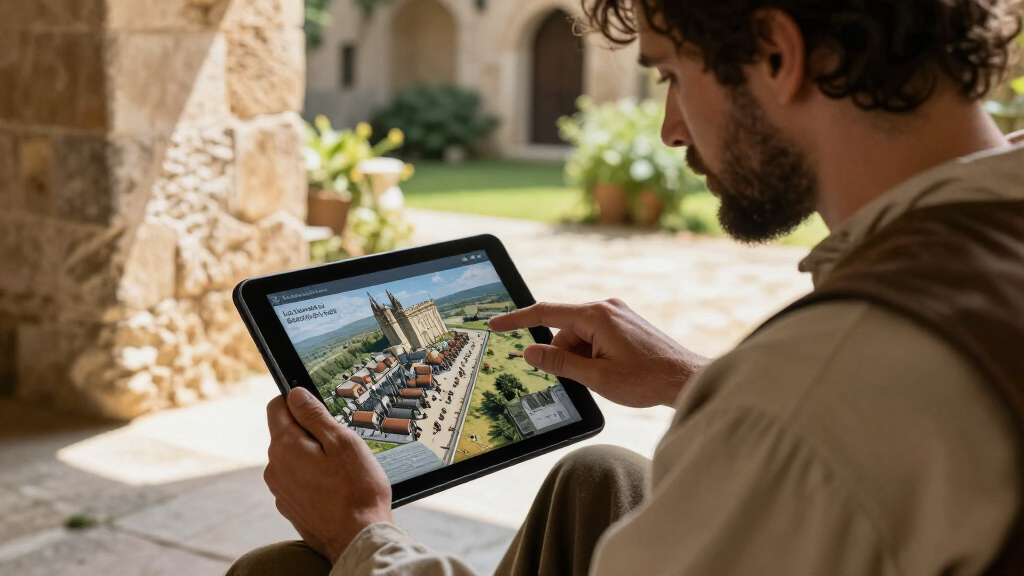

🔍 Read the full analysis: AI And The Art Of Historical Reconstruction: La Citadelle Siege Of 1693 on ThorstenMeyerAI.com

Get the little things that make your day delivered free with Prime
- Fast, free delivery on millions of items
- Prime Video, Amazon Music and more included
- Member-only deals all year
TL;DR
An AI-powered digital exhibition has recreated the 1693 siege of La Citadelle, offering a cinematic, scroll-driven exploration of the historic event. The project uses layered SVGs, CSS, and canvas without images, guided by AI critique and art direction.
An AI-generated interactive exhibition has vividly reconstructed the 1693 siege of La Citadelle, providing viewers with a cinematic, scroll-driven experience that explores the historic event in unprecedented detail. The project, developed through a meticulous AI-guided workflow, balances historical fidelity with artistic storytelling, making it accessible through a web browser without any static images.
The exhibit, hosted on a dedicated online platform, employs layered SVGs, CSS, and HTML5 canvas elements to animate the siege’s terrain, military movements, and fortifications. It features a dynamic diagram that transforms as users scroll, illustrating the progression of the siege over days, with earthworks, artillery fire, and breaches animated through JavaScript functions. This approach creates a cinematic tableau that immerses viewers in the historical event, guided by a detailed AI critique process that ensures visual coherence, responsiveness, and historical plausibility.
Developed by an interdisciplinary team guided by an AI assistant, the project follows a three-stage pipeline: initial construction with layered digital assets, iterative critique and refinement driven by AI analysis, and final approval by an art director. The design employs a restrained color palette inspired by parchment, fortress ink, and smoke, with typography combining elegance and clarity—Cinzel, EB Garamond, and Space Mono—to enhance the storytelling. The signature interaction involves animated siege maps, trajectories, and earthworks, all coded directly in HTML, CSS, and JavaScript, without external image assets or frameworks.
Impact of AI-Driven Digital Siege Reconstruction
This project demonstrates how AI can facilitate detailed reconstructions of historical events in digital form, expanding educational and cultural access. By combining artistic storytelling with technical execution, it offers a new approach for engaging audiences with history through interactive, cinematic experiences. The method also highlights the potential for AI to assist in preserving and interpreting complex military and architectural histories, making them accessible to a broad audience without reliance on static images or traditional media.
interactive digital history exhibit
As an affiliate, we earn on qualifying purchases.
As an affiliate, we earn on qualifying purchases.
Historical and Technological Background of La Citadelle Siege
The siege of La Citadelle in 1693 was a significant event during the Franco-Dutch War, involving a fortified star-shaped fortress defending against a coalition of attacking forces. The siege is noted for its engineering complexity, Vauban’s fortification principles, and the strategic use of earthworks and artillery. Prior efforts to digitally reconstruct such events relied heavily on static images or limited animations; this project marks a shift toward fully interactive, cinematic representations driven by AI. The development aligns with a broader trend of using advanced web technologies and AI critique to enhance historical education and digital preservation.
AI-powered historical reconstruction software
As an affiliate, we earn on qualifying purchases.
As an affiliate, we earn on qualifying purchases.
Remaining Questions About AI Accuracy and User Experience
While the exhibit emphasizes historical fidelity, questions remain regarding how closely the AI critique process aligns with actual historical records or military engineering standards. The influence of artistic interpretation on the reconstruction is still being evaluated, and user feedback on the immersive experience is being collected. Additionally, considerations around long-term accessibility and updates based on new historical research are ongoing.
As an affiliate, we earn on qualifying purchases.
Future Developments and Expanding Interactive Historical Exhibits
Developers plan to incorporate user feedback to improve the cinematic and interactive features. There is interest in expanding this AI-guided approach to reconstruct other historic sieges and battles, creating a broader digital archive of immersive educational experiences. Collaboration with historians and technologists aims to enhance AI critique accuracy and explore more complex storytelling techniques, including multi-layered narratives and increased interactivity.
As an affiliate, we earn on qualifying purchases.
Key Questions
How does the AI ensure historical accuracy in the reconstruction?
The AI employs a detailed critique process guided by a manual emphasizing layered architecture, military geometry, and historical plausibility, with final validation provided by an art director and ongoing expert review.
Can I explore the siege on any device?
Yes, the exhibit is designed to be fully scalable and responsive across devices, functioning entirely within a web browser without external images or frameworks.
Will this approach be used for other historical events?
Yes, there are plans to expand this AI-guided, cinematic reconstruction method to other significant battles and sieges, creating a digital archive of immersive history experiences.
What are the limitations of the current reconstruction?
While detailed, the reconstruction may include artistic interpretations, and its accuracy depends on the available historical sources and the AI critique process, which are subject to ongoing refinement.
Source: ThorstenMeyerAI.com
Columbus Day / Indigenous Peoples' Day Picks
long weekend sales
As an affiliate, we earn on qualifying purchases.