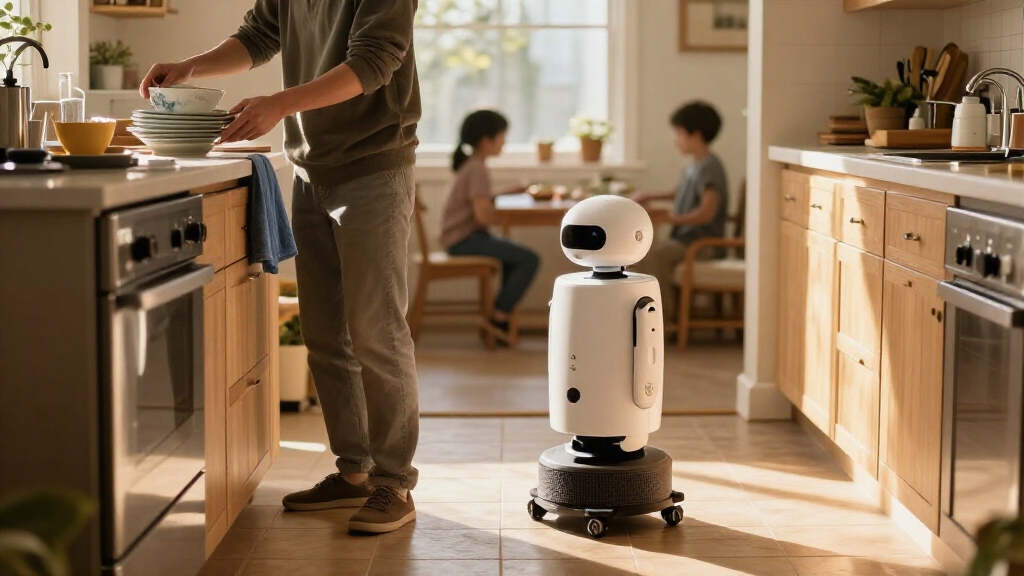

🔍 Read the full analysis: Could Meta's Reported Robot Max Help With Household Chores? on ThorstenMeyerAI.com

Get the little things that make your day delivered free with Prime
- Fast, free delivery on millions of items
- Prime Video, Amazon Music and more included
- Member-only deals all year
TL;DR
The Information reported that Meta and Chinese robot maker Fourier built a humanoid prototype called Max in about three months. Meta has not announced the robot and, according to the report, says the work is for internal research with no plans to sell units. Whether Max can perform useful household chores remains unproven.
Meta reportedly built a five-foot humanoid prototype called Max with Shanghai-based robot maker Fourier in about three months, according to a report by The Information published October 31. Meta has not publicly announced the robot, and the reported work is for internal research—not a confirmed plan to sell a home robot or a demonstration that Max can do household chores.
The Information reported that Max weighs about 106 pounds (48 kilograms) and stands roughly 1.5 metres (five feet) tall. It reportedly has a screen that can display facial expressions, built-in speakers and five-fingered hands designed to handle small objects. The robot is said to use Nvidia’s Jetson Thor computer, a processor designed for robotics.
The report said Meta and Fourier developed the prototype in around three months. Meta’s vice president of product for robotics reportedly spent nearly two months at Fourier’s factory in Shanghai. Some Meta employees are said to have seen Max at an internal robotics summit in late August. Reuters reported that it could not immediately verify The Information’s account.
Work on a second version, reportedly called Max 2, began in September, according to accounts of The Information’s reporting carried by other outlets. It is described as having a redesigned torso, improved hands, a projector and additional sensors intended to help it handle stairs. Those details, like the prototype’s specifications, have not been confirmed in a public announcement from Meta.
Infographic 01 · Meta’s humanoid, on paper
Max: a humanoid built in about three months
What multiple outlets reported from The Information’s story, and what is not confirmed.
What the report says Max is
From The Information (31 Oct 2026), as carried by Engadget, The Next Web and Investing.com
- Built by Meta with Fourier, a Shanghai robot maker
- Runs on Nvidia Jetson Thor, a computer for robots
- A screen that shows facial expressions, built-in speakers
- Five-fingered hands designed for small objects
- Shown to some Meta staff at an internal summit in late August
- Max 2: new torso, better hands, a projector, sensors for stairs
What you should not take from the headlines
- No Meta announcement. Reuters “could not immediately verify the report.”
- Not for sale. Meta told The Information the work is internal research, with no plans to sell units.
- No chores shown. “Can do household chores” is a goal, not a reported demonstration.
- Dropped: “lifts bottles and toys” and a Muse quote, found only on aggregator sites.
Jetson Thor, per Nvidia: up to 2,070 FP4 teraflops of AI compute, 128 GB memory, 130-watt power envelope; developer kit from $3,499 at launch in August 2025. Meta was named an early adopter.
Sources: The Information (paywalled), reported by Engadget, The Next Web, Investing.com and Reuters, all 31 Oct 2026 · Nvidia, 25 Aug 2025.
Powered by Thorsten Meyer AI
A Home Robot Is Not Yet a Chore Helper
The distinction between a humanoid prototype and a robot that can reliably help at home is central to this report. A human-shaped body, capable computer and articulated hands do not establish that a machine can safely navigate a cluttered house, recognize objects, handle fragile items or complete chores without help. The available reporting describes a research project; it does not document Max completing household tasks.
The possibility matters because domestic work is both widespread and unevenly distributed. The International Labour Organization estimates that people perform 16.4 billion hours of unpaid care work every day, with women doing about three quarters. Paid domestic work employs an estimated 80 million people worldwide, 83% of them informally, according to the figures cited in the source material. Those numbers describe the scale of care and household work, not work that current robots have been shown to replace.
If household robots become capable and affordable, they could change who performs some routine tasks and how much time households spend on them. They could also affect workers who already provide domestic services. But the Max report supplies no evidence about performance, cost, availability or effects on employment. For now, those are questions about a possible future use, not demonstrated outcomes.
Products Worth Considering

Oral-B iO5 Rechargeable Electric Toothbrush with 5 Cleaning Modes

Oral-B iO Series 9 Limited Rechargeable Electric Toothbrush with 7 Cleaning Modes

Oura Ring 5 Smart Ring, Silver, Size 7
As an affiliate, we earn on qualifying purchases.
Fourier and Nvidia Supply Building Blocks
The reported three-month development period does not mean Meta built a humanoid from scratch. Fourier already makes robots. The company introduced its GR-3 in August 2025, describing it as a care robot for settings such as nursing homes and rehabilitation centres. The reported partnership gives Meta access to a robotics manufacturer’s experience and production facilities, while Meta brings its interest in AI and consumer hardware.
Nvidia made its Jetson Thor platform generally available in August 2025. The company said the system could deliver up to 2,070 FP4 teraflops of AI computing with 128 gigabytes of memory, within a 130-watt power envelope. Those are Nvidia’s stated specifications, not an independent measure of Max’s abilities. Nvidia also named Meta among early adopters of the platform. The same computer is reported to be used in 1X’s NEO home robot.
Other companies are testing home robots, but their reported progress should not be confused with proof that general-purpose domestic work is solved. The source material says 1X sells NEO for $20,000 and uses remote human “experts” for tasks the robot does not know how to do. Figure has said its robot completed entire chores in 56% of trials across 30 homes it had not previously seen. That is a company-reported result, not an independent comparison with Max, which has no reported household trial results.
“The work with Fourier is for internal research and experimentation, and Meta has no plans to sell the units.”
— Meta, as reported by The Information
Max’s Abilities Have Not Been Tested Publicly
Meta has not publicly confirmed the report or released a product page, demonstration or technical documentation for Max. It is not clear what tasks the prototype can perform, how often it succeeds, whether a person must supervise it, or what safety measures are in place. The reported design features do not answer those questions.
It is also unclear what Max 2’s development status is, whether the reported partnership will continue, or whether Meta intends to pursue a commercial product later. The source material says Meta has no plans to sell the units at present. No price, release date or household testing programme has been announced.
Reports that Max can do chores should be treated cautiously: the cited reporting describes a robot intended to help in homes one day, but does not provide verified evidence of completed chores. The Information’s original article is behind a paywall, and the details available here come through other outlets’ accounts of that reporting.
Watch for Tests, Not Just Hardware
The next useful evidence would be a public demonstration or independent testing showing what Max can do in a real home, how much human supervision it needs, and how it handles unexpected obstacles. Further details about Max 2 could clarify whether the project is moving from an early prototype toward more capable research hardware.
For now, there is no announced launch or sales plan to track. Meta’s reported position is that the work is for research and experimentation. Until the company confirms more—or published testing shows household performance—Max remains a reported prototype rather than a household chore service.
Key Questions
Has Meta officially announced Max?
No. The account comes from The Information’s October 31 report. The source material says Meta has not made a public announcement, and Reuters said it could not immediately verify the report.
Can Max do household chores now?
That has not been established. The reporting describes a prototype intended to support possible future household tasks, but does not document Max completing chores or provide public test results.
Is Meta planning to sell the robot?
According to The Information’s account of Meta’s position, the Fourier project is for internal research and experimentation and Meta has no plans to sell the units. No price or launch date has been reported.
What is reportedly different about Max 2?
The reported second version has a redesigned torso, improved hands, a projector and additional sensors intended to help it manage stairs. Meta has not publicly confirmed those specifications.
How does Max compare with other home robots?
There is not enough public evidence for a direct comparison. The source material says 1X sells NEO for $20,000 and relies on remote human experts for unfamiliar tasks, while Figure has reported its own results from trials in 30 homes. Neither result is a test of Max.
Source: ThorstenMeyerAI.com