Generative AI tools like Stable Diffusion and Artbreeder are transforming illustration by allowing you to create high-quality images instantly through simple prompts and interactive tweaks. Stable Diffusion, an open-source model, powers most AI-generated images, offering customization, while Artbreeder enables collaborative experimentation with styles and features. These tools speed up your creative process, making visual content more accessible and versatile. Keep exploring to discover how these innovations can enhance your projects even further.
Key Takeaways
- Generative AI tools like Stable Diffusion and Artbreeder enable rapid, customizable image creation from prompts or data inputs.
- Stable Diffusion is an open-source model powering 80% of AI-generated images, offering flexibility and high-quality output.
- Artbreeder facilitates collaborative experimentation by blending features and styles to produce unique visuals.
- These tools transform creative workflows by reducing costs, accelerating idea testing, and expanding artistic possibilities.
- Ethical considerations include intellectual property rights and responsible use, influencing adoption and industry standards.
Overview of Generative AI in Visual Content Creation

Generative AI has revolutionized visual content creation by enabling rapid and cost-effective production of images, illustrations, and designs. Instead of relying solely on traditional methods, you can now generate high-quality visuals instantly using AI models. These tools analyze vast amounts of data to produce original artwork from simple prompts or sketches, saving time and resources. This technology allows you to experiment freely, test ideas quickly, and scale your creative projects without the need for expensive photoshoots or extensive manual work. The market’s explosive growth reflects how widely these tools are adopted across industries, transforming how visual content is created, refined, and utilized. Additionally, it facilitates creating authentic farmhouse-style visuals, making specialized aesthetics more accessible to creators. As a result, generative AI is reshaping the landscape of digital creativity, making high-quality visuals accessible to everyone.
Prominent Tools Transforming Illustration: Stable Diffusion and DALL·E 3
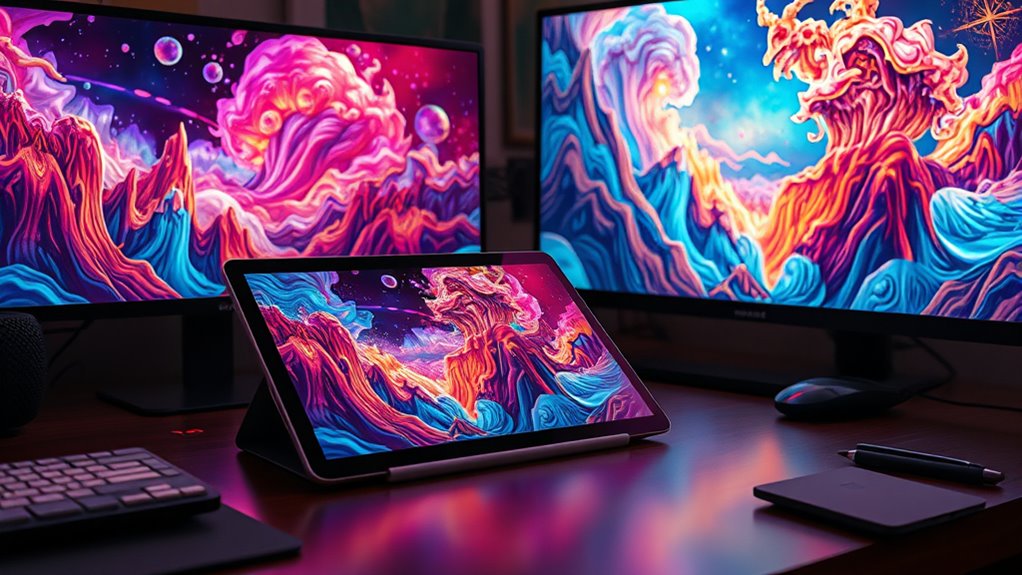
Stable Diffusion and DALL·E 3 are leading tools that are reshaping the illustration landscape through AI-powered image generation. They enable you to create detailed, high-quality visuals from simple text prompts, streamlining your creative process. Stable Diffusion, an open-source model, powers around 80% of AI-generated images, giving you access to a versatile and customizable platform. DALL·E 3 excels at generating realistic images with improved contextual understanding, allowing you to produce more accurate and complex visuals. These tools are integrated into workflows, helping you rapidly test ideas and iterate designs without expensive resources. They’re transforming how you approach illustration, making it faster, more accessible, and highly adaptable to different creative needs. As a result, your creative potential is expanded profoundly with these AI-driven tools. Additionally, understanding high resolution output is essential for producing professional-quality images that meet varying project requirements.
How Artbreeder and Midjourney Enable Creative Experimentation
You can use Artbreeder and Midjourney to push the boundaries of your creativity by collaborating with AI to generate unique visuals. These tools expand your artistic possibilities, allowing you to experiment freely with styles and concepts. As a result, you gain new ways to explore and refine your ideas more quickly and intuitively. Additionally, understanding online deals and coupon codes can help you access these innovative tools at better prices, optimizing your creative investments.
Collaborative Creative Processes
Artbreeder and Midjourney are transforming how artists and creators experiment with visual ideas by facilitating seamless collaboration between humans and AI. These tools empower you to blend, modify, and refine images interactively, fostering real-time feedback and co-creation. You can start with a rough concept and iteratively improve it, leveraging AI suggestions to explore new styles or themes. This collaborative process accelerates innovation, reducing trial-and-error time and expanding creative boundaries. Additionally, they support vibrational alignment with your creative intentions, helping you manifest the artistic visions you desire.
Expanding Artistic Possibilities
By leveraging AI-powered tools like Artbreeder and Midjourney, you can push the boundaries of traditional visual experimentation. These platforms allow you to blend existing images, modify features, and generate entirely new visuals from simple prompts. Artbreeder’s collaborative interface makes it easy to evolve images over iterations, giving you control over genetics-inspired adjustments. Midjourney excels at transforming text prompts into detailed, unique artworks, encouraging bold ideas without technical constraints. Together, these tools open endless creative possibilities, enabling you to explore styles, themes, and concepts that might be difficult or time-consuming with conventional methods. As a result, you can rapidly test ideas, refine visuals, and discover novel artistic directions, expanding what’s possible in illustration and digital art. Additionally, understanding solar panel orientation and maintenance can optimize energy efficiency in related creative projects involving sustainable design.
Impact of AI-Generated Images on the Creative Industry
AI-generated images are revolutionizing the creative industry by enabling artists and designers to produce visual content at an unprecedented speed and scale. You can now rapidly test ideas, iterate concepts, and create complex visuals without costly photoshoots or lengthy processes. This accelerates workflows across marketing, advertising, and product design, allowing you to meet tight deadlines and explore new creative directions. AI tools like DALL·E 3 and Stable Diffusion make it easier to generate realistic and diverse images from simple prompts, broadening artistic possibilities. As a result, you’re empowered to experiment more freely, customize visuals for specific audiences, and reduce production costs. The widespread adoption of AI-generated images is fundamentally changing how visual content is created, shared, and consumed in the industry. Understanding the impact of these tools helps artists and companies make informed decisions about integrating AI into their creative workflows.
Adoption Trends and Enterprise Integration of AI Illustration Tools
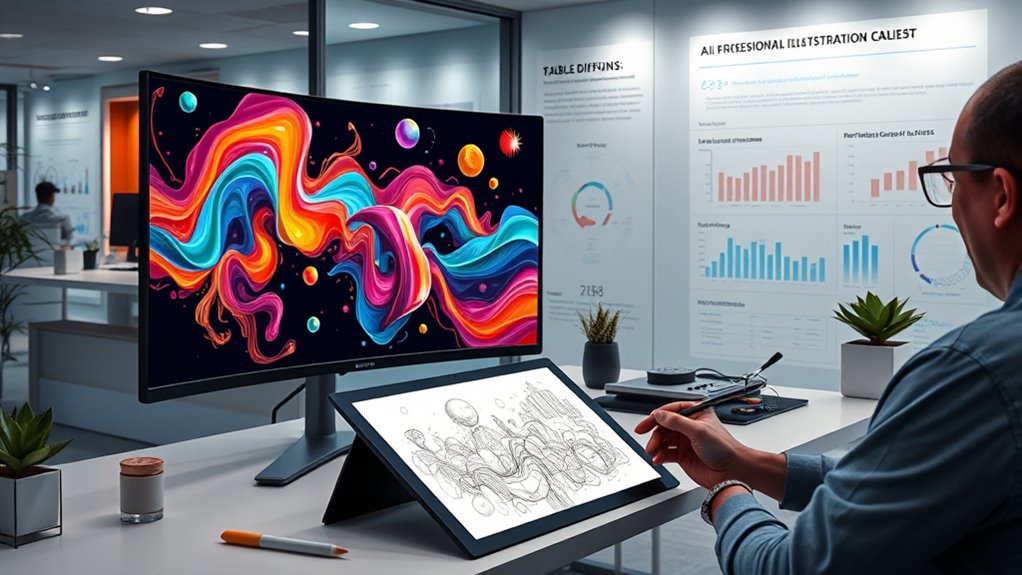
You’re likely noticing how quickly enterprises are adopting AI illustration tools, with around 30% already using DALL·E 3 and more testing it. These tools are seamlessly integrating into workflows to boost collaboration, personalize content, and speed up design processes. As adoption accelerates, future trends point to even deeper integration and smarter AI capabilities across industries. Additionally, the ongoing advancements in AI in Education demonstrate how automation and intelligent systems are transforming various sectors, including creative industries.
Growing Industry Adoption Rates
The adoption of AI illustration tools is accelerating rapidly across industries, with nearly one-third of enterprises already integrating platforms like DALL·E 3 into their workflows. You’ll notice companies leveraging these tools to streamline creative processes, reduce costs, and improve speed. Many organizations are testing AI platforms to generate marketing visuals, product prototypes, and personalized content, often seeing quick wins. As familiarity grows, more enterprises are expanding their use, driven by the clear benefits of faster ideation and scalable output. This trend reflects a shift toward embracing AI as a core component of creative and design strategies. The increasing adoption signals that AI illustration tools are becoming essential assets for businesses seeking to stay competitive and innovative in a rapidly evolving digital landscape. Additionally, as more users learn to keep Ring devices charged and maintained, the overall effectiveness and longevity of AI-powered imaging tools continue to improve.
Enterprise Workflow Integration
As more enterprises adopt AI illustration tools, integration into existing workflows has become a key focus. You’ll find many organizations embedding tools like Stable Diffusion and DALL·E 3 into creative pipelines, streamlining idea generation and visual content creation. These tools are integrated with design platforms such as Adobe Creative Cloud, enabling seamless collaboration between AI outputs and human designers. Automation features allow rapid iteration, reducing time and costs associated with traditional methods. You’re likely to see AI-driven content personalized for target audiences, enhancing marketing efforts and product development. Additionally, enterprise systems are adopting APIs and custom integrations to embed AI capabilities directly into workflows, making AI-generated images an integral part of daily operations. This shift optimizes productivity while maintaining creative flexibility.
Future Adoption Predictions
Future adoption of AI illustration tools is poised to accelerate as enterprises recognize their potential to enhance creativity, efficiency, and personalization. You’ll see more companies integrating tools like Stable Diffusion and DALL·E 3 into workflows to streamline content production and improve visual quality. As these tools become more accurate and user-friendly, expect wider implementation across marketing, product design, and customer engagement. Collaboration between humans and AI will grow, enabling real-time co-creation and faster iteration cycles. Enterprises will also leverage AI for hyper-personalized experiences, tailoring visuals to individual preferences at scale. With the market projected to reach over $356 billion by 2030, you’ll likely witness AI illustration tools becoming foundational in creative industries and enterprise operations, driving innovation and transforming how visual content is generated and consumed. Additionally, as the socialization aspect of AI tools improves, collaborative platforms will foster greater user engagement and shared creativity.
Future Opportunities and Challenges in AI-Driven Illustration
AI-driven illustration presents exciting opportunities to revolutionize creative workflows, enabling you to generate high-quality visuals rapidly and customize content with ease. However, challenges like intellectual property concerns, data privacy, and ethical issues remain. You’ll need to navigate the balance between innovation and regulation, ensuring responsible use. Future advancements could bring more realistic, photorealistic images and real-time collaboration, boosting productivity. Yet, job displacement in some creative sectors might occur as AI takes on more tasks. Staying informed and adapting your skills will be key. Here’s a quick overview:
| Opportunity | Challenge | Future Focus |
|---|---|---|
| Faster content creation | IP and privacy concerns | Improving model transparency |
| Personalized visuals | Ethical considerations | Enhancing AI-human collaboration |
| Scalable design workflows | Job displacement risks | Developing responsible AI guidelines |
A deeper understanding of ethical considerations in AI development can help guide responsible innovation and mitigate potential societal impacts.
Frequently Asked Questions
How Do AI Tools Ensure Originality in Generated Artwork?
AI tools guarantee originality by combining and modifying existing data in unique ways, avoiding direct copying. They learn patterns but generate new images based on your prompts, blending elements creatively. You can tweak settings or input specific details to influence the output. This process encourages innovation, helping you produce artwork that feels fresh and distinctive, even though it’s built on prior data.
What Are the Costs Associated With Using AI Illustration Platforms?
You might think AI illustration platforms are free since they often seem accessible, but the costs add up fast. Subscription fees, pay-per-use charges, or premium features can drain your budget. Plus, consider the time spent learning tools and potential licensing fees if you use AI-generated images commercially. So, while it feels like a bargain, investing in quality AI art isn’t exactly cheap—prepare for hidden expenses.
How Is Copyright Handled for Ai-Created Images?
You need to understand that copyright for AI-created images is complex. Typically, the rights depend on the platform’s policies and local laws. Some platforms claim ownership, while others grant users rights to their creations. If you use AI tools, check their licensing terms to see if you can commercialize or modify images. Always stay informed about evolving regulations to protect your rights and avoid legal issues.
Can AI Tools Replicate Specific Artistic Styles Accurately?
Yes, AI tools can replicate specific artistic styles with impressive accuracy. You can input detailed prompts or examples, and the AI learns to mimic the style’s unique features, such as brushwork, color palette, and composition. This allows you to generate images that closely resemble the original artist’s work, making style replication a powerful feature for creative projects. However, results may vary depending on the tool’s sophistication and input quality.
What Skills Are Needed to Effectively Use AI for Illustration?
You need a mix of technical and creative skills to use AI effectively for illustration. Learn how to operate AI tools and understand prompts to generate desired results. Develop an eye for composition, color, and style to guide AI outputs. You should also stay updated on AI capabilities and limitations, experiment regularly, and possess basic knowledge of image editing to refine AI-generated images. Combining these skills boosts your creative process.
Conclusion
As you marvel at AI’s artistic prowess, remember it’s just algorithms mimicking creativity—no soul required. While you might think it’s revolutionizing art, it’s really just automating the artist’s touch. So, go ahead, embrace these tools; after all, who needs human intuition when pixels can do the dreaming? Ironically, in a world chasing authenticity, AI’s creations might just be the most genuine art of all.