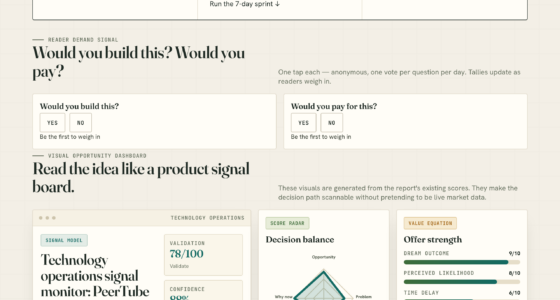

📊 Full opportunity report: Understanding China’s Rapid AI Deployment: Four Frontier Open Models on ThorstenMeyerAI.com — validation score, market gap, and execution plan.
TL;DR
Between late April and mid-June 2026, Chinese labs launched four frontier-class open models, marking a rapid production line that shifts the global AI power balance. These models are widely accessible, licensed permissively, and challenge Western dominance.
Over a span of just eight weeks between late April and mid-June 2026, Chinese AI laboratories released four frontier-class open-weight language models, marking an acceleration in AI deployment. These models, including DeepSeek V4, MiniMax M3, Kimi K2.7-Code, and GLM-5.2, are all downloadable, most under permissive licenses, and priced lower than Western API offerings. This pattern suggests a consistent release cycle rather than isolated events, reflecting a strategic approach in global AI development and deployment.
During this period, Chinese labs released four high-capacity open models in roughly eight weeks. The most prominent, DeepSeek V4 Pro, scored 87 on BenchLM’s July rankings, making it the top Chinese open-weight model and comparable to some leading proprietary models globally. The models vary in design: DeepSeek emphasizes affordability with 1.6 trillion total parameters but activates only 49 billion per pass, targeting low-cost API access; Z.ai’s GLM-5.2 leads in open-weight intelligence; Moonshot’s Kimi models focus on long-horizon agent stability and cost-efficiency; Alibaba’s Qwen family offers compact variants suitable for self-hosting on single GPUs.
Meanwhile, the Western open-weight landscape has seen limited progress, with Meta’s efforts stalling and Ai2’s Olmo 3 trailing behind Chinese counterparts in raw capability. The Chinese open field now features four distinct labs—DeepSeek, Z.ai, Moonshot, Alibaba—each with specific strategic focuses, marking a notable change from two years prior, when Chinese open models were limited to a single lab.
Four Frontier-Class Open Models in Eight Weeks
China’s Release Cadence Is the Story
Same-day-verified market pulse · July 13, 2026
The production line — spring 2026
The board this week — BenchLM overall score, July 2026
Gift & complication — the European read
The gift
Frontier-adjacent capability, permissive licenses, weeks-long refresh cycle. This cadence is what makes serious on-premises AI economically thinkable in 2026.
The complication
Still a dependency — geopolitical, not technical. Hosted Chinese APIs fall under Chinese data law; many Western agencies won’t touch the weights at all. Licensing generosity is a policy, not a law of nature.
The signal: if your infrastructure strategy assumes open models improve slowly, it’s already wrong. If it assumes the current licensing generosity is permanent, it’s unhedged.

Building Applications with AI Agents: Designing and Implementing Multiagent Systems
As an affiliate, we earn on qualifying purchases.
As an affiliate, we earn on qualifying purchases.
Implications for Global AI Development and Sovereignty
This rapid deployment indicates a notable development in the global AI landscape, with Chinese labs expanding their capability offerings and establishing a consistent release cycle. For countries and organizations aiming to develop sovereign or local-first AI, this may improve the feasibility of self-hosting advanced models due to reduced costs, permissive licensing, and frequent updates. However, reliance on Chinese-origin models raises considerations related to data laws and geopolitical factors. US federal agencies have already restricted the use of the DeepSeek app on government devices, although the model weights remain legally available for download and use. The pace of releases may be influenced by strategic responses to US export controls and hardware shortages, with the aim of maintaining a competitive AI infrastructure.

From Weights to Wisdom: The Complete Guide to Running and Adapting Opensource AI Models
As an affiliate, we earn on qualifying purchases.
As an affiliate, we earn on qualifying purchases.
Rapid Chinese Model Releases Reshape AI Power Dynamics
Historically, China’s open-weight AI development was concentrated in a single lab, but the recent release of four major models within eight weeks demonstrates a significant acceleration. These models, released by labs such as DeepSeek, Z.ai, Moonshot, and Alibaba, each pursue different strategic goals, including affordability, stability, and self-hosting capabilities. This trend appears to be partly driven by hardware shortages and export restrictions, prompting Chinese labs to optimize for efficiency and rapid iteration. Meanwhile, efforts in Western regions have seen limited progress, with some open-source models lagging behind Chinese offerings in raw performance.
This development suggests a strategic shift: China is establishing a continuous pipeline of high-capability open models, which could influence the global AI power balance. The licensing terms—mostly permissive—may facilitate broader adoption but also introduce considerations regarding dependencies and geopolitical risks.
“The cadence of Chinese open model releases has shifted from isolated headlines to a continuous production line, potentially influencing the global AI development landscape.”
— an anonymous researcher
self-hosted AI models for small GPU
As an affiliate, we earn on qualifying purchases.
As an affiliate, we earn on qualifying purchases.
Unclear Longevity and Global Adoption of Chinese Models
It remains uncertain how long this rapid release cycle will continue, as licensing policies and export regulations may evolve. While Chinese models are gaining recognition for their capabilities and accessibility, many Western governments and organizations remain cautious about adopting Chinese-origin AI models due to geopolitical and legal considerations. The long-term effects on global AI leadership and the potential for Western models to catch up or adapt are still uncertain.

Micro AI: Empowering Small Businesses and Freelancers with Smart Solutions
As an affiliate, we earn on qualifying purchases.
As an affiliate, we earn on qualifying purchases.
Next Steps in Chinese AI Model Development and Global Response
Further rapid releases from Chinese labs are anticipated, potentially expanding model capabilities and refining licensing terms. Western organizations may increase efforts to develop their own open-source models or explore alternative strategies to maintain competitiveness. Monitoring policy developments, licensing changes, and technological advancements will be important for understanding future shifts in the global AI landscape.
Key Questions
Why are Chinese labs releasing models so rapidly?
Chinese labs are likely responding to hardware shortages, export restrictions, and strategic considerations, aiming to establish a robust presence in the global AI infrastructure through frequent, high-capacity releases.
What are the main differences between Chinese and Western open models?
Chinese models tend to be released more frequently, often with permissive licenses, and focus on affordability and scalability. Western efforts have experienced slower progress, with some models lagging in raw performance and adopting more restrictive licensing policies.
Are these Chinese models safe for use in sensitive or regulated environments?
Many Western governments have restrictions on the use of certain models, such as DeepSeek, due to data laws and geopolitical concerns. While the model weights are often available for download, their use in regulated sectors may be subject to legal and policy limitations.
Will this rapid release cycle continue?
The continuation of this trend depends on geopolitical developments, licensing policies, and hardware availability. While current patterns suggest ongoing rapid releases, uncertainties remain regarding future pace.
How might Western organizations respond to these Chinese developments?
Western organizations may accelerate their open-source projects, seek alternative licensing approaches, or develop new hardware and software solutions to maintain competitiveness in the evolving AI landscape.
Source: ThorstenMeyerAI.com