
📊 Full opportunity report: Forezai · Polybot: When the AI Disagrees With the Odds on ThorstenMeyerAI.com — validation score, market gap, and execution plan.
TL;DR
Polybot is an experimental AI tool that compares its own probability estimates to market prices on prediction markets. It aims to determine when its assessments differ significantly enough to justify trading, emphasizing cautious, calibrated decision-making. This development raises questions about AI’s ability to challenge market consensus without overconfidence.
Polybot, an open-source AI trading agent for prediction markets, is designed to assess whether it can reliably identify when its probability estimates diverge from market prices and act on those discrepancies. This experiment explores the potential and limitations of AI in financial prediction, emphasizing cautious, calibrated decision-making rather than aggressive trading. The project is significant because it tests the boundaries of AI’s ability to challenge market consensus using public information.
Polybot is built to research the question: when, if ever, can an AI form a probability estimate that meaningfully disagrees with the market price? The system compares its own probability derived from public information with the market’s implied probability, and only considers trading when the gap exceeds a carefully calibrated threshold that accounts for costs, slippage, and the risk of model error.
The design emphasizes auditability—each estimate includes recorded reasoning, allowing post-trade analysis. The default approach is to avoid trading unless there is a strong, justifiable disagreement, reflecting a disciplined, risk-averse stance. Polybot is explicitly labeled as a research artifact, not a commercial trading tool, acknowledging the many challenges in beating prediction markets reliably.
Developers stress that edge is a hypothesis and that past performance does not guarantee future success. The system’s calibration over time, rather than single trades, will determine its effectiveness, with ongoing testing needed to assess whether it can genuinely identify mispricings or simply reflect noise.
Polybot — when the AI disagrees with the odds
A prediction market puts a price on the future. Polybot asks: can an AI’s own estimate diverge from that price for real — and should it ever act on the gap?
Not financial, investment, legal or tax advice; not a recommendation or solicitation to trade, invest or use any software. Forezai · Polybot is experimental open-source software (MIT), provided “as is” without warranty of accuracy or profitability. Trading and automated trading carry a substantial risk of loss including total loss of capital; past or backtested performance does not indicate future results. Prediction-market participation is restricted or prohibited in some jurisdictions (including for US persons) — you are solely responsible for compliance with applicable law. Consult a licensed professional before any financial decision. Produced with AI assistance under human editorial oversight; independent commentary, the author’s own views. Product and company names are trademarks of their respective owners; mention does not imply endorsement.
Potential Impact of AI Market Disagreement Detection
This development matters because it probes the limits of AI in financial prediction, especially in markets where prices already aggregate diverse information. If successful, Polybot could demonstrate a method for AI to identify genuine mispricings, challenging the assumption that markets are always efficient. However, the project also highlights the risks of overconfidence and the importance of disciplined, calibrated approaches in automated trading, emphasizing that even sophisticated AI must operate cautiously in adversarial, real-world markets.

Use Claude to Build an AI Trading Bot: 90 Days with Stocks and Prediction Markets (AI Trading Bot Series Book 1)
As an affiliate, we earn on qualifying purchases.
As an affiliate, we earn on qualifying purchases.
Limitations and Challenges of AI in Prediction Markets
Prediction markets like Polymarket put a price on future events by aggregating public opinions and money, making them difficult to beat. Historically, most attempts to outperform markets have failed due to noise, slippage, liquidity issues, and the adaptive nature of markets. Polybot’s approach is to test whether an AI can reliably identify when its own estimates differ significantly from market prices, but past efforts have often been confounded by costs and the market’s efficiency.
Open-source projects like Polybot reflect a broader interest in understanding AI’s capabilities and limitations in financial contexts. The experiment is part of a cautious exploration, recognizing that even well-designed models can be confidently wrong, especially in adversarial environments where other traders may act on similar signals.
“Polybot is an experiment in testing whether an AI can reliably identify when its probability estimates diverge from market prices and act on those differences. It’s not about beating the market but understanding the boundaries of AI prediction.”
— Thorsten Meyer, creator of Polybot
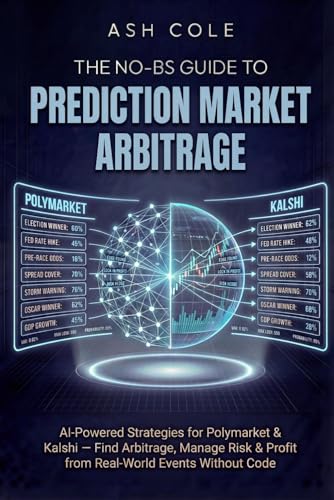
The No-BS Guide to Prediction Market Arbitrage: AI-Powered Strategies for Polymarket & Kalshi — Find Arbitrage, Manage Risk & Profit from Real-World Events Without Code (The No-BS AI Playbooks)
As an affiliate, we earn on qualifying purchases.
As an affiliate, we earn on qualifying purchases.
Uncertainties About AI Performance and Market Impact
It remains unclear whether Polybot can reliably identify meaningful mispricings in live markets over extended periods. The system’s effectiveness depends on accurate calibration, robust reasoning, and the ability to avoid overconfidence. Additionally, the broader impact of AI challenging market prices is still uncertain, especially regarding regulatory, ethical, and market stability considerations. Ongoing testing and real-world deployment are needed to evaluate its true capabilities and limitations.
Use Claude to Build an AI Trading Bot: 90 Days with Stocks and Prediction Markets (AI Trading Bot Series Book 1)
As an affiliate, we earn on qualifying purchases.
As an affiliate, we earn on qualifying purchases.
Next Steps for Testing and Evaluating Polybot
Developers plan to continue live testing of Polybot’s decision-making over multiple market cycles, focusing on its calibration and accuracy. They will analyze post-trade reasoning and adjust thresholds to improve reliability. Further, the project aims to publish detailed performance metrics and insights, contributing to broader research on AI in prediction markets. Monitoring market reactions and potential regulatory responses will also be part of the ongoing assessment.
As an affiliate, we earn on qualifying purchases.
Key Questions
Can Polybot reliably beat prediction markets?
Currently, Polybot is an experimental tool designed to test the limits of AI in identifying mispricings. Its ability to reliably beat markets remains unproven, and the project emphasizes cautious, calibrated decision-making rather than profit.
Is this system safe for real trading?
No. Polybot is an open-source research project, not a commercial trading system. Automated trading involves substantial risks, including loss of capital, and should only be undertaken with full understanding of these risks.
What are the main challenges in using AI for prediction markets?
Challenges include market efficiency, costs like slippage and fees, the adversarial nature of markets, and the difficulty of maintaining calibration over time. Past successes often fade when faced with real-world conditions.
Will AI ever replace human traders in prediction markets?
It is unlikely that AI will fully replace humans soon. Instead, AI tools may serve as aids for better decision-making, but they must operate within disciplined, calibrated frameworks to be effective and safe.
Source: ThorstenMeyerAI.com