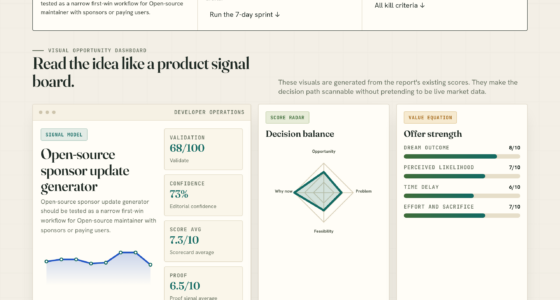

📊 Full opportunity report: The Door: Why the Interface Is Worth More Than the Model on ThorstenMeyerAI.com — validation score, market gap, and execution plan.

Get the little things that make your day delivered free with Prime
- Fast, free delivery on millions of items
- Prime Video, Amazon Music and more included
- Member-only deals all year
TL;DR
SpaceX bought a $60 billion coding interface, emphasizing that the interface layer, not the AI model itself, is now the most valuable asset in AI. Control over the user interface determines demand routing, data flow, and user habits.
SpaceX’s recent acquisition of a coding interface platform for $60 billion marks a significant shift in AI industry dynamics, emphasizing the importance of the interface layer over the underlying models. This move highlights how control of the user interface—where developers and users interact—has become the most valuable asset in AI distribution, routing, and data collection.
The platform, built by Anysphere, provides a coding interface on top of various AI models, generating approximately $4 billion in annualized revenue. SpaceX’s purchase was driven by the recognition that owning the interface—where developers live and demand flows—offers strategic advantages beyond just the AI models themselves. The interface determines the default model, user habits, and the flow of data back to the owner, making it a critical chokepoint in AI deployment.
This development underscores a broader industry trend: as AI models become commoditized, the value shifts toward the surface where humans interact with AI systems. Major tech companies like Google and Microsoft are also investing heavily in browser and OS-level AI interfaces, aiming to control the primary access points for users. The interface layer’s ability to route demand and influence user behavior makes it a strategic asset, potentially more valuable than the models underneath.
The Door: Worth More Than the Model
SpaceX paid $60B for a coding tool — not a model. As the model commoditizes, the surface the human touches captures the value: the default, the habit, the data, and the choice of which model gets called.
Perplexity
The most valuable chokepoint — and, strangely, the most winnable. You can’t bootstrap a gigawatt or a 555K-GPU cluster, but a small team can still build the door (Cursor was a few founders on rented models). Own the interface and the user relationship even if you rent everything underneath — and never let a platform’s default be your only door to your users.
Why Interface Control Will Shape AI Dominance
This shift means that the companies controlling the interface—such as browsers, operating systems, or specialized front-ends—will hold the real power in AI ecosystems. They can determine which models are used, collect critical user data, and influence demand routing. The move by SpaceX to acquire a leading coding interface underscores that the industry’s future depends less on developing new models and more on owning the surface where humans and AI meet.
Control over the interface could lead to monopolistic advantages, as it consolidates user attention, data, and demand flow. This dynamic elevates the interface from a mere tool to a strategic chokepoint, making it a key battleground for AI dominance and distribution control.
As an affiliate, we earn on qualifying purchases.
Industry Shift Toward Interface Dominance
For years, the AI industry focused on improving models, with the assumption that the smartest weights would determine leadership. However, recent trends show that as frontier models become more accessible and commoditized—evidenced by declining costs and open weights—the real battleground is the interface layer. In 2025, companies like OpenAI, Perplexity, and others launched new browser and desktop interfaces, aiming to embed AI into daily habits. Major tech firms are integrating AI features directly into browsers and OS-level services, reinforcing the importance of the interface as a distribution channel. The recent $60 billion acquisition by SpaceX confirms this evolving landscape, emphasizing that owning the entry point to AI usage is now more valuable than owning the models themselves.
“Our investment is focused on the interface layer, which we see as the key to unlocking scalable AI distribution and control.”
— SpaceX spokesperson
As an affiliate, we earn on qualifying purchases.
Unclear Impact of Ownership on Model Innovation
It remains unclear how owning the interface will influence the development and innovation of AI models themselves. Will control over the surface stifle competition or incentivize better models? Also, the long-term effects on open-source models and industry competition are still uncertain, as industry players navigate this new power dynamic.
As an affiliate, we earn on qualifying purchases.
Future Strategies for Interface Ownership and Competition
Expect more tech giants and AI startups to prioritize building and controlling interfaces, with potential acquisitions similar to SpaceX’s. Regulatory scrutiny over monopolistic control of interfaces and demand routing may increase. Additionally, industry alliances or standards could emerge to balance power among interface owners and model providers.
As an affiliate, we earn on qualifying purchases.
Key Questions
Why is the interface more valuable than the AI model?
The interface determines user habits, controls data flow, and routes demand to different models, making it a strategic chokepoint that influences AI distribution and monetization.
How did SpaceX justify paying $60 billion for an interface?
SpaceX recognized that owning the interface layer offers control over user interaction, demand routing, and data collection, which are more strategic than owning the models themselves.
Will this shift limit innovation in AI models?
It’s uncertain; while control over interfaces may consolidate power, it could also incentivize better models targeted at specific interfaces, but industry dynamics remain to be seen.
Could regulatory action challenge this control?
Yes, regulators may scrutinize monopolistic practices related to interface control, especially if it stifles competition or limits user choice.
Source: ThorstenMeyerAI.com
Fall Picks
fall essentials
As an affiliate, we earn on qualifying purchases.