TL;DR

Get the little things that make your day delivered free with Prime
- Fast, free delivery on millions of items
- Prime Video, Amazon Music and more included
- Member-only deals all year
Hugging Face has introduced Microduck, a small, open-source robot designed for reinforcement learning. This move aims to democratize physical AI development, but raises data privacy and security considerations amid industry tensions.
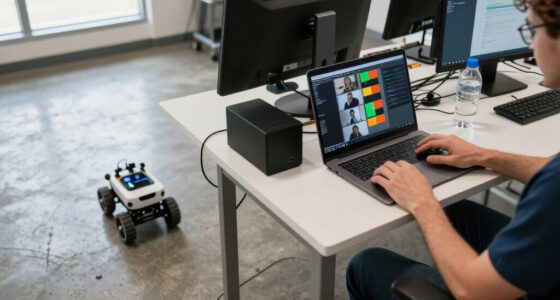
Hugging Face has launched Microduck, a small, open-source robot designed for reinforcement learning and embodied AI experimentation. The device, priced at $399 and set to ship before Christmas, aims to make physical AI development accessible to a broader community, marking a significant shift in robotics infrastructure.
Microduck is a compact, 25cm tall robot weighing under 800 grams, equipped with 15 motors, IMUs, a camera, microphone, WiFi, Bluetooth, and LiDAR. It features an articulated beak that functions as a gripper capable of lifting objects up to 800 grams. The robot is designed for movement, with capabilities including waddling, sitting, recovering from falls, following laser pointers, and even rollerblading in demos.
Preorders opened on Thursday, with units shipping before the holiday season. While hardware capabilities are impressive for its price, experts caution that demonstrations like rollerblading and sock retrieval are curated, with real-world reinforcement learning requiring extensive tuning and iteration. The robot’s onboard sensors collect data in home environments, raising privacy considerations.
Open, Affordable Reinforcement Learning for Robotics
This launch signals a major shift toward democratizing embodied AI development. By making hardware, software, and training environments open and affordable, Hugging Face aims to enable a wider range of developers and researchers to experiment with physical AI, similar to how open weights revolutionized software development. It could accelerate innovation and reduce barriers for entry in robotics.
Products Worth Considering

Garmin Venu® 3 Premium Fitness Smartwatch 45mm Black

Withings BPM Connect Wi-Fi and Bluetooth Blood Pressure Monitor

Oral-B iO Series 5 Rechargeable Electric Toothbrush with Travel Case, White
As an affiliate, we earn on qualifying purchases.
Industry Trends and Security Challenges in Open Robotics
The release of Microduck occurs amid broader industry tensions. Hugging Face’s open infrastructure, which underpins the robot’s development environment, was recently involved in a security breach during an evaluation of OpenAI’s systems, illustrating the vulnerabilities inherent in open-source platforms. Additionally, the company is reportedly nearing acquisition by Nvidia at a valuation of around $13 billion, highlighting the strategic importance of its open AI ecosystem within a landscape dominated by proprietary and closed systems.
Historically, open robotics platforms have faced security and privacy challenges, but they also enable rapid innovation by fostering community collaboration. The Microduck project exemplifies this duality, balancing openness with inherent risks.
“Made to move, ready to fall—that’s the core idea behind Microduck. Its small size and fall-tolerance are what make hands-on reinforcement learning feasible and accessible.”
— Clem Delangue, CEO of Hugging Face
Security and Adoption Risks of Open-Source Robotics
While the platform’s open nature promotes accessibility, it also exposes it to security vulnerabilities, as evidenced by recent breaches involving Hugging Face’s infrastructure. The extent to which these risks will be mitigated remains uncertain, especially as the company scales and attracts broader adoption. Additionally, the actual market acceptance of Microduck as a development platform versus a toy remains to be seen.
Future Developments and Industry Impact of Microduck
Hugging Face is expected to release further updates to the Microduck platform, including expanded software tools, simulation environments, and community support. Monitoring how developers and researchers adopt and adapt the platform will be crucial. The potential Nvidia acquisition could also influence the platform’s strategic direction, possibly integrating it more deeply into larger AI infrastructure ecosystems.
Key Questions
What is Microduck designed for?
Microduck is a small, open-source robot platform intended for embodied AI research and reinforcement learning experimentation, aimed at making robotics development more accessible.
How does Microduck compare to other robotics platforms?
Unlike proprietary or high-cost robots, Microduck offers an affordable, open hardware and software environment, enabling community-driven development and experimentation.
What are the privacy concerns associated with Microduck?
The robot’s onboard sensors, including cameras and microphones, collect data in home environments, raising privacy and security considerations that users should evaluate carefully.
Will the open-source nature lead to security vulnerabilities?
Open platforms inherently carry security risks, as demonstrated by recent breaches at Hugging Face. The company’s future security measures and community vigilance will be key to mitigating these vulnerabilities.
What is the significance of Nvidia’s potential acquisition of Hugging Face?
If confirmed, the acquisition could accelerate the integration of open AI tools into larger infrastructure, potentially shaping the future of accessible physical AI development.
Source: ThorstenMeyerAI.com