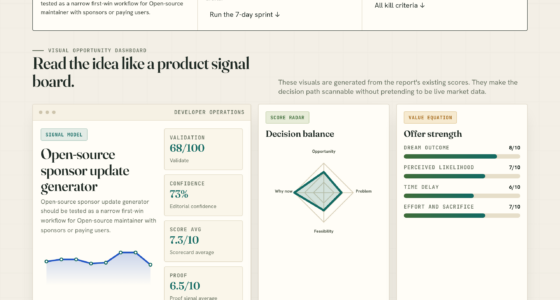

📊 Full opportunity report: Europe Regulated the Interface and Forgot to Build the Engine on ThorstenMeyerAI.com — validation score, market gap, and execution plan.

Get the little things that make your day delivered free with Prime
- Fast, free delivery on millions of items
- Prime Video, Amazon Music and more included
- Member-only deals all year
TL;DR
Europe has focused on regulating AI interfaces, such as cookie banners, but has not invested in developing competitive AI engines. This has led to a significant gap in technological capability compared to the US and China.
Europe has primarily regulated the surface of digital technology, exemplified by its focus on cookie banners, while neglecting the development of the underlying AI engines that are now dominating the global landscape. This strategic oversight has left the continent behind in the AI race, with significant implications for its technological sovereignty and economic competitiveness.
European policymakers have concentrated on regulating user interfaces, such as cookie banners, under laws like the GDPR and the ePrivacy Directive, aiming to control data privacy and digital consent. However, this focus on superficial regulation has not been matched by investments or policies supporting the development of advanced AI models. As a result, Europe’s AI ecosystem remains underfunded and technologically lagging behind the US and China.
For example, Europe’s leading AI lab, Mistral, has raised only around $3-4 billion, far less than US and Chinese competitors like OpenAI, Anthropic, or Chinese firms such as Zhipu. Mistral’s models, while innovative, trail behind in capabilities and market presence, and Europe lacks the national security-level models that are now a strategic asset for other countries. The continent’s regulatory approach, focused on surface-level compliance, has inadvertently hindered its ability to build competitive AI engines.
Meanwhile, China and the US have made significant strides by releasing near-frontier models freely or at low cost, capturing global market share and technological influence. China’s Zhipu, for example, has released models surpassing many European offerings in both size and capability, challenging Europe’s technological sovereignty.
Europe regulated the interface and forgot the engine
The cookie banner is the most-used European software of the decade. While Brussels perfected the consent pop-up, the frontier was built elsewhere — and now, in H2 2026, Europe wants to buy back in without changing what put it on the outside.
This isn’t about whether privacy or safety matter — they do. It’s that Europe mistook regulating the interface for having a seat at the table. You can’t grant your way out of a structural problem while keeping the structure — the laws, the capital gaps, the energy costs, the talent drain all left untouched. The fix isn’t another framework: it’s open weights as a product, sovereign compute on affordable power, real capital plumbing — and to stop mistaking a check for a strategy.
Implications of Europe’s Focus on Interface Regulation
This focus on regulating interfaces like cookie banners signals a misallocation of regulatory efforts, as it does not address the core technological capabilities needed to compete globally in AI. Europe risks falling behind in AI innovation, economic leadership, and national security if it continues to neglect building and funding the engines of AI development. The continent’s inability to produce world-class models diminishes its influence in shaping the future of AI and digital sovereignty.
As an affiliate, we earn on qualifying purchases.
Europe’s AI Development and Regulatory Strategy
Europe’s approach to AI regulation was pioneering with the 2023 AI Act, aiming to establish comprehensive rules before the technology reached scale. However, this regulation was enacted without European leadership in AI development, which remains concentrated in the US and China. European AI labs, like Mistral, have struggled to secure capital, raising only a fraction of what their US counterparts attract. Meanwhile, China has aggressively released powerful models, such as Zhipu’s GLM 5.2, which outperforms many European models and is freely available worldwide.
Historically, Europe’s regulatory efforts have focused on privacy and data protection, often at the expense of fostering innovation. The continent’s capital markets are fragmented, and venture funding remains limited compared to Silicon Valley and Chinese tech hubs. This combination of regulatory focus and financial constraints has resulted in a lag in AI engine development, leaving Europe dependent on external technology.
“Europe built a continent-wide ritual of friction that annoys its citizens and signals where its regulatory reflex points: at the surface of technology, not its substance.”
— Thorsten Meyer
As an affiliate, we earn on qualifying purchases.
Unclear Future of Europe’s AI Capabilities
It remains unclear whether Europe will shift its focus from superficial regulation to investing in core AI development. The extent to which policymakers will prioritize funding, infrastructure, and strategic support for AI engines is still uncertain, as is the potential for European models to catch up with US and Chinese advancements in the near future.
As an affiliate, we earn on qualifying purchases.
Next Steps for Europe’s AI Strategy and Regulation
European policymakers are expected to consider new legislation aimed at supporting AI development, possibly including funding initiatives, research incentives, and strategic partnerships. However, without fundamental changes in investment and a move away from purely regulatory measures, Europe risks continued technological marginalization. The coming months will reveal whether Brussels can realign its policies to foster innovation and regain its position in the global AI landscape.
As an affiliate, we earn on qualifying purchases.
Key Questions
Europe prioritized interface regulation to enhance data privacy and user control, aiming to set global standards for digital consent and privacy compliance.
What is the main consequence of Europe’s focus on surface regulation?
It has led to underinvestment in core AI development, leaving European models behind in capability and market share compared to US and Chinese competitors.
Can Europe catch up in AI development?
It remains uncertain. Success depends on whether European policymakers and investors shift focus toward funding and building advanced AI engines rather than just regulating interfaces.
How does China’s AI progress compare to Europe’s?
China has released powerful, open-access models like Zhipu’s GLM 5.2, which outperform many European offerings and are freely available, giving China a significant technological advantage.
What are the risks if Europe continues on its current path?
Europe risks losing technological sovereignty, economic competitiveness, and influence in shaping AI’s future, potentially becoming dependent on external AI technologies.
Source: ThorstenMeyerAI.com
NFL season / tailgating Picks
team gear
As an affiliate, we earn on qualifying purchases.