📊 Full opportunity report: Phone-based injury-risk movement screening for hiring on IdeaNavigator AI — validation score, market gap, and execution plan.

Get the little things that make your day delivered free with Prime
- Fast, free delivery on millions of items
- Prime Video, Amazon Music and more included
- Member-only deals all year
TL;DR
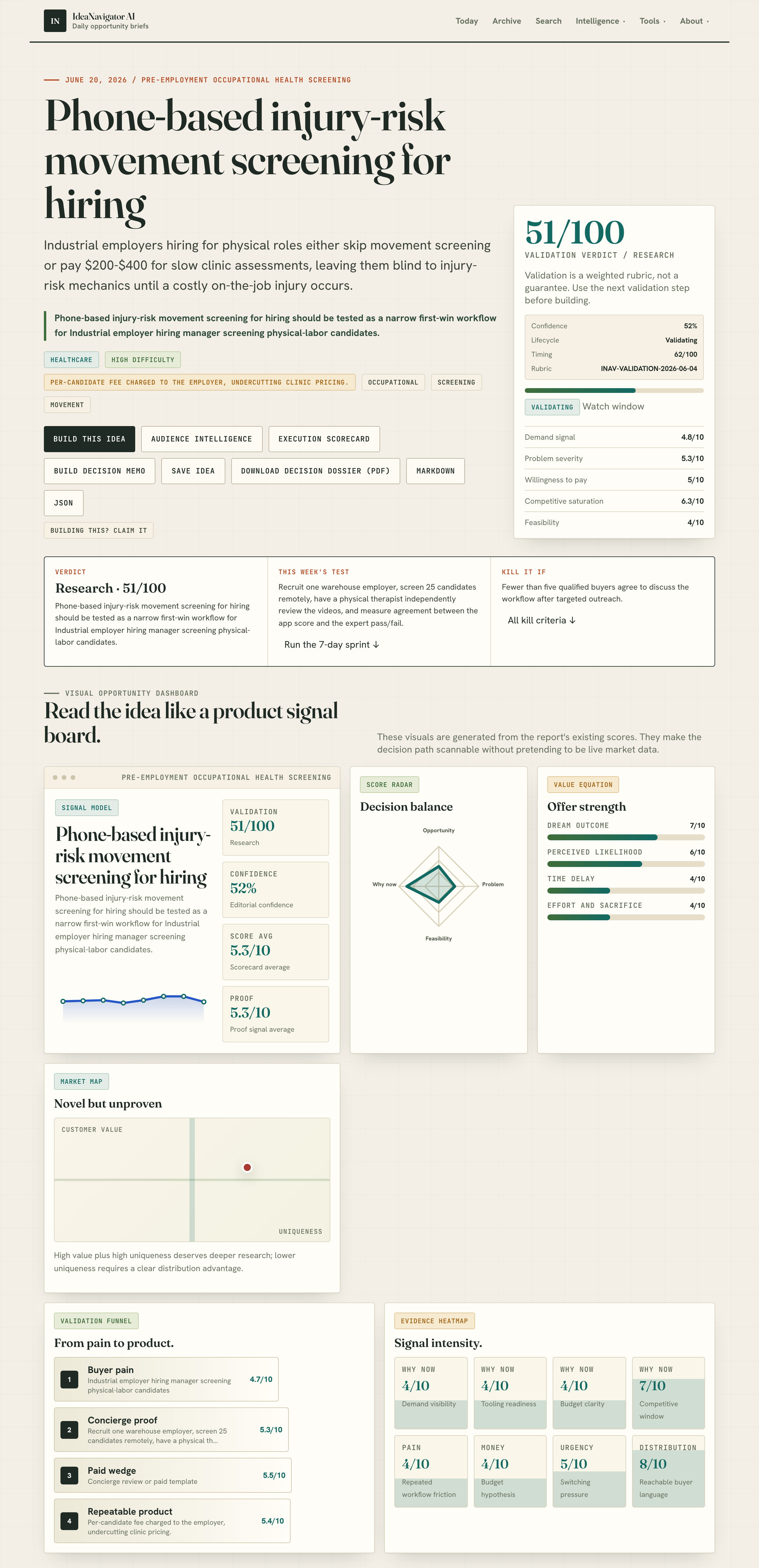
A pilot program is testing a phone-based movement screening tool for screening physical labor candidates remotely. The approach aims to cut costs and improve injury prevention before hiring. Results are pending validation with employers and experts.
A pilot program is currently testing a phone-based movement screening tool designed to assess injury risk in candidates for physical labor roles. The initiative aims to provide a low-cost, efficient alternative to traditional clinic assessments, helping employers prevent costly on-the-job injuries. This development could transform pre-employment screening processes for industrial companies.
The proposed system uses a guided phone camera capture of 5 to 7 movements—including squats, reaches, lifts, and balance holds—that are scored against occupational benchmarks to determine injury risk. The screening is intended to deliver results within 24 hours at a cost of $30 to $50 per candidate, significantly lower than clinic assessments costing $200 to $400. The approach leverages advances in pose estimation technology, making remote movement capture feasible.
To validate the system, a pilot involving one warehouse employer will screen 25 candidates remotely. Independent physical therapists will review the video recordings and compare their assessments with the app-generated pass/fail scores to measure agreement and accuracy. The goal is to establish the tool as a reliable, scalable method for injury risk screening before employment.
Potential Impact on Workplace Injury Prevention
If successful, this phone-based screening could significantly reduce workplace injuries among physically demanding roles by identifying high-risk candidates early. Employers could save costs associated with injuries, workers’ compensation, and lost productivity. Additionally, the approach offers a faster, more accessible alternative to traditional clinic assessments, making injury prevention more feasible at scale.
Reducing injury risk through early screening aligns with rising workers’ compensation costs and the need for more proactive health management in industrial settings. The method’s low cost and remote nature could enable widespread adoption, especially for high-volume hiring processes.
phone-based movement screening tool
As an affiliate, we earn on qualifying purchases.
As an affiliate, we earn on qualifying purchases.
Growing Need for Cost-Effective Injury Screening Tools
Industrial employers have long struggled with balancing thorough pre-employment assessments against costs and logistical challenges. Traditional movement screenings are often performed in clinics, costing between $200 and $400 per candidate, and are time-consuming. Many employers skip movement screening altogether, leaving injury risks unassessed until an incident occurs, which can be costly.
Recent technological advances in phone cameras and pose estimation algorithms now make remote movement capture feasible. Rising workers’ compensation premiums and injury-related costs are pushing employers to explore new, scalable solutions for injury risk assessment before hiring. This context has prompted interest in developing low-cost, remote screening tools that can be integrated into existing hiring workflows.
“The technology now allows us to remotely capture and analyze candidate movements with a high degree of accuracy, opening new possibilities for injury prevention.”
— an anonymous researcher
remote injury risk assessment device
As an affiliate, we earn on qualifying purchases.
As an affiliate, we earn on qualifying purchases.
Validation Results and Reliability of the Screening Tool
It is not yet clear how accurately the phone-based system will match expert assessments of injury risk. The pilot is ongoing, and results are expected in the coming months. The effectiveness of the tool across different candidate populations, movement types, and lighting conditions remains to be confirmed. Additionally, the scalability and integration into existing hiring workflows are still under evaluation.
industrial worker movement analysis app
As an affiliate, we earn on qualifying purchases.
As an affiliate, we earn on qualifying purchases.
Next Steps for Pilot Testing and Broader Adoption
The pilot involving one warehouse employer will conclude with an analysis of agreement between app scores and physical therapist reviews. If results are favorable, further testing across multiple employers and industries will follow to validate reliability and scalability. Pending positive validation, the developers plan to refine the platform and seek broader adoption in pre-employment screening processes.
pre-employment movement screening software
As an affiliate, we earn on qualifying purchases.
As an affiliate, we earn on qualifying purchases.
Key Questions
How does the phone-based screening work?
Candidates perform a series of movements guided by instructions on their phone, which are recorded and analyzed using pose estimation technology to assess injury risk based on occupational benchmarks.
What are the benefits of remote screening over traditional clinic assessments?
Remote screening offers lower costs, faster results, and greater convenience for both employers and candidates, enabling scalable pre-employment injury risk assessments.
Will this replace physical therapists in injury assessment?
Initially, the system is intended to serve as a screening tool, with physical therapists providing validation and detailed assessments when needed. It is not meant to replace expert evaluations entirely.
When will this system be widely available?
The pilot results are expected within the next few months. If validation is successful, developers aim to roll out the platform for broader use within the next year.
Are there limitations to using phone cameras for movement analysis?
Yes, factors like lighting, camera quality, and candidate positioning can affect accuracy. Ongoing validation aims to address these challenges.
Source: IdeaNavigator AI
Fall Picks
fall essentials
As an affiliate, we earn on qualifying purchases.