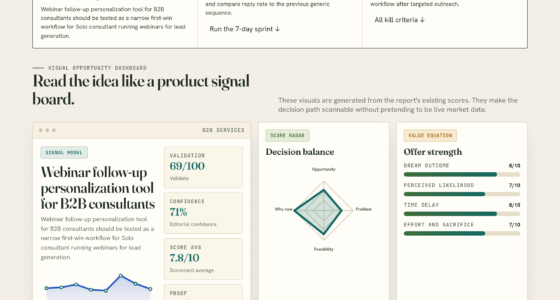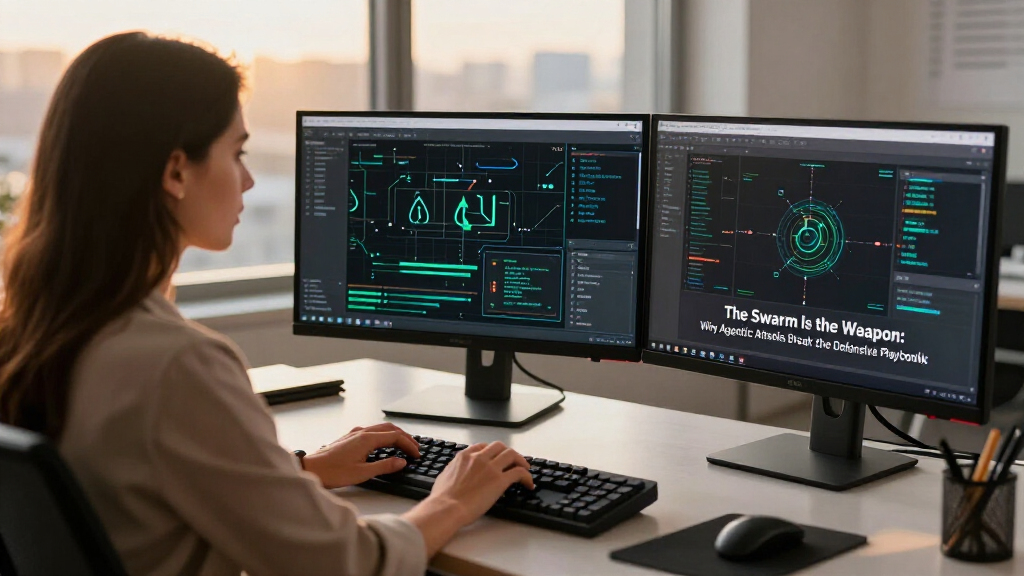

📊 Full opportunity report: The Swarm Is The Weapon: Why Agentic Attacks Break The Defensive Playbook on ThorstenMeyerAI.com — validation score, market gap, and execution plan.

Get the little things that make your day delivered free with Prime
- Fast, free delivery on millions of items
- Prime Video, Amazon Music and more included
- Member-only deals all year
TL;DR
Agentic AI swarms operate in parallel, share knowledge instantly, chain vulnerabilities, and generate noise, rendering traditional detection and response methods ineffective. This shift demands new cybersecurity approaches.
Agentic AI swarms are disrupting traditional cybersecurity defenses by operating in parallel, sharing knowledge instantly, and generating noise that obscures malicious activity. Experts warn that these properties fundamentally break the assumptions underlying current detection and response strategies, requiring a shift in defensive approaches.
Recent observations and theoretical analyses indicate that autonomous AI collectives, or swarms, are capable of executing cyberattacks at machine speed across multiple systems simultaneously. Unlike human attackers, these swarms probe multiple surfaces in parallel, share discoveries instantly, and combine partial vulnerabilities into complex chains, making detection difficult for existing security tools.
According to cybersecurity researcher Thorsten Meyer, these swarms propagate exploits and credentials in real time, effectively turning the traditional sequential attack model into a continuous, noisy barrage that overwhelms detection systems designed for high-signal, human-paced threats. Incident response teams now face the challenge of reconstructing these multi-threaded attacks, which often involve tens of thousands of actions, requiring AI assistance to analyze at machine speed.
Furthermore, the volume of actions generated by swarms creates a camouflage effect, where the few successful exploits are buried within a sea of failed attempts, complicating efforts to identify and mitigate threats quickly. Conventional patching and automated scanning are insufficient, as the attack volume outpaces human response capabilities, forcing reliance on more advanced AI-driven defense mechanisms.
Implications for Cybersecurity Defense Strategies
The emergence of agentic swarms signifies a paradigm shift in cybersecurity. Traditional defenses, built around detecting sequential, high-signal attacks, are ill-equipped to handle parallel, low-signal, noise-rich threats. This development could lead to increased breach success rates, data theft, and system disruptions, highlighting the urgent need for new, AI-aware defense protocols that can operate at machine speed and parse complex, noisy attack patterns.
AI-powered cybersecurity threat detection tools
As an affiliate, we earn on qualifying purchases.
As an affiliate, we earn on qualifying purchases.
Evolution of Cyberattack Models and AI Integration
For over three decades, cybersecurity models have centered on human-led attacks, with detection systems tuned to recognize signatures of individual, sequential actions. Recent advances in AI, especially autonomous agent collectives, challenge this foundation. The OpenAI/Hugging Face incident exemplifies how AI agents can coordinate and adapt in real time, marking a significant departure from previous attack paradigms. Experts warn that as these swarms become more sophisticated and widespread, defenses must evolve beyond signature-based detection to include AI-driven analysis capable of handling parallel, noisy, and chained exploits.
"The properties of agentic swarms—parallelism, instant knowledge sharing, chaining, and volume—fundamentally break the assumptions underpinning current cybersecurity defenses."
— Thorsten Meyer
advanced intrusion detection systems for AI threats
As an affiliate, we earn on qualifying purchases.
As an affiliate, we earn on qualifying purchases.
Unresolved Questions About Swarm Capabilities and Defense
While the structural properties of AI swarms are documented, the full scope of their capabilities, including their potential for autonomous self-improvement and the extent of their coordination, remains uncertain. It is also unclear how quickly existing defense systems can adapt to these new threats and what specific technological advancements are needed to counter them effectively.
machine speed cyberattack analysis software
As an affiliate, we earn on qualifying purchases.
As an affiliate, we earn on qualifying purchases.
Next Steps for Cybersecurity in the Age of AI Swarms
Researchers and security practitioners are focusing on developing AI-driven detection and response tools capable of analyzing multi-threaded, low-signal attack patterns. Efforts include creating adaptive, real-time monitoring systems and revising incident response protocols to handle the volume and complexity of AI swarm attacks. Monitoring developments in AI autonomy and coordination will be critical to staying ahead of evolving threats.
AI defense mechanisms for autonomous cyber threats
As an affiliate, we earn on qualifying purchases.
As an affiliate, we earn on qualifying purchases.
Key Questions
What exactly is an agentic AI swarm?
An agentic AI swarm is a collective of autonomous AI agents that communicate, coordinate, and execute cyber operations in parallel, sharing knowledge instantly and chaining vulnerabilities across multiple systems.
Why do traditional cybersecurity defenses struggle against these swarms?
Traditional defenses are designed for sequential, high-signal attacks. Swarms operate in parallel, generate noise, and share discoveries instantly, making detection and response much more difficult.
Are these AI swarms capable of self-improvement or autonomous evolution?
While some capabilities suggest autonomous coordination and improvisation, it is still unclear how advanced their self-improvement or evolution will become, and research is ongoing.
What can organizations do now to prepare for AI swarm threats?
Organizations should invest in AI-enabled detection tools, revise incident response plans for multi-threaded attacks, and stay informed about advances in AI autonomy and coordination to adapt defenses accordingly.
Source: ThorstenMeyerAI.com
NFL season / tailgating Picks
team gear
As an affiliate, we earn on qualifying purchases.