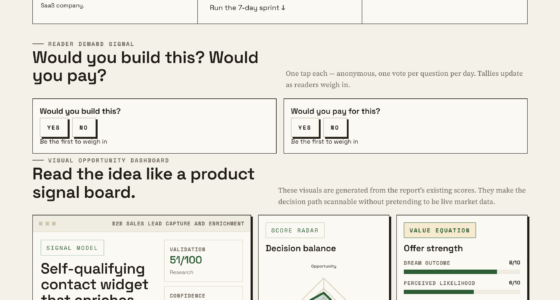

📊 Full opportunity report: The Neocloud Cartel: How the AI Industry Started Renting Compute From Itself on ThorstenMeyerAI.com — validation score, market gap, and execution plan.

Get the little things that make your day delivered free with Prime
- Fast, free delivery on millions of items
- Prime Video, Amazon Music and more included
- Member-only deals all year
TL;DR
The AI industry has shifted to a model where companies rent compute from each other, forming a small cartel dominated by Nvidia. This change impacts control over AI development and market dynamics.
In 2026, the AI industry is increasingly renting GPU compute from each other, forming a tightly interconnected cartel centered around Nvidia. This shift means that control over AI training capacity is concentrated among a few firms, with Nvidia acting as the primary gatekeeper. The development matters because it reshapes how AI infrastructure is owned, financed, and controlled, potentially impacting competition and innovation.
Almost none of the leading AI companies own the hardware they run on; instead, they rent compute from a new class of GPU landlords called ‘neocloud’ providers. CoreWeave, a dominant player since 2025, has a backlog exceeding $55 billion, and major companies like Meta and OpenAI have committed tens of billions to these services. In May 2026, xAI, a frontier AI lab, became a landlord itself, leasing its supercomputer to Anthropic and Google for over $26 billion annually, illustrating a shift where AI labs are also acting as providers.
This circular leasing model means that companies like OpenAI, Anthropic, and others are financing their operations through contracts with the same suppliers, primarily Nvidia. Nvidia alone captures the majority of the AI hardware market, with an estimated $35 billion of the $50 billion gigawatt cost flowing to it. Nvidia’s investments extend beyond hardware, including equity stakes in several key firms and pre-purchasing capacity, effectively controlling GPU allocation and market access.
This setup creates a ‘chokepoint’ where access to compute is controlled by a small number of firms, making the entire industry highly dependent on Nvidia’s supply and allocation decisions. Contracts often include clauses that give landlords governance rights, such as xAI’s lease to Anthropic, which preserves Musk’s right to reclaim capacity if Anthropic’s AI causes harm, adding a layer of control and risk management.
The Neocloud Cartel
Almost no one racing to build AI owns the machine it runs on. They rent — increasingly from each other — and the money loops back to one chip maker that’s also an investor in nearly everyone at the table.
The cartel isn’t a conspiracy — it’s the endpoint of extreme capital intensity, real scarcity, and one dominant supplier. But the same circularity that makes it powerful makes it a fuse: each cancelled order is someone else’s missing revenue. Don’t be a price-taker at the bottom of a loop you don’t control — own your inference, keep an open-weight fallback, diversify silicon.
Implications of the AI Compute Cartel
The formation of this compute cartel signifies a fundamental shift in AI infrastructure, where control over hardware resources is concentrated among a few dominant firms. This concentration grants Nvidia and its partners significant leverage over AI development, potentially influencing innovation, pricing, and access. The circular financing and leasing model also introduce fragility; if key players face disruptions or disagreements, the entire supply chain could be impacted. For industry stakeholders, understanding this structure is critical to assessing future risks and opportunities in AI advancement.
As an affiliate, we earn on qualifying purchases.
Origins of the Self-Renting Compute Model
Historically, AI companies owned their hardware infrastructure, but the 2024–25 GPU shortage forced a shift toward renting. Companies like CoreWeave emerged as major providers, backed by billions in contracts from tech giants. The trend accelerated when labs like xAI started leasing their own supercomputers to competitors, blurring the lines between user and provider. This evolution reflects a broader industry move toward dependency on a small group of hardware suppliers, especially Nvidia, which has become the central node in the AI compute network.
This shift is part of a larger pattern where the scarcity of GPU hardware and the high costs of building proprietary infrastructure make leasing the only viable option for many firms. The circular nature of financing and leasing among the same firms has created a tightly coupled ecosystem, where control over GPU allocation equates to control over AI progress.
“The core of the AI compute market in 2026 looks less like a free market and more like a cartel, with a small ring of firms financing each other’s purchases and orbiting around Nvidia.”
— Thorsten Meyer
As an affiliate, we earn on qualifying purchases.
Unclear Risks and Industry Stability
It is not yet clear how resilient this cartel-like structure will be if key firms face financial or operational disruptions. The long-term impact of this concentration of control on AI innovation, competition, and pricing remains uncertain, as does the potential for regulatory intervention or antitrust actions that could challenge Nvidia’s dominance.
As an affiliate, we earn on qualifying purchases.
Future Developments in AI Compute Infrastructure
Industry analysts expect ongoing consolidation and possible regulatory scrutiny as the dependence on Nvidia and a small group of firms deepens. Further shifts may include new leasing agreements, alternative hardware developments, or policies aimed at decentralizing access. Monitoring how these relationships evolve will be critical for understanding the future landscape of AI development and competition.
As an affiliate, we earn on qualifying purchases.
Key Questions
Why are AI companies renting compute instead of owning it?
High costs and hardware shortages make owning infrastructure less feasible; renting offers flexibility and faster access to scale.
How does Nvidia control the AI hardware market?
Nvidia supplies the majority of GPUs, controls capacity allocation, and has invested heavily in key AI firms, giving it significant leverage over the industry.
What risks does this compute cartel pose?
The dependence on a few firms creates fragility; disruptions or disputes could impact AI development and access to hardware.
Could regulatory action break up this cartel?
Potential exists, especially if authorities view the concentration as anti-competitive, but no major actions have been announced yet.
What might change in the industry going forward?
Expect increased scrutiny, potential new hardware innovations, or alternative leasing models that could decentralize control.
Source: ThorstenMeyerAI.com
NFL season / tailgating Picks
team gear
As an affiliate, we earn on qualifying purchases.