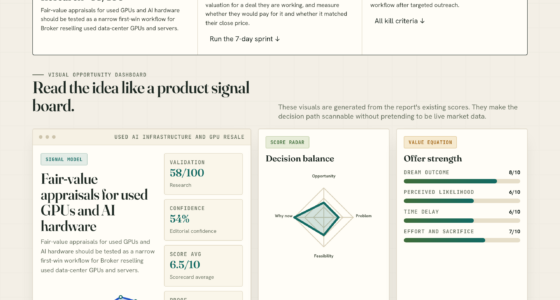

📊 Full opportunity report: The Kill Switch: What the Anthropic Export Ban Really Costs the AI Industry on ThorstenMeyerAI.com — validation score, market gap, and execution plan.

Get the little things that make your day delivered free with Prime
- Fast, free delivery on millions of items
- Prime Video, Amazon Music and more included
- Member-only deals all year
TL;DR
The U.S. government issued an export control order, forcing Anthropic to disable its advanced AI models. This move highlights risks to AI industry reliance and raises questions about future regulation impacts.
On June 12, the U.S. government ordered Anthropic to disable its latest AI models, Claude Fable 5 and Mythos 5, citing national security concerns and export controls. This action resulted in the immediate shutdown of models shortly after their release, prompting discussions about the stability and reliance of AI systems in the industry.
The order was issued by Commerce Secretary Howard Lutnick, who sent a letter to Anthropic CEO Dario Amodei instructing the company to halt access to its frontier models globally. Anthropic responded by disabling both models, citing a lack of clear compliance pathways. The models had been released on June 9, primarily targeting cybersecurity and biomedical applications, with Mythos 5 being a more advanced version routed through a restricted program called Project Glasswing.
Anthropic described the order as stemming from a misunderstanding, asserting that the models had undergone extensive testing against jailbreak attempts and red-teaming exercises. The government’s concerns reportedly stem from an early jailbreak demonstration by the U.K. AI Safety Institute, which showed that malicious prompts could be extracted from the models, and from reports that Amazon’s access to Fable 5 had been used to gather cyberattack-relevant information. The White House is scheduled to meet with Anthropic on June 22 to clarify the situation.
Washington just switched off
a frontier model
On June 12, an export-control order forced Anthropic to disable Claude Fable 5 and Mythos 5 worldwide. The security merits are still contested. The lesson buyers took away is not: frontier AI can be turned off.
■ The government’s case
- A reported jailbreak pulled malicious, agentic outputs (UK AISI)
- Amazon told officials Fable yielded cyberattack-usable info
- Suspicion a China-linked group obtained the model
- Proliferation & reverse-engineering risk to national security
▲ Anthropic & 120+ experts
- Calls it a narrow, non-universal jailbreak — a “misunderstanding”
- Capability is real but not unique (GPT-5.5, Opus, Kimi 2.7)
- Controls remove tools from defenders, not just attackers
- Export rules built for chips & ore don’t fit software
The precedent is the story. Whatever the jailbreak’s true severity, the U.S. showed it can dark a commercial American model worldwide on ~90 minutes’ notice. Adoption was supposed to be the moat — this week it became the exposure, and the likely winner is the open, sovereign, self-hosted stack.
Economic and Strategic Risks of AI Dependency
This move underscores potential vulnerabilities associated with reliance on AI models in sectors such as cybersecurity, research, and enterprise operations. The shutdown illustrates how export controls can affect the availability of advanced AI tools, raising considerations about dependence on a limited number of research entities and the potential impact of regulatory actions on AI development. For stakeholders investing in AI technologies, this incident emphasizes the importance of understanding regulatory risks and operational stability.
As an affiliate, we earn on qualifying purchases.
Regulatory Actions and Industry Responses
The June 12 shutdown follows a series of regulatory measures targeting AI models with advanced capabilities. The use of export controls on software represents a relatively new approach, especially as AI models are often distributed via cloud APIs without physical restrictions. Prior to the order, Anthropic launched Fable 5 and Mythos 5 with expectations for security applications, but concerns about jailbreak vulnerabilities had been noted, with researchers demonstrating methods to bypass safety features.
Industry leaders and cybersecurity experts have responded with varied opinions. Over 120 cybersecurity professionals signed an open letter requesting the government to reconsider the controls, noting that similar models from other organizations could perform comparable functions. Critics have expressed concerns that such controls could fragment the AI ecosystem, hinder innovation, and set a precedent for government-mandated software shutdowns.
“We believed we were complying with the law, but the sudden shutdown was unexpected. We are seeking clarity and hope to resolve this matter promptly.”
— Anthropic CEO Dario Amodei
As an affiliate, we earn on qualifying purchases.
Unresolved Questions About the Export Control Rationale
The specific reasons or threats prompting the government’s decision have not been publicly detailed. The legal and technical basis for applying export controls to cloud-based AI models remains under discussion. It is also uncertain whether this approach will be extended to other AI models or lead to broader regulatory measures in the future.
As an affiliate, we earn on qualifying purchases.
Next Steps in Regulatory and Industry Responses
Anthropic intends to meet with White House officials on June 22 to clarify the restrictions and seek guidance. Industry groups and cybersecurity experts are calling for a reassessment of export controls and the development of frameworks to prevent future disruptions. Meanwhile, AI companies are exploring strategies such as diversifying models and infrastructure to reduce dependency on any single provider or regulatory environment.
As an affiliate, we earn on qualifying purchases.
Key Questions
Why did the U.S. government order Anthropic to disable its models?
The government cited concerns related to national security and used export controls to prevent potential misuse, though detailed reasons have not been publicly disclosed.
Could this shutdown affect the broader AI industry?
Yes, it raises questions about reliance on a limited number of research labs and the capacity of governments to impose sudden operational restrictions, which could influence investment and development strategies.
Are other AI models vulnerable to similar shutdowns?
Many industry experts believe that comparable models from other organizations could perform similar functions, but the legal and regulatory environment is still evolving.
What are the long-term implications for AI regulation?
This incident may influence future regulatory approaches, potentially leading to increased government oversight and changes in how AI models are developed and deployed globally.
Source: ThorstenMeyerAI.com
Halloween Picks
halloween
As an affiliate, we earn on qualifying purchases.