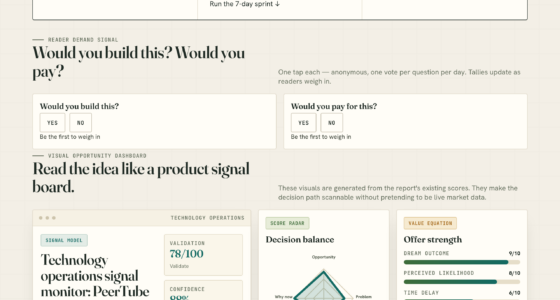

📊 Full opportunity report: The Internal Customer—Your Organization’s Hidden AI Hurdle on ThorstenMeyerAI.com — validation score, market gap, and execution plan.

Get the little things that make your day delivered free with Prime
- Fast, free delivery on millions of items
- Prime Video, Amazon Music and more included
- Member-only deals all year
TL;DR
Most enterprises have deployed AI but fail to see measurable ROI due to internal resistance and organizational challenges. Success depends on addressing internal customer buy-in and organizational change, not just technology.
Despite widespread deployment of AI in enterprises, most organizations are not achieving measurable ROI, primarily due to internal resistance and organizational barriers rather than technology limitations, according to recent industry analysis.
Data shows that between 72% and 88% of Fortune 500 companies now have at least one AI workload in production, with AI spending reaching an average of $11.6 million per enterprise in 2026. However, studies from MIT, McKinsey, and Morgan Stanley reveal that roughly 95% of AI pilots deliver zero immediate P&L impact, and only about 16% of initiatives scale beyond pilot phases.
The core issue is organizational dysfunction: unclear ownership, lack of success criteria, and failure to redesign workflows. Experts emphasize that 80% of the effort to move AI from pilot to production involves data engineering, governance, and organizational change—areas often neglected in initial deployments. Most data remains siloed, and resistance stems from fear, job security concerns, and political inertia within organizations.
Additionally, a significant portion of employees, especially Gen Z, admit to sabotaging AI initiatives due to fears of job loss, while many companies report data leaks from shadow AI tools. These internal dynamics create a hostile environment for AI adoption, making successful integration far more complex than technological capability alone.
Near-universal adoption, near-total value failure. The gap between spend and proof is the defining tension of enterprise AI in 2026.
Why Internal Resistance Halts AI Value Realization
The failure to fully adopt AI within organizations stems from internal resistance, not technical shortcomings. Addressing organizational and cultural barriers is essential for unlocking AI's potential and achieving ROI. This insight shifts focus from technology to change management, emphasizing the importance of internal customer engagement and organizational redesign in AI success.
As an affiliate, we earn on qualifying purchases.
Organizational Challenges in Enterprise AI Deployment
Since 2020, AI adoption has surged, with over 80% of Fortune 500 companies deploying AI tools. Despite this, studies indicate most projects do not deliver expected financial benefits, highlighting a disconnect between deployment and impact. The core issues involve organizational inertia, siloed data, and employee fears, which have persisted despite technological advances. Successful cases often involve partnerships and cross-functional teams that address both technical and organizational aspects.
"The real bottleneck was never the model. Around 80% of the work is organizational—data governance, workflows, and change management—yet most pilots neglect this."
— Thorsten Meyer
organizational change management tools
As an affiliate, we earn on qualifying purchases.
As an affiliate, we earn on qualifying purchases.
Unresolved Questions About Overcoming Internal Barriers
It remains unclear how effectively organizations can change internal culture and overcome fears to fully embed AI into workflows. The best practices for winning internal customer buy-in and redesigning organizational processes are still evolving, and success stories are often context-specific.
AI governance and data management solutions
As an affiliate, we earn on qualifying purchases.
As an affiliate, we earn on qualifying purchases.
Next Steps for Improving AI Adoption and Impact
Organizations need to focus on organizational change management, employee engagement, and workflow redesign. Developing frameworks that address internal resistance and foster collaboration between technical and business teams will be crucial. Future research and case studies will likely reveal more effective strategies for overcoming internal hurdles and scaling AI impact.
As an affiliate, we earn on qualifying purchases.
Key Questions
Why do most AI pilots fail to deliver ROI?
Most pilots fail because organizations neglect the organizational changes needed—such as workflow redesign, data governance, and change management—rather than issues with the AI models themselves.
What is the main internal challenge to AI adoption?
The primary challenge is resistance from employees and management due to fears of job loss, data security concerns, and political inertia within the organization.
How can companies improve internal AI acceptance?
Successful companies partner with cross-functional teams, involve employees early, address fears transparently, and redesign workflows to integrate AI seamlessly into existing processes.
Is technology the main obstacle to AI success?
No, the technology is capable; the main obstacles are organizational, cultural, and process-related barriers that hinder full adoption and value realization.
Source: ThorstenMeyerAI.com
Fall Picks
fall essentials
As an affiliate, we earn on qualifying purchases.