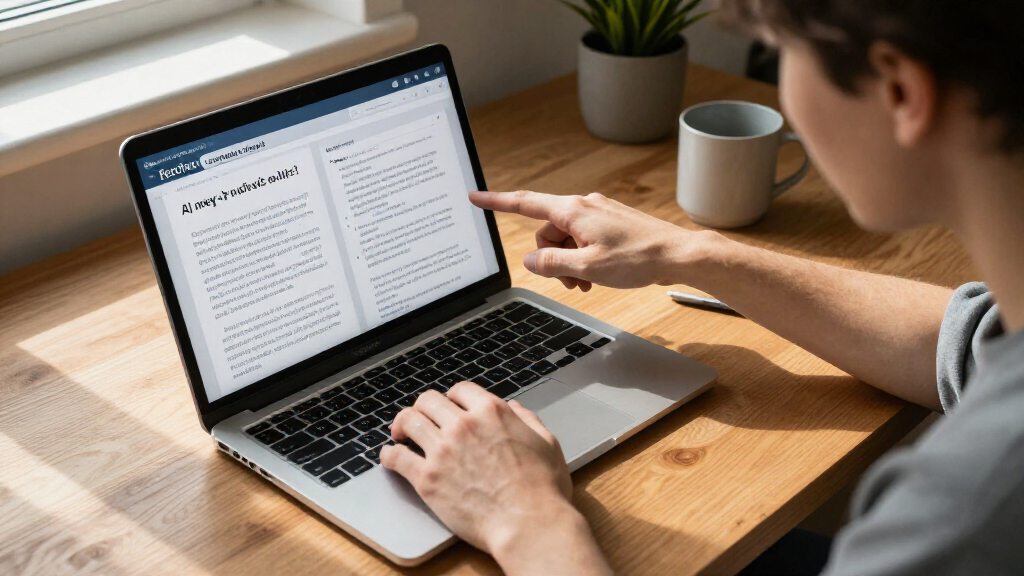
🔍 Read the full analysis: The Confidence Trick: How To Spot AI-Made-Up Information on ThorstenMeyerAI.com

Get the little things that make your day delivered free with Prime
- Fast, free delivery on millions of items
- Prime Video, Amazon Music and more included
- Member-only deals all year
TL;DR
A November 26, 2026, guide from ThorstenMeyerAI.com explains why language models can present plausible but false information as fact: they predict likely text, and many benchmarks reward correct answers without rewarding uncertainty. The guide recommends checking specific details, supplying source documents and testing AI systems on questions whose correct answer is “I don’t know.”
ThorstenMeyerAI.com published a guide on November 26 explaining why AI tools can deliver invented details in a confident tone and how users can check them. The report focuses on language models’ tendency to predict plausible text, and on evaluation systems that may reward a guess while giving little or no credit for admitting uncertainty.
The guide defines an AI hallucination as a plausible but false statement generated by a language model. It cites OpenAI’s definition and notes that the U.S. National Institute of Standards and Technology uses the term “confabulation” for confidently stated but erroneous or false content. In practical use, the distinction between a correct answer and a fabricated one may not be apparent from the wording alone.
As an example, the article describes research in which a model was asked for the birthday of one of the researchers and told to answer only if it knew. Across three attempts, it returned three different dates, all incorrect, according to the cited study. The example illustrates why names, dates, quotations, numbers and sources deserve particular scrutiny: plausible language does not establish that a detail is true.
The guide says language models generate text by predicting what words are likely to come next, based on patterns learned from text. That method can work well for common, patterned information, but it cannot reliably infer arbitrary details such as a person’s birthday from grammar or general knowledge. The article also points to benchmark scoring: if a test awards points for right answers but none for “I don’t know,” a model that guesses can score better than one that abstains, even if the guesser produces more false answers.
The Cost of Confident Guessing
AI-generated errors can move beyond a chat window. The guide identifies invented legal rulings, nonexistent software packages and false company policies as examples of where a fabricated answer could cause harm. A made-up citation can mislead someone researching a legal issue; an invented package name may expose a developer to security risks if an attacker registers it; and an inaccurate chatbot answer can create problems for customers and the business operating it.
The article says users should treat specific details in AI responses as claims to verify, not as established facts. For businesses, that means responsibility does not end when a chatbot is deployed. The guide refers to a Canadian tribunal case involving an airline chatbot, but does not provide enough detail here to establish the case’s circumstances or legal reasoning. Its broader point is that organizations can face consequences for information their customer-facing systems provide.
For readers, the risk is not limited to spectacular errors. A wrong date, quote or source can quietly undermine a report, a work decision or a customer interaction. The concern is heightened by the answer’s delivery: a calm, fluent response may sound as reliable as a verified one. Confidence in tone is not evidence of accuracy.
Products Worth Considering

Levoit Vital 100S-P Air Purifier with Washable Pre-Filter

Philips Sonicare 9900 Prestige Electric Toothbrush with 5 Brush Heads, Champagne

Hyperice Hypervolt 3 Percussion Massage Gun with Heated Head and Carry Case
As an affiliate, we earn on qualifying purchases.
Why Models Learn to Guess
The guide describes language models as systems trained to continue text, rather than as databases that attach a truth label to every sentence. It quotes OpenAI as saying that training data does not carry “true/false” labels for each statement. The model therefore learns patterns of fluent language, which often correspond to accurate information but do not guarantee it.
Assessment practices can reinforce the problem. The article cites research that examined 10 widely used benchmarks: nine reportedly gave no credit for a model saying it did not know, while one offered some partial credit. The guide compares this to a multiple-choice test where a blank answer scores no better than a wrong one. Under that incentive, guessing can improve a score even when it also creates more errors.
It also reports an OpenAI comparison on SimpleQA, a short factual-question test. In the figures cited, the older o4-mini answered correctly 24% of the time and incorrectly 75% of the time, while a newer model abstained in 52% of cases, answered correctly 22% and incorrectly 26%. These figures describe that particular test and model comparison; they do not establish how every AI system performs across other tasks.
“Awards 1 point for a correct answer and none for blanks or IDKs.”
— Researchers cited by ThorstenMeyerAI.com
Limits of the Evidence
The source material describes selected studies and tests, not a universal rate of AI hallucinations. The SimpleQA figures apply to the named models on that quiz and should not be read as a measure of performance in every setting. The guide also refers to an independent Artificial Analysis test, AA-Omniscience, but the supplied source text cuts off before giving its results. No conclusions about those results can be drawn from the material provided.
The article’s account of the Canadian airline tribunal case is brief. It does not name the tribunal, give the decision date or set out what the chatbot said, so those details remain unverified here. The guide also does not establish how much any one intervention—such as retrieval, improved training or a different benchmark—reduces hallucinations across products. It presents these as possible ways to help, each with limits.
Practical Checks Before Use
The guide recommends giving a model the material it should rely on, such as a document, and asking it to answer only from that source. Users should then check the cited passages and verify key names, numbers, dates, quotations and links independently. Asking the same question again can reveal inconsistent answers; if the response changes, the article advises treating both versions as unchecked rather than choosing the more confident one.
Businesses deploying customer-facing chatbots should test questions where the correct response is “I don’t know”, the guide says. Developers should confirm that a suggested software package exists and is trustworthy before installing it. These steps can help catch errors, but they do not prove that an answer is correct or remove the need for human review.
The broader development to watch is whether AI evaluations give systems credit for calibrated uncertainty, not just correct answers. The source article argues that incentives matter, but provides no timetable for changes to benchmark design or product behavior. Until those practices are clearer, readers should verify consequential claims before relying on them.
Key Questions
What is an AI hallucination?
It is a plausible but false answer produced by an AI language model. The response may sound confident even when its details are wrong.
Why does AI make up details?
Language models generate likely next words based on learned patterns. That can produce fluent answers without confirming that each claim is true, especially for arbitrary or uncommon facts.
How can I check an AI answer?
Verify specific names, dates, numbers, quotations and sources. When possible, provide the source document and ask the model to answer only from it, then check the relevant passages yourself.
Does asking the same question twice prove which answer is right?
No. If answers differ, that is a warning that they need checking; repetition does not establish which version is accurate.
Can a better or newer model still hallucinate?
Yes. The guide says factual knowledge and recognizing when to abstain are different abilities. Its cited test comparison suggests that a model may give fewer wrong answers by saying “I don’t know” more often, but results depend on the model and test.
Source: ThorstenMeyerAI.com