
🔍 Read the full analysis: 10 Best NVMe SSDs For AI Data Workloads And HPC In 2027 on ThorstenMeyerAI.com

Get the little things that make your day delivered free with Prime
- Fast, free delivery on millions of items
- Prime Video, Amazon Music and more included
- Member-only deals all year
TL;DR
The supplied source names 10 NVMe SSD models and discusses trade-offs such as sustained writes, capacity, thermals and cost. It does not provide the workload-specific benchmarks, full specifications or independent verification needed to establish that these are the best drives for AI data workloads and HPC in 2027.
A buyer’s guide attributed to ThorstenMeyerAI.com lists 10 NVMe SSDs for AI data workloads and high-performance computing, naming the Samsung 990 PRO 2TB as its overall pick and the Kingston NV3 1TB as a budget option, as detailed in the original analysis. The supplied material describes general storage trade-offs, but does not include the model-by-model benchmark results or full technical evidence needed to verify the ranking for AI or HPC use.
The guide says its selection weighs sustained sequential performance, random read and write operations, thermal throttling, endurance ratings and warranty terms, considerations also relevant to NVMe SSDs for AI. It warns that peak speeds can overstate performance during long transfers, particularly on smaller drives after their SLC cache is exhausted. It also says 1TB models may slow more noticeably than 2TB or 4TB versions during large transfers, a concern for AI data storage.
The named recommendations include the Samsung 990 PRO 2TB, Kingston NV3 1TB, Samsung 9100 PRO and SanDisk Optimus 5100. The source characterizes the 990 PRO as a balance of speed and power efficiency, the NV3 as a lower-cost PCIe 4.0 option, the 9100 PRO as more power-efficient for laptops, and the Optimus 5100 as a DRAM-less drive aimed at general users.
The material also names a Bestoss 1TB drive, described as having an integrated heatsink, but does not provide a complete, clearly itemized list of all 10 products in the text supplied. Model specifications, prices, test conditions and measured results are absent, limiting comparisons among the picks.
The 10 picks
- 1
 Samsung 990 PRO 4TB PCIe 4.0 NVMe M.2 2280 SSDView on Amazon →
- 2
 Gigastone Game Turbo 4TB M.2 NVMe PCIe 4.0 Internal SSDView on Amazon →
- 3
 Gigastone 1TB Game Turbo PCIe Gen4x4 M.2 NVMe SSD (2-Pack)View on Amazon →
- 4
 Samsung 9100 PRO 2TB Internal SSDView on Amazon →
- 5
 Samsung 990 PRO 2TB PCIe 4.0 M.2 2280 NVMe SSDView on Amazon →
- 6
 Bestoss 1TB PCIe 4.0 NVMe M.2 2280 SSD with HeatsinkView on Amazon →
- 7
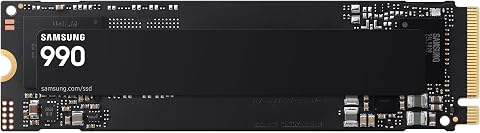 Samsung 990 1TB PCIe 4.0 NVMe Internal SSDView on Amazon →
- 8
 SanDisk Optimus 5100 1TB NVMe SSD, PCIe 4.0, M.2 2280View on Amazon →
- 9
 Kingston NV3 1TB M.2 2280 PCIe 4.0 NVMe SSDView on Amazon →
- 10
 SanDisk Optimus 5100 500GB NVMe SSD, PCIe 4.0, M.2 2280View on Amazon →
Matching SSDs to AI and HPC Loads
Storage can affect how quickly a system reads datasets, stages training jobs, loads checkpoints and moves results. For those tasks, a drive’s behavior during sustained transfers and concurrent access can matter more than its advertised peak sequential speed. Capacity, endurance and cooling also influence whether a drive can keep pace with frequent large writes.
But an SSD recommendation for gaming or creative work does not automatically establish suitability for AI or HPC. The source offers general selection criteria rather than workload-specific results such as latency under queue depth, sustained throughput, performance during mixed reads and writes, or endurance under repeated dataset and checkpoint activity. Readers should treat its list as a starting point, not a validated performance ranking for compute clusters.
Products Worth Considering

Garmin Venu X1 GPS Smartwatch, 51 mm, Black

Withings Sleep Tracking Pad

Therabody Theragun Relief Massage Gun, 3-Speed, Navy
As an affiliate, we earn on qualifying purchases.
The Criteria Behind the List
The guide argues that PCIe generation affects available bandwidth and says buyers should check motherboard support. It describes PCIe 4.0 as a practical fit for many systems and notes that PCIe 5.0 drives can need more effective cooling. Actual compatibility and performance depend on the host system and the M.2 slot; the supplied text does not document testing on specific platforms.
It also distinguishes drives with DRAM cache from DRAM-less designs that use Host Memory Buffer technology. The source presents DRAM models as a safer option for heavier multitasking, while describing DRAM-less drives as suitable for lighter use or secondary storage. Those are broad buying guidelines, not measured conclusions for the named products in AI or HPC systems.
Evidence Missing From the Rankings
The supplied material does not show benchmark tables, test methods, prices or a complete 10-drive breakdown. It also does not establish when the products were tested, which capacities were compared, or whether results came from AI and HPC workloads rather than general computing. The claim that the Samsung 9100 PRO is a generational improvement in power efficiency is not accompanied by comparative measurements in the provided text.
It is also unclear whether the listed models and specifications remain current for 2027. Buyers should verify each drive’s interface, capacity-specific endurance, warranty, cooling requirements and availability with manufacturers or retailers before purchasing. No source statements or direct quotations were supplied, so none are presented as quotes here.
Verify Models Before Buying
The next step for readers is to compare current manufacturer specifications and independent tests for the exact capacity they plan to buy. For AI and HPC deployments, useful evidence would include sustained throughput, mixed-workload latency, thermal behavior and write endurance measured on a comparable host system. Prices and warranty coverage should also be checked at the time of purchase.
Until those details are available, the source’s recommendations remain general guidance rather than a verified 2027 ranking for AI data workloads. A fuller assessment would need to identify all 10 drives, disclose test conditions and show results for the storage tasks the title promises to address.
Key Questions
Which SSD does the source name as its overall pick?
The source names the Samsung 990 PRO 2TB as its overall choice, citing speed and power efficiency. The supplied text does not provide benchmark data to independently verify that ranking.
Is the Kingston NV3 presented as an AI or HPC benchmark winner?
No. The source describes the Kingston NV3 1TB as a budget PCIe 4.0 option and warns that sustained write speed may fall after its SLC cache is exhausted. It does not provide AI- or HPC-specific test results.
Why does drive capacity matter for sustained performance?
The guide says 1TB drives may slow more during large transfers than 2TB or 4TB versions. The supplied material gives no model-by-model measurements or test conditions for that comparison.
Does the source provide all 10 picks and their specifications?
No. The text names several models, including Samsung, Kingston, SanDisk and Bestoss products, but does not provide a complete, itemized list of 10 drives with specifications, prices and test results.
Source: ThorstenMeyerAI.com