
📊 Full opportunity report: Micro-agency Proposal Scope Checker on IdeaNavigator AI — validation score, market gap, and execution plan.

Get the little things that make your day delivered free with Prime
- Fast, free delivery on millions of items
- Prime Video, Amazon Music and more included
- Member-only deals all year
TL;DR
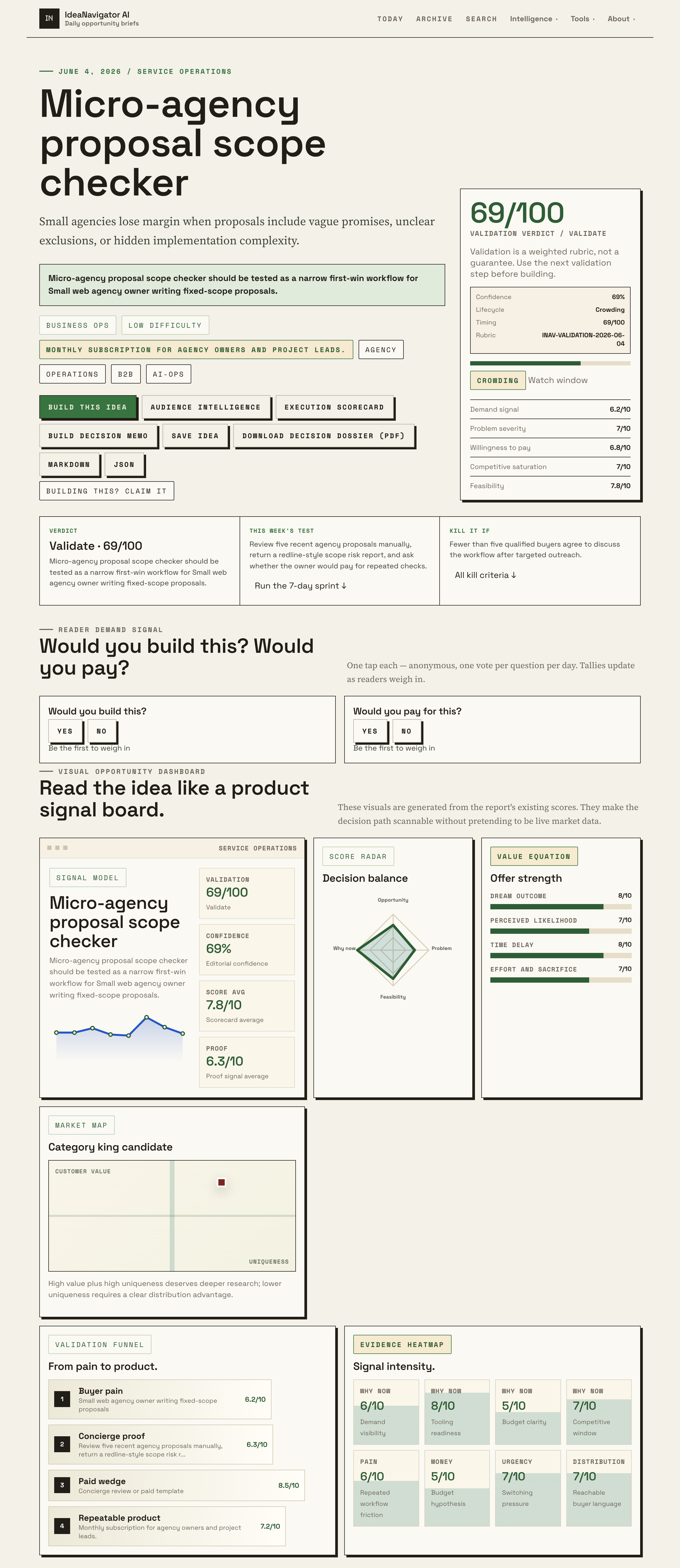
A new AI-powered scope checker is being tested for small web agencies to flag vague deliverables and risky integrations in proposals. The tool aims to reduce scope creep and improve margins. Its effectiveness is under evaluation through manual proposal reviews.
IdeaNavigator AI is beginning a pilot test of a proposal scope checker designed specifically for small web agencies. The tool aims to help agencies identify scope risks such as vague deliverables, missing assumptions, and risky integrations before proposals are sent to clients. This development could address common margin erosion caused by unclear proposals and scope creep.
The scope checker is intended as a lightweight, MVP-style tool that allows agency owners to upload draft proposals. It then highlights potential issues such as vague language, missing assumptions, and risky technical requirements, offering suggested exclusions to clarify scope.
According to IdeaNavigator AI, the initial validation involves manually reviewing five recent agency proposals, generating redline-style reports that pinpoint scope risks. The goal is to determine whether agency owners would be willing to pay for repeated checks based on these reports. The tool is planned to operate on a monthly subscription model targeted at small web agencies and project leads.
Potential Impact on Small Web Agencies’ Profit Margins
This tool could significantly improve profit margins for small web agencies by reducing scope creep and clarifying project boundaries early in the proposal process. Clearer proposals can prevent costly misunderstandings and rework, which are common issues in service-based projects. If successful, this AI-driven approach could set a new standard for proposal management in the industry, especially for small teams lacking extensive legal or project management resources.Products Worth Considering

Withings Sleep Under-Mattress Sleep Tracking Pad

Therabody TheraFace Cordless LED Light Therapy Mask

Garmin Forerunner 970 GPS Running and Triathlon Smartwatch, 47mm, Carbon Gray DLC Titanium with Black/Whitestone Band
As an affiliate, we earn on qualifying purchases.
Background on Proposal Risks and AI in Service Operations
Small web agencies often struggle with scope management, as vague proposals can lead to margin erosion and client disputes. Currently, many rely on manual reviews and experience to identify scope issues, but this process is time-consuming and inconsistent. AI tools targeting scope clarity are emerging as potential solutions, with some startups exploring automation to improve proposal accuracy and risk assessment. The pilot by IdeaNavigator AI represents an early attempt to systematically address these challenges through automation, focusing on fixed-scope proposals common among small agencies.“The ability to flag scope risks before proposals are finalized could be a game-changer for small agencies struggling with margins.”
— an anonymous researcher
Unconfirmed Aspects of the Scope Checker’s Effectiveness
It is not yet clear how accurately the tool will identify scope risks or how agency owners will perceive its usefulness after initial testing. The effectiveness of the redline reports and whether they will lead to increased adoption or willingness to pay remains to be seen. Additionally, the scope of issues the tool can detect and its integration into existing proposal workflows are still under development.
Next Steps in Pilot Testing and Validation
IdeaNavigator AI plans to complete the manual review of five proposals and gather feedback from participating agencies. Based on this, further iterations of the tool will be developed, and broader testing may follow. The company aims to determine whether the scope checker can become a recurring revenue product and how it can be integrated into standard proposal processes for small agencies.
Key Questions
How does the scope checker identify scope risks?
The tool compares draft proposals against reusable delivery checklists to flag vague language, missing assumptions, risky integrations, and suggest exclusion language.
Who is the target user for this tool?
Small web agency owners and project leads who produce fixed-scope proposals are the primary target users.
Will this tool replace manual proposal reviews?
It is intended as an assistive tool to augment manual reviews, not replace human judgment entirely.
What is the pricing model for the scope checker?
The tool will operate on a monthly subscription basis, targeting small agencies and project teams.
When will the full version be available?
The pilot phase is ongoing; a broader rollout depends on initial testing outcomes, likely within the next few months.
Source: IdeaNavigator AI