
📊 Full opportunity report: Tracking Changes In Symptoms And Labs During TRT on IdeaNavigator AI — validation score, market gap, and execution plan.

Get the little things that make your day delivered free with Prime
- Fast, free delivery on millions of items
- Prime Video, Amazon Music and more included
- Member-only deals all year
TL;DR
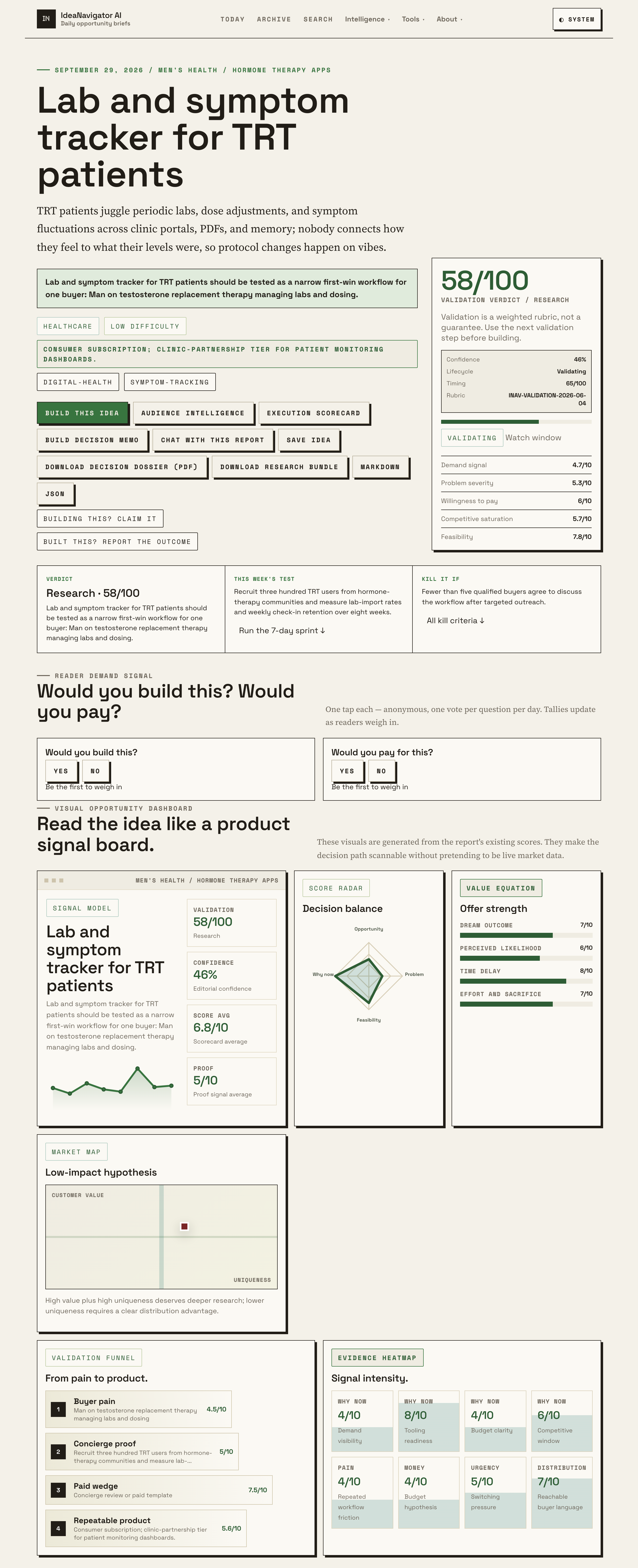
IdeaNavigator AI has outlined a proposed tracker for men managing testosterone replacement therapy, pairing imported lab results and dose changes with daily symptom check-ins. The proposal describes a possible product and an eight-week user study, but reports no app launch, completed trial or clinical findings.
IdeaNavigator AI has outlined a proposed app for men managing testosterone replacement therapy (TRT) that would bring lab results, dose changes and daily symptom reports into one timeline. The concept addresses fragmented recordkeeping, but the published outline does not report a launched product, clinical evaluation or user-study results.
According to IdeaNavigator AI’s published proposal, the tracker would let users import lab-test PDFs and chart hormone measurements over time alongside changes to their prescribed dose. The outline also proposes daily symptom check-ins, with the aim of giving patients and clinicians a shared record to review during appointments. IdeaNavigator AI describes the intended user as a man on TRT managing labs and dosing.
The proposal says the app could generate trend summaries for clinic visits and flag results that move outside selected target ranges. It does not specify which laboratory measures would be included, how target ranges would be set, or whether clinicians would review flagged results. Those details would affect how the product works in practice.
IdeaNavigator AI proposes a two-part business model: a consumer subscription and a clinic partnership tier with patient-monitoring dashboards. To test demand, the outline suggests recruiting 300 TRT users from hormone-therapy communities and tracking lab-import rates and weekly check-in retention over eight weeks. This is a suggested validation plan; the source reports no recruitment or study results.
A Record for TRT Appointments
The idea targets a practical recordkeeping problem: a patient may have lab results, dosing instructions and symptom notes spread across clinic portals, PDF files and personal memory. Putting those records together could make it easier to describe changes over time and prepare questions for a clinician. Whether it improves care or saves appointment time has not been established.
Linking symptoms with test results and dose history could give patients and clinicians a more organized account of what changed and when. But a chart showing that events occurred together would not, by itself, establish that a dose change caused a symptom or that a particular lab value explains how someone feels. The proposal offers a way to organize information; it provides no evidence of clinical benefit.
The clinic dashboard could also change who sees the information and how it is handled. The outline does not describe clinician workflows, privacy protections, data-sharing controls or how the product would fit alongside existing medical records. Those questions matter to patients considering a subscription and to clinics weighing a partnership.
The Proposed Eight-Week Test
IdeaNavigator AI frames the tracker as a narrow first product for one user group: men already receiving TRT who manage recurring labs and dosing. Its description says care can be spread across providers and digital records, leaving patients to piece together how they feel and what their test results showed. That is the problem the proposed timeline is meant to address.
The suggested test in IdeaNavigator AI’s outline would recruit 300 people from hormone-therapy communities and observe two measures over eight weeks: how often participants import lab results and whether they continue weekly symptom check-ins. These measures could show whether people use the core features during the test period. They would not, on their own, show that the app changes treatment decisions or health outcomes.
The proposal places the product in the men’s health and hormone-therapy app market and suggests both direct subscriptions and clinic partnerships. It does not provide market-size figures, pricing, named clinic partners or evidence of existing demand. No individual researchers, clinicians or patients are quoted in the outline.
Clinical and Product Questions
IdeaNavigator AI’s published outline does not identify a released app, development team, launch schedule or participating clinic. It also gives no completed user research, retention figures, patient testimonials or clinical results. The 300-person, eight-week study is a proposed way to assess use, not evidence that testing has begun.
Several product and clinical details remain open. The proposal does not explain which hormone tests would be charted, how imported PDFs would be checked for errors, who would define target ranges, or how alerts would be reviewed. It also does not say how the app would distinguish a symptom pattern from a cause, or what users should do if a result is flagged.
Data handling is another unanswered issue. The concept does not describe how sensitive health records would be stored, whether users could control clinic access, or what safeguards would apply to a clinic dashboard. Pricing and partnership terms are also unspecified. No claims about safety, effectiveness or regulatory status are supported by the published outline.
Validation Before Wider Claims
IdeaNavigator AI’s proposed next step is an eight-week test with 300 TRT users, measuring lab imports and weekly check-in retention. The outline includes no start date, recruitment notice or results, so it is not clear whether the test will take place. If conducted, reporting the number of participants who complete the study and how the measures are calculated would help readers interpret the findings.
Before the tracker could be assessed as a clinic tool, further details would be needed about PDF accuracy, range selection, patient consent, data access and clinician review. Any claims that the product improves treatment decisions or patient outcomes would require evidence beyond usage metrics. For now, the proposal describes a product direction and a possible way to test whether patients keep using it.
Source: IdeaNavigator AI
Key Questions
Has the TRT tracker launched?
The published outline describes a proposed app. It gives no launch date and does not say that a product is available.
What would the tracker record?
The proposed features include lab PDF imports, dose changes and daily symptom check-ins, shown together over time. The outline does not specify which lab measures would be supported.
Has the suggested user study started?
No start or completion is reported. IdeaNavigator AI proposes recruiting 300 TRT users for eight weeks and measuring lab-import rates and weekly check-in retention.
Would the app tell patients how to change a dose?
The outline describes tracking, trend summaries and flags for results outside target ranges. It does not say the app would recommend dose changes, and it reports no clinical testing.
How would clinics and patients pay for it?
The suggested model combines a consumer subscription with a clinic partnership tier. No prices, participating clinics or terms are provided.
Source: IdeaNavigator AI
Fall Picks
fall essentials
As an affiliate, we earn on qualifying purchases.