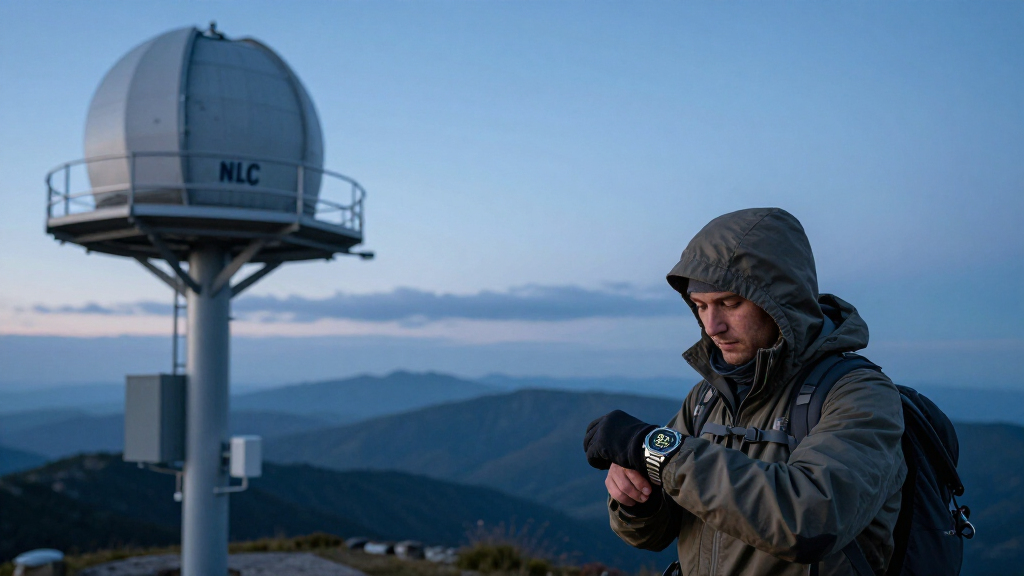

🔍 Read the full analysis: An AI Take On The Twilight Dial Behind NLC Watch At 83 Km on ThorstenMeyerAI.com

Get the little things that make your day delivered free with Prime
- Fast, free delivery on millions of items
- Prime Video, Amazon Music and more included
- Member-only deals all year
TL;DR
ThorstenMeyerAI.com describes “Noctilucent — NLC Watch at 83 km,” an AI-built exhibition website about real high-altitude clouds, as a fictional project—not a real company or scientific service. Its central feature is a solar-depression dial that changes the page’s lighting and illustrations to show how clouds can remain sunlit after the ground is dark.
ThorstenMeyerAI.com has presented “Noctilucent — NLC Watch at 83 km”, an AI-built exhibition website that uses an interactive twilight dial to explain how real noctilucent clouds can remain illuminated after the ground below has entered darkness, as detailed in the original analysis. The site describes itself as a fictional field journal for an invented observing project, not a real company, monitoring network or live scientific service.
The exhibit’s central control represents the Sun’s position below the horizon. According to the source, the dial covers a range of six to sixteen degrees below the horizon, with the page’s most expressive lighting near eleven degrees. Adjusting it changes several visual elements together, including sky brightness, shadow depth, cloud glow, ambient color, grain and horizon flare. The accompanying diagrams and explanatory text also reflect the selected state.
The page presents its visuals as browser-generated rather than photographic. Canvas produces the twilight sky, stars and layered cloud paths; inline SVG supplies diagrams and an altitude illustration, while CSS adds visual details such as grain and light rays. The source says different illustrated cloud forms use different patterns: billows have tighter crests, whirls bend into polar shapes, and bands move in broader waves.
A later interaction asks visitors to hold a control as ground-level haze recedes and a cloud band at 83 kilometres becomes clearer. Releasing early allows the apparent sighting to fade. The source says the interaction supports pointer, keyboard and touch-like input. The article also describes reduced-motion and visibility-aware behavior: animation is simplified for visitors who request less motion and pauses when the page is hidden.
How the Twilight Dial Teaches
The exhibit turns a scientific idea into an interaction: a change in the Sun’s position below the horizon alters the page’s depiction of which parts of the sky are illuminated. Rather than presenting twilight as a fixed background, the dial links the lighting model, diagrams and written explanation. That gives visitors a visual way to explore the contrast between a dark observer’s surroundings and clouds that can still catch sunlight at high altitude.
That approach also makes the distinction between real atmospheric science and invented project details important. The clouds are real, but the observing network, station logs and field-journal framing are fictional. The site should not be mistaken for a source of current sightings, forecasts or verified observations. Its value, as described in the source, is educational and design-focused rather than operational.
interactive astronomy educational kit
As an affiliate, we earn on qualifying purchases.
As an affiliate, we earn on qualifying purchases.
A Fictional Watch, Real Clouds
Noctilucent clouds are high-altitude ice clouds. The source explains the core phenomenon in straightforward terms: they can remain sunlit after the ground below has fallen into darkness. The exhibit uses that relationship as the basis for its twilight geometry, depicting sunlight grazing the shadowed Earth and reaching ice high above it. The stated altitude in the project title and visual concept is 83 kilometres.
The source frames the page as room 162 in a series of 175 exhibition projects and presents a three-pass design process: build the working page, critique it for clarity and interaction, then conduct an art-director review. It says the accompanying design guide documents elements such as the lighting model, procedural graphics and animation behavior. These details describe the project’s design process; the source does not provide an independent evaluation or external verification of the claimed reviews.
The visual direction contrasts electric blue and violet with a cream-colored field-log section. The source says Manrope is used for general reading and Major Mono Display for coordinates and measurements. It also describes invented station logs and observation-calendar material as parts of the exhibition concept, not as records from real observers.
““Noctilucent — NLC Watch at 83 km” is an AI-built exhibition piece: a fictional field journal for a fictional observing project, not a real company or live scientific service.”
— ThorstenMeyerAI.com
high-altitude cloud observation telescope
As an affiliate, we earn on qualifying purchases.
As an affiliate, we earn on qualifying purchases.
What the Exhibit Does Not Verify
The source does not identify a publication date, provide independent scientific review of the explanations, or link the exhibit to a real observing organization. It also does not establish that the invented station logs or any specific cloud sightings correspond to actual observations. The page is explicitly described as fictional, so its project names and field-journal details should not be treated as evidence of live monitoring.
The source describes the intended interactions and rendering methods, but it does not provide independent performance testing, accessibility audit results or evidence that the site works identically across devices. No visitor numbers, scientific outcomes or measured educational effects are reported. The specific accuracy of individual diagrams and explanatory passages beyond the stated general phenomenon is not independently assessed in the supplied material.
As an affiliate, we earn on qualifying purchases.
The Design Guide and Live Page
The source directs readers to the live exhibition page and a separate design guide with implementation notes. Those materials are the next places to inspect the dial, diagrams and interactions directly. The source does not announce a launch date, a scientific observing schedule or plans to turn the fictional project into a real monitoring service.
Any later claims about sightings, data collection or an operational NLC network would need separate confirmation from identifiable scientific or institutional sources. For now, the confirmed development is the presentation of an AI-built design exhibit that uses a fictional observer’s framework to illustrate a real atmospheric phenomenon.
solar-depression dial astronomy model
As an affiliate, we earn on qualifying purchases.
As an affiliate, we earn on qualifying purchases.
Key Questions
Is NLC Watch at 83 km a real cloud-monitoring service?
No. ThorstenMeyerAI.com describes it as an AI-built fictional exhibition, not a real company, observing network or live scientific service.
What are noctilucent clouds?
They are high-altitude ice clouds that can remain illuminated after the ground below is dark. The exhibit uses that contrast to explain its twilight concept.
What does the solar-depression dial change?
It represents the Sun’s position from six to sixteen degrees below the horizon. According to the source, changing the dial updates the page’s sky lighting, cloud glow, shadows, color and related diagrams and text.
Are the station logs and sightings real?
The project describes its observing project and station framework as fictional. The source does not verify the logs as real observations, so they should be read as part of the exhibit rather than live sighting reports.
Where can readers find more detail about how it was made?
ThorstenMeyerAI.com points to a live version of the exhibit and a design guide describing its lighting model, procedural graphics and animation behavior. The supplied material does not include independent performance or scientific validation.
Source: ThorstenMeyerAI.com
Halloween Picks
halloween
As an affiliate, we earn on qualifying purchases.