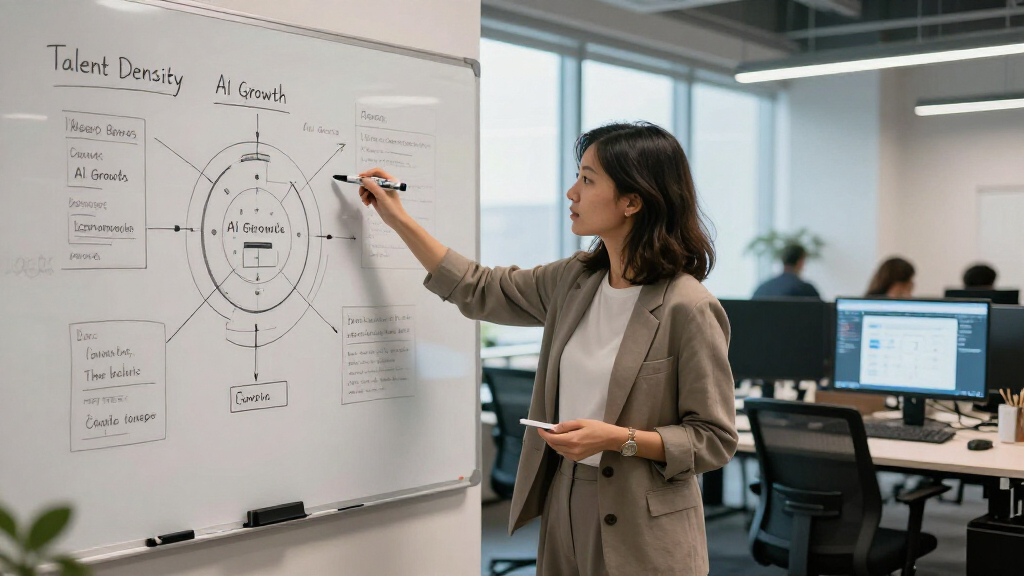

📊 Full opportunity report: Understanding Talent Density To Accelerate AI Growth on ThorstenMeyerAI.com — validation score, market gap, and execution plan.

Get the little things that make your day delivered free with Prime
- Fast, free delivery on millions of items
- Prime Video, Amazon Music and more included
- Member-only deals all year
TL;DR
AI has amplified the impact of talent density, enabling small, high-performing teams to outperform traditional organizations by significant margins. This shift is redefining productivity metrics and company scalability in the AI economy.
AI-driven companies in 2026 are achieving unprecedented revenue per employee metrics, with some reaching up to $4.7 million per employee, a significant increase from traditional software benchmarks. This shift is rooted in the strategic focus on talent density—concentrating high performers equipped with AI tools—transforming organizational productivity and scale.
Recent data shows AI-native firms like Midjourney, Cursor, Gamma, and Lovable generating revenue figures that exceed those of traditional software companies. For example, Midjourney, with about 100 employees, generates roughly $500 million annually, equating to nearly $4.7 million per employee. Similarly, Cursor’s $2 billion annualized revenue with a team in the low hundreds results in about $3.3 million per employee. These figures reflect a shift in how productivity and organizational scale are measured in the AI era.
This evolution is driven by two key factors: first, AI’s ability to automate functions like customer support, content creation, and sales reduces headcount needs; second, the concept of talent density—small, trusted teams of highly capable individuals—becomes a new operational mode. Such teams require less coordination, make faster decisions, and leverage AI to enhance their capabilities, enabling organizations to operate at a scale previously difficult to achieve.
For a decade, revenue per employee was stable and boring. AI-native companies posted figures that don’t fit on the same chart — a 10-to-38× break.
Implications of Talent Density for AI-Driven Business Growth
This shift has implications for organizational efficiency and scalability. Companies that effectively utilize talent density combined with AI tools may outperform larger traditional firms, potentially influencing industry competitiveness. The ability for small teams to generate substantial revenue challenges traditional notions of company size and workforce requirements, opening new opportunities for startups and established companies alike.
Investors are increasingly considering revenue per employee as a key metric, reflecting the importance of dense, high-performing teams in AI-powered organizations. This trend may influence innovation cycles and scaling strategies, while also raising questions about talent acquisition and retention in this evolving landscape.
ergonomic laptop stand for remote work
As an affiliate, we earn on qualifying purchases.
As an affiliate, we earn on qualifying purchases.
The Evolution of Productivity Metrics in the AI Era
Over the past decade, revenue per employee has been a standard metric for assessing software companies, with median SaaS firms generating around $130,000 per employee. Large companies like Salesforce and Google employed tens of thousands of workers to reach billions in revenue. In contrast, AI-native companies like Midjourney and Gamma have achieved comparable or higher revenue with a smaller workforce. For example, Midjourney's $500 million revenue with 100 employees represents a substantial increase over traditional benchmarks.
This change is partly due to AI automating functions previously handled by entire departments, and partly because high talent density—small, highly capable teams—has become a new operational approach. These teams rely on deep customer understanding, domain expertise, and fluency with AI capabilities, which together can replace larger organizational structures.
"Talent density, combined with AI, is enabling small teams to operate at scales that previously required thousands of employees."
— Thorsten Meyer
high performance AI developer keyboard
As an affiliate, we earn on qualifying purchases.
As an affiliate, we earn on qualifying purchases.
Uncertainties Around Long-Term Sustainability and Metrics
The long-term sustainability of these high revenue per employee figures remains uncertain, particularly given their basis on recent growth rates and revenue estimates. There are questions about how talent acquisition and retention will evolve as demand for high-level AI skills increases. Additionally, the specific point at which talent density becomes a distinct operational mode is still being studied, and the applicability of these models across different industries is not yet fully established.
professional noise-canceling headphones for coding
As an affiliate, we earn on qualifying purchases.
As an affiliate, we earn on qualifying purchases.
Future Developments in Talent Density and AI Integration
Anticipate continued growth in AI-native companies demonstrating high revenue per employee, with more organizations adopting talent density principles. Investors and managers will likely refine metrics and strategies to optimize small, high-performing teams, while ongoing research explores the limits and best practices of this approach. Monitoring talent acquisition trends and organizational adaptations will be important to understanding the full impact of this shift.
ergonomic backpack for tech professionals
As an affiliate, we earn on qualifying purchases.
As an affiliate, we earn on qualifying purchases.
Key Questions
What exactly is talent density?
Talent density refers to the concentration of high-performing, skilled individuals within a small, trusted team, supported by AI tools that enhance their capabilities and reduce coordination overhead.
How does AI contribute to increased revenue per employee?
AI automates functions that previously required entire departments, enabling small teams of specialists to manage tasks at scale, which can lead to higher revenue per employee.
Are these high revenue per employee figures sustainable?
The sustainability of these figures is uncertain, as many are based on recent growth rates and revenue estimates. Long-term stability will depend on market conditions, talent retention, and technological developments.
Will talent density replace traditional organizational structures?
While talent density offers advantages, it is unlikely to completely replace large organizational structures across all industries. Instead, it represents a different operational approach suited to contexts where high skill levels and AI leverage are essential.
Source: ThorstenMeyerAI.com
Halloween Picks
halloween
As an affiliate, we earn on qualifying purchases.