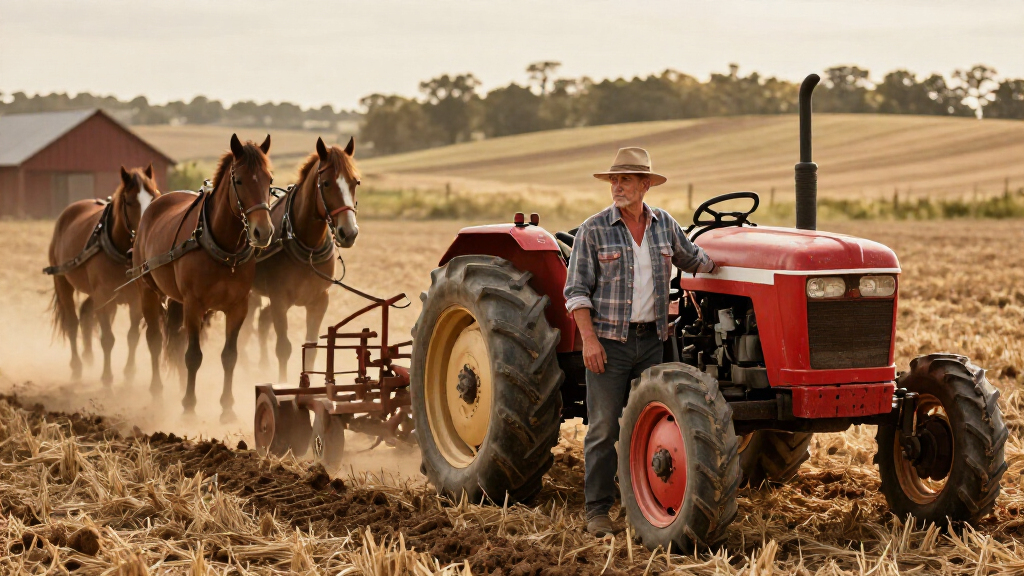

🔍 Read the full analysis: The Move From Horse-Powered Farms To Tractors on ThorstenMeyerAI.com

Get the little things that make your day delivered free with Prime
- Fast, free delivery on millions of items
- Prime Video, Amazon Music and more included
- Member-only deals all year
TL;DR
U.S. farm horses and mules peaked at 26.7 million in January 1918, then fell to 3.1 million by 1960 as tractors and other machinery spread. The shift freed cropland used to grow animal feed and sharply reduced farm employment, while the U.S. labor force grew and work increasingly moved to cities. The historical comparison is often used to discuss automation, but it does not establish what will happen to workers today.
U.S. farms went from 26.7 million working horses and mules in January 1918 to 3.1 million in 1960, as tractors and other machinery took over farm work, according to historical figures reviewed in a November 4 report by ThorstenMeyerAI.com. The change reshaped how land and labor were used, and the report says it remains a useful—but limited—comparison in debates about automation and jobs.
The animals were a large part of the farm economy, not just a source of power in the fields. In 1915, about 93 million acres of harvested U.S. cropland—more than a quarter of the total—grew feed for horses and mules. The cited historical statistics put the total harvested crop area that year at 340 million acres. By 1920, about 90 million acres were still devoted to feed.
Tractor numbers rose rapidly over the following decades. The report gives about 1,000 tractors on U.S. farms in 1910, 246,000 in 1920 and 4.69 million in 1960. Around 1955, tractors outnumbered horses and mules: 4.35 million compared with 4.31 million. By 1960, the working-animal count had fallen by almost 90% from its 1918 peak.
Mechanization extended beyond tractors. Combine harvesters, which cut, thresh and clean grain in one pass, increased from about 4,000 on U.S. farms in 1920 to 1.042 million in 1960, according to the report. The U.S. Department of Agriculture estimated that each farm worker supplied 7.1 people in 1910 and 47.1 in 1970; the latter figure includes people abroad supplied by exports.
How Mechanization Changed Farm Work
The figures show that the transition was not simply a change in equipment. It altered the amount of land needed to power agriculture and the number of people required to produce food. The report says land devoted to horse and mule feed fell from 93 million acres in 1915 to about 5 million acres in 1960, allowing that land to be used for other crops.
Farm employment also contracted. The report cites a peak of 13.6 million U.S. farm workers in 1916, falling to 4.5 million by 1970, while the overall U.S. labor force doubled. It describes new work as increasingly city-based, meaning the shift involved migration as well as changes to jobs on farms. These numbers describe a long economic transformation; they do not show that every displaced farm worker moved directly into a new job.
The episode matters to current automation debates because it offers a concrete case of machines replacing a major form of work. But it is historical evidence, not a forecast: the effects on people depended on new industries, migration and broader economic changes, not machinery alone.
Products Worth Considering

Blueair Blue Pure 511i Max Air Purifier

Therabody Theragun Prime 6th Generation Deep Tissue Massage Gun, Navy

Therabody Theragun Mini 3rd Gen Massage Gun (Travel Essential, Black)
As an affiliate, we earn on qualifying purchases.
From Fordson to Farm Machinery
Gasoline tractors existed before World War I, but the source says early models were heavy, expensive and better suited to large farms. Ford introduced the Fordson in 1917. The Henry Ford museum describes it as the “first mass-produced and inexpensive lightweight tractor,” designed for small farmers, and says it quickly became the most popular tractor in America. The 100,000th Fordson left the assembly line on February 21, 1920.
The animal count and tractor timeline come from historical series cited in the report, including the U.S. Census Bureau’s Historical Statistics of the United States, Colonial Times to 1970, which reprinted Agriculture Department estimates. The figures are not perfectly uniform: tractor counts for several census years used slightly different dates, and from 1951 the Agriculture Department counted horses and mules together. Those qualifications matter when comparing individual years.
The report also notes that economist Wassily Leontief compared workers to horses displaced by tractors in 1983. It says Leontief identified a major difference: horses could not vote. The analogy has since been used to frame concerns about automation, but the historical shift alone cannot establish how modern workers or institutions will respond.
Limits of the Horse Analogy
The historical figures establish the scale and timing of the farm transition, but they do not show exactly what happened to every animal or worker. The report says farmers stopped breeding replacement horses and mules, and the working population aged out; it does not provide a complete account of their individual fates. Likewise, the employment totals show a decline in farm work but do not track each worker’s destination or income.
The comparison with present-day automation is also uncertain. The report describes John Deere’s 16-camera autonomy kit, introduced in February 2025, as performing tillage on select large tractors, and says China reported that about 74% of ploughing, sowing and harvesting was mechanized in 2023. Those figures do not establish how many jobs current systems replace, how quickly adoption will spread, or what new work will emerge. The source provides no consistent cross-country data for comparing the U.S. transformation with developments in China, Germany and Japan.
Where Farm Automation Goes Next
The immediate next step is broader observation of where autonomous equipment can work beyond the limited use described in the report. Its account places Deere’s camera-based kit on select large tractors and identifies tillage as its task; it does not give a timetable for wider availability or evidence of adoption across farms of different sizes.
For readers comparing past and present, the most useful milestones will be adoption rates, the tasks machines can reliably perform, changes in farm employment and whether new jobs are accessible to workers who leave agriculture. The historical record shows that tractors transformed farming over several decades. It cannot, by itself, answer how quickly today’s systems will spread or how their effects on workers will be managed.
Key Questions
When did tractors outnumber horses and mules on U.S. farms?
According to the historical figures in the report, the crossover came around 1955, when there were about 4.35 million tractors and 4.31 million horses and mules.
How many horses and mules worked on U.S. farms at the peak?
The combined total peaked at 26.7 million on January 1, 1918, including about 21.2 million horses and 5.5 million mules.
Why were tractors attractive to farmers?
Horses and mules needed feed year-round. The report says about 93 million acres of harvested cropland grew their feed in 1915, while tractors needed fuel when operating and reduced the land required to feed work animals.
Does the horse-to-tractor shift prove that automation will eliminate human jobs?
No. It is a historical comparison, not proof of a specific outcome for modern workers. Farm employment fell during mechanization while the wider labor force grew, but the report does not trace individual workers’ paths or predict how current automation will affect jobs.
Source: ThorstenMeyerAI.com