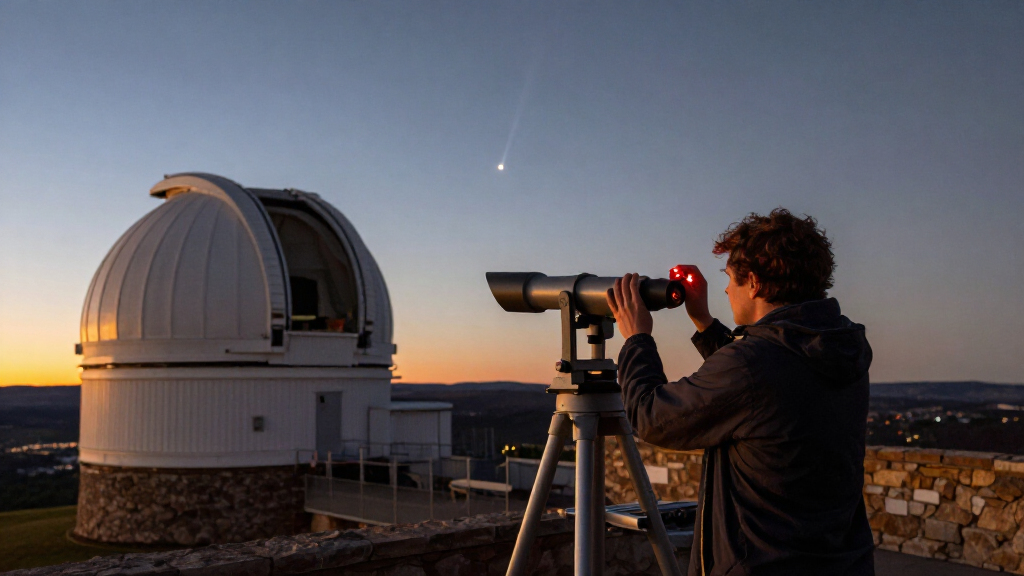

🔍 Read the full analysis: Held-Light Technique: A Key To “OORT — Comet Vigil For P/2043 K1 Vesper” on ThorstenMeyerAI.com

Get the little things that make your day delivered free with Prime
- Fast, free delivery on millions of items
- Prime Video, Amazon Music and more included
- Member-only deals all year
TL;DR
OORT is an AI-built web exhibition about a fictional observatory watching the fictional comet P/2043 K1 Vesper. Its “held-light” effect accumulates star trails as visitors stay, while other interactive elements animate the comet’s imagined orbit; the site does not report a real astronomical discovery.
OORT — Comet Vigil for P/2043 K1 Vesper is an AI-built web exhibition that turns a visitor’s time on the page into part of its artwork, using slowly lengthening star trails to depict a vigil for a fictional comet. The piece matters as an example of interactive digital art built around duration, not as an astronomical report: the comet and observatory are invented, and the site presents no real observation or discovery, as detailed in the original analysis.
The exhibition’s central device is “held light”: a canvas displays a seeded field of stars whose curved trails grow with elapsed time. According to the project description on ThorstenMeyerAI.com, the local sky can resume when a visitor returns on the same device because the site stores elapsed time locally. The effect makes remaining on the page part of the work rather than simply a pause before reading.
Other controls extend that idea. Scrolling moves the imagined comet through an inline SVG, with its ion tail directed away from the sun and its dust tail curving along the imagined orbit. Both paths respond to a shared progress value, tying the changing geometry to the display of distance and year. A range control adjusts a defocus view and a related brightness estimate, while visitors can hold a control briefly to open a simulated shutter.
The shutter records a timestamp, but the site does not present the moment as a sighting: its premise is that the comet remains unseen and in transit. The design description also says the animation stops when the page is hidden and that users who prefer reduced motion receive a still version. The project is presented as room 170 of 175 in the FABLE/175 collection, and the site links to its live room and a design guide.
Digital art / duration / imagined astronomy
Held-Light Technique: A Key to OORT
Inside “OORT — Comet Vigil for P/2043 K1 Vesper,” a visitor’s time on the page becomes part of the artwork: star trails slowly lengthen as an imagined comet moves through an invented sky.
01 / How it works
Waiting becomes visible
The interaction turns ordinary page time into a continuing exposure, inviting visitors to notice change instead of simply moving on.
Enter the field
A canvas begins with a seeded sky of stars.
Stay awhile
Curved trails lengthen as elapsed time accumulates.
Leave and return
Elapsed time is stored locally and may continue on the same device.
Keep watching
The changing sky makes duration part of the artwork.
02 / The visitor’s instruments
One imagined orbit, several ways to observe
Controls extend the feeling of a vigil while keeping each interaction inside the artwork’s fictional frame.
01 · Scrolling
Orbit in motion
Scrolling shifts the comet through inline SVG. Its ion tail points away from the imagined sun; its dust tail curves along the imagined orbit.
02 · Range control
Defocus & brightness
A range control adjusts a defocus view and a related brightness estimate, linking a visitor’s input to a changing visual reading.
03 · Simulated shutter
A timestamp, not a sighting
Holding a control briefly opens a simulated shutter and records a timestamp. The comet remains unseen and in transit.
03 / A visual language for time
An observatory made of interface
The project description frames the room through instrument-like readings, logbook text and a restrained observatory palette.
Deep black sets the night-sky stage. Pale text carries longer passages, while display lettering gives headings and measurements an instrument-like quality.
Monospaced coordinates and field notes evoke a logbook. The imagined orbit, star trails and shutter make the visitor an observer in the scene.
The brief describes responsive layouts, keyboard focus styles, reduced-motion support and pausing animation when the page is hidden. These are stated design aims; independent test results were not supplied.
Visual summary of the described design elements; bar lengths are illustrative, not performance measurements.
04 / Keep the frame clear
What the exhibition establishes
OORT borrows the language of astronomy to create an experience of waiting. Its claims belong to a work of fiction.
The artwork presents
A fictional vigil
P/2043 K1 Vesper, its observatory and its long-running watching community are invented elements. The simulated shutter is a record of attention, not evidence of an observation.
The material does not establish
A real comet or technical audit
No real astronomical discovery is reported. The supplied description also gives no independent performance review and does not explain local timing across changed devices, cleared storage or different browsers.
05 / Quick guide
Questions visitors may ask
A few details help distinguish the interactive fiction from real observing records.
Is P/2043 K1 Vesper a real comet?
No. The project description identifies it as fictional and presents OORT as an imagined observatory.
What does “held light” mean?
It names the effect in which a seeded star field’s trails grow over time. The description says elapsed time is saved locally.
Does the shutter capture a comet image?
No. It records a timestamp as a gesture of attention; the site does not claim a real sighting.
Where does the exhibition sit?
It is listed as room 170 of the 175-room FABLE/175 collection, with a live room and design guide linked by the project.
How Time Becomes the Artwork
OORT uses a familiar feature of websites—time spent on a page—as a visual material. The changing star trails give duration a visible form, while the saved local state makes a return visit feel like a continuation of the same exposure. That approach shifts attention from completing a page to observing how it changes.
The project also sets limits on what interaction means. A shutter press creates a record of attention, not evidence that anyone has seen a comet. That distinction matters because the artwork borrows the language and instruments of astronomy while explicitly keeping its subject fictional. Its value for readers is in the design concept: code can create an experience of waiting without disguising invented events as scientific findings.
As an affiliate, we earn on qualifying purchases.
An Imagined Observatory Online
The exhibition frames itself as a fictional observatory devoted to P/2043 K1 Vesper, watched by an imagined community over decades. Its art direction draws on observatory settings: deep black backgrounds, cyan for the ion tail and readings, amber-red for instructions, and pale text for longer passages. Display lettering gives headings and measurements an instrument-like feel, while monospaced text presents coordinates and field notes in a logbook style.
The source material identifies the room as part of the FABLE/175 pipeline and says its underlying art-direction brief is available through a “Prompt” link in the room’s footer. The brief called for a single-page site made with HTML, CSS and JavaScript, with canvas and SVG visuals and no external image assets. It also specified responsive layouts, keyboard focus styles, reduced-motion handling, and animation that pauses when a browser tab is hidden. These are stated design aims; the supplied material does not provide independent testing results.
“The page makes duration part of the artwork instead of treating it as time spent before the content.”
— OORT project description on ThorstenMeyerAI.com
As an affiliate, we earn on qualifying purchases.
What the Site Does Not Establish
The comet, observatory, long-running vigil and associated observing records are fictional elements, not verified astronomical information. The supplied material does not identify an actual comet matching the exhibition’s narrative or provide an external source for its invented provenance. Its references to a past sighting and a future orbit belong to the artwork’s framing.
It is also unclear from the source description how the implementation performs across devices beyond its stated design targets, or how local timing behaves if a visitor changes devices, clears browser storage or revisits through a different browser. No independent technical review or performance measurements are included in the material provided.
As an affiliate, we earn on qualifying purchases.
Explore the Room and Its Guide
The project description directs readers to the live OORT room and its design guide, where the exhibition’s visual approach and interaction details can be explored. Visitors can watch the trails accumulate, test the scroll-driven orbit and use the simulated shutter while keeping in mind that the comet is fictional.
The piece is listed as room 170 within a collection of 175. The supplied information does not announce a further release date or a new astronomical milestone; the next step for readers is to visit the room or browse the wider exhibition.
As an affiliate, we earn on qualifying purchases.
Key Questions
Is P/2043 K1 Vesper a real comet?
No. The project description identifies P/2043 K1 Vesper as fictional and describes OORT as an imagined observatory. The site is an artwork, not a report of a comet discovery.
What does “held light” mean in OORT?
It is the exhibition’s name for a canvas effect in which star trails lengthen over time. The description says the seeded sky and elapsed time are saved locally so the effect can continue when a visitor returns on the same device.
Does pressing the shutter capture a comet image?
No. The simulated shutter records a timestamp as a record of attention. The project says the comet remains unseen and in transit; it does not claim the interaction produces a real observation.
How does the comet move through the page?
Scrolling changes the comet’s position in an inline SVG. Its ion tail points away from the imagined sun, while the dust tail curves along the imagined orbit; both are tied to the same progress value.
Where can the exhibition be viewed?
The project description links to the live OORT room and says it is part of the FABLE/175 collection. It also points to a design guide with notes on the room’s visual and technical approach.
Source: ThorstenMeyerAI.com
NFL season / tailgating Picks
team gear
As an affiliate, we earn on qualifying purchases.