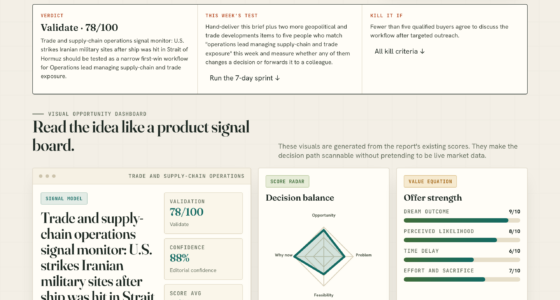

📊 Full opportunity report: The Cost Of Free AI In The Age Of Data Privacy on ThorstenMeyerAI.com — validation score, market gap, and execution plan.

Get the little things that make your day delivered free with Prime
- Fast, free delivery on millions of items
- Prime Video, Amazon Music and more included
- Member-only deals all year
TL;DR
As AI becomes increasingly abundant and cheap, its value shifts from intelligence to physical infrastructure and human judgment. This raises questions about data privacy, regional sovereignty, and the true cost of free AI services.
As artificial intelligence becomes more abundant and cost-effective, the core value shifts away from raw intelligence toward physical infrastructure and human judgment, raising significant concerns about data privacy and regional sovereignty, according to industry experts.
Industry analyst Thorsten Meyer emphasizes that as AI models become commoditized, the real strategic advantage lies in physical assets such as compute fleets, data centers, and supply chains, not the models themselves. These physical assets are costly and time-consuming to build, making them the true moat in AI development. This shift means regions that do not control the infrastructure risk outsourcing their AI capabilities and losing sovereignty.
Furthermore, despite the proliferation of AI models, human oversight remains a critical, non-commoditized element. People are valued for their accountability, judgment, and trustworthiness, which AI cannot replicate. This human factor is increasingly important as AI tools become more capable but lack human accountability, raising questions about decision-making transparency and data privacy protections.
Experts warn that the commoditization of AI models could lead to intensified data privacy concerns, as physical infrastructure and data flows become central to maintaining competitive advantage, potentially exposing sensitive data to new risks and vulnerabilities.
The forecast is right: intelligence becomes a commodity, cheap and ambient like electricity. But “commodity” is a statement about where value leaves. The whole game is being early to where it goes instead.
▲ Opinion & analysis · not investment adviceWhen the crude is cheap, value moves to the refinery, the trusted name on the deal, and the buyer who can only drink so much. Same shape here.
When a capability becomes abundant and free, we stop exercising it. Some of that is fine. Some of it hollows us out.
knowing which wishes are worth making — and being a person who can still tell.
Implications of Infrastructure Dominance and Data Privacy Risks
The shift toward physical infrastructure as the core of AI value has major implications for data privacy and regional sovereignty. Countries that do not develop or maintain their own AI infrastructure may become dependent on external providers, risking data leaks, loss of control, and strategic vulnerabilities. Additionally, as human judgment remains a scarce and valuable resource, safeguarding accountability and transparency becomes essential to maintaining trust in AI-driven decisions.
enterprise data center security hardware
As an affiliate, we earn on qualifying purchases.
As an affiliate, we earn on qualifying purchases.
AI Industry Shift Toward Infrastructure and Human Oversight
The industry has long forecasted that AI will become a commodity, similar to electricity or oil, with models rapidly decreasing in value. However, the physical assets required to produce and sustain AI—such as chips, data centers, and power—are expensive and slow to build, creating a new strategic layer of advantage. Historically, control over these assets has been linked to regional sovereignty, but the current trend risks centralizing this control in a few dominant regions or corporations. Meanwhile, despite the rise of AI models, human oversight remains vital, especially for accountability, trust, and ethical considerations, which are not easily commoditized.
"The moat was never the intelligence. The moat is the means of production."
— Thorsten Meyer
As an affiliate, we earn on qualifying purchases.
Unresolved Questions About Data Privacy and Infrastructure Control
It remains unclear how governments and corporations will balance the increasing importance of physical infrastructure with the need for robust data privacy protections. The extent to which regions can develop independent AI infrastructure to safeguard sovereignty is still uncertain, as is the future of human oversight in AI decision-making processes amid rapid technological change.
human oversight decision-making tools
As an affiliate, we earn on qualifying purchases.
As an affiliate, we earn on qualifying purchases.
Future Developments in AI Infrastructure and Privacy Safeguards
Next steps include increased investments in regional AI infrastructure, policies to protect data privacy, and innovations to enhance human oversight. Monitoring how governments and companies navigate these challenges will be key to understanding the evolving landscape of AI and data sovereignty.
As an affiliate, we earn on qualifying purchases.
Key Questions
Why does infrastructure matter more than AI models in this context?
Because physical assets like data centers, chips, and power supply are costly and time-consuming to build, they create a durable strategic advantage, unlike AI models which can be rapidly replicated and traded.
How does commoditization of AI models affect data privacy?
As models become cheap and abundant, there is increased reliance on physical infrastructure and data flows, which can expose sensitive data to higher risks if not properly protected.
What does this mean for regional sovereignty in AI development?
Regions that do not develop their own infrastructure risk dependence on external providers, potentially losing control over their data and strategic capabilities.
Will human oversight remain relevant in an AI-dominated world?
Yes. Human judgment, accountability, and trust are seen as scarce and valuable, making human oversight essential, especially for ethical and legal reasons.
What should policymakers focus on to address these challenges?
Policymakers should invest in local infrastructure, establish strong data privacy laws, and promote transparency and accountability in AI decision-making.
Source: ThorstenMeyerAI.com
Halloween Picks
halloween
As an affiliate, we earn on qualifying purchases.