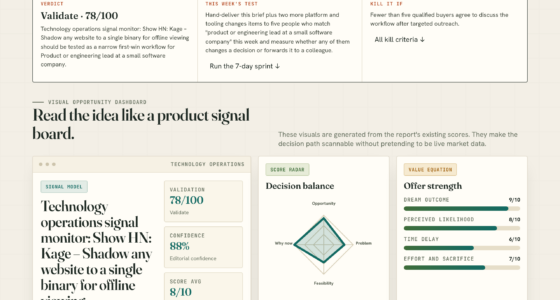

📊 Full opportunity report: Every Benchmark Launched 2023-2024 Has Fallen — The METR / SWE-Bench / CORE-Bench / MLE-Bench / PostTrainBench Sequence on ThorstenMeyerAI.com — validation score, market gap, and execution plan.

Get the little things that make your day delivered free — and shop member deals
- Fast, free delivery on millions of items
- Access to Prime Big Deal Days deals on October 6–7
- Prime Video, Amazon Music and more included
TL;DR
Six key AI benchmarks launched between 2023 and 2024 have all reached or are approaching saturation within a few months. This pattern suggests a rapid acceleration in AI research capabilities, with implications for AI development and deployment timelines.
All six major AI research benchmarks launched during 2023 and 2024 have reached or are approaching saturation within months, signaling a rapid acceleration in AI development capabilities. This pattern challenges previous assumptions about the pace of AI progress and has significant implications for the industry and policy makers.
Researcher Jack Clark and Thorsten Meyer have documented that every benchmark designed to measure AI R&D capabilities—covering software engineering, model training, research reproduction, and AI fine-tuning—has either been saturated or is nearing saturation within a timeframe of months rather than years. Notable examples include SWE-Bench, which improved from 2% to 93.9% in 30 months, and the METR time horizon, which expanded from 30 seconds to 12 hours over four years. The CORE-Bench, measuring research reproduction, was declared solved in December 2025 after reaching 95.5% accuracy in 15 months. These patterns suggest a structural shift in AI progress, with capabilities advancing at an accelerated pace.
Implications of Rapid Benchmark Saturation for AI Development
This rapid saturation indicates that AI systems are approaching human-level performance across multiple domains within a compressed timeline. It suggests that the trajectory of AI capabilities may be faster than previously estimated, raising questions about the pace of deployment, regulation, and workforce adaptation. Stakeholders should consider these accelerating trends in planning for AI’s societal and economic impacts.
As an affiliate, we earn on qualifying purchases.
Background on AI Benchmark Progress and Recent Developments
Prior to 2023, AI benchmarks showed steady but gradual improvements over several years. The launch of new challenging benchmarks in 2023-2024 aimed to push the boundaries of AI research. However, recent data indicates that all six of these benchmarks have saturated or are nearing saturation within a short period, a pattern that was not observed in earlier years. This shift suggests a possible structural change in the pace of AI research, driven by advancements in algorithms, compute, and data availability, leading to rapid capability gains.
“Every benchmark launched in 2023-2024 to measure AI R&D capability has either saturated or is tracking toward saturation on a cadence of months, not years.”
— Thorsten Meyer
As an affiliate, we earn on qualifying purchases.
Uncertainties Surrounding Benchmark Saturation and Future Trajectory
While current data shows rapid saturation across six benchmarks, it remains uncertain whether this pattern will continue as AI systems evolve further. Some experts suggest that new benchmarks or capabilities may emerge that could alter or extend these saturation points. Additionally, the practical implications for deployment and safety are still being evaluated, and it is not yet clear how these rapid capability gains will influence real-world applications or regulatory frameworks.
As an affiliate, we earn on qualifying purchases.
Next Steps for Monitoring AI Capability Progress
Researchers and industry stakeholders are expected to continue developing new benchmarks to evaluate AI systems further and determine whether current saturation points are sustainable. Monitoring AI performance in practical applications, along with safety and regulatory assessments, will be important. Discussions around the implications of these advancements for AI governance, workforce adaptation, and ethical considerations are anticipated to increase in the coming months.
As an affiliate, we earn on qualifying purchases.
Key Questions
What does benchmark saturation mean for AI development?
Benchmark saturation indicates that AI systems are reaching or surpassing the performance levels set by these tests, reflecting significant progress in AI capabilities across various domains.
Are these saturation points a sign of AI reaching human-level intelligence?
While saturation in benchmarks demonstrates notable improvements in specific capabilities, it does not necessarily indicate that AI systems have achieved human-level intelligence in all aspects. It reflects technical progress but not comprehensive understanding or reasoning.
What are the risks of such rapid AI progress?
Accelerated progress raises considerations regarding safety, regulation, and ethical use, as AI systems become more capable and potentially autonomous at a faster rate than policy frameworks can adapt.
Will new benchmarks emerge to challenge AI systems further?
It is probable that researchers will develop more advanced benchmarks to continue measuring AI progress, especially as existing benchmarks reach saturation.
How should policymakers respond to these developments?
Policymakers should consider proactive regulation, establishing safety standards, and investing in AI governance to manage the rapid pace of capability advancements effectively.
Source: ThorstenMeyerAI.com
NFL season / tailgating Picks
team gear
As an affiliate, we earn on qualifying purchases.