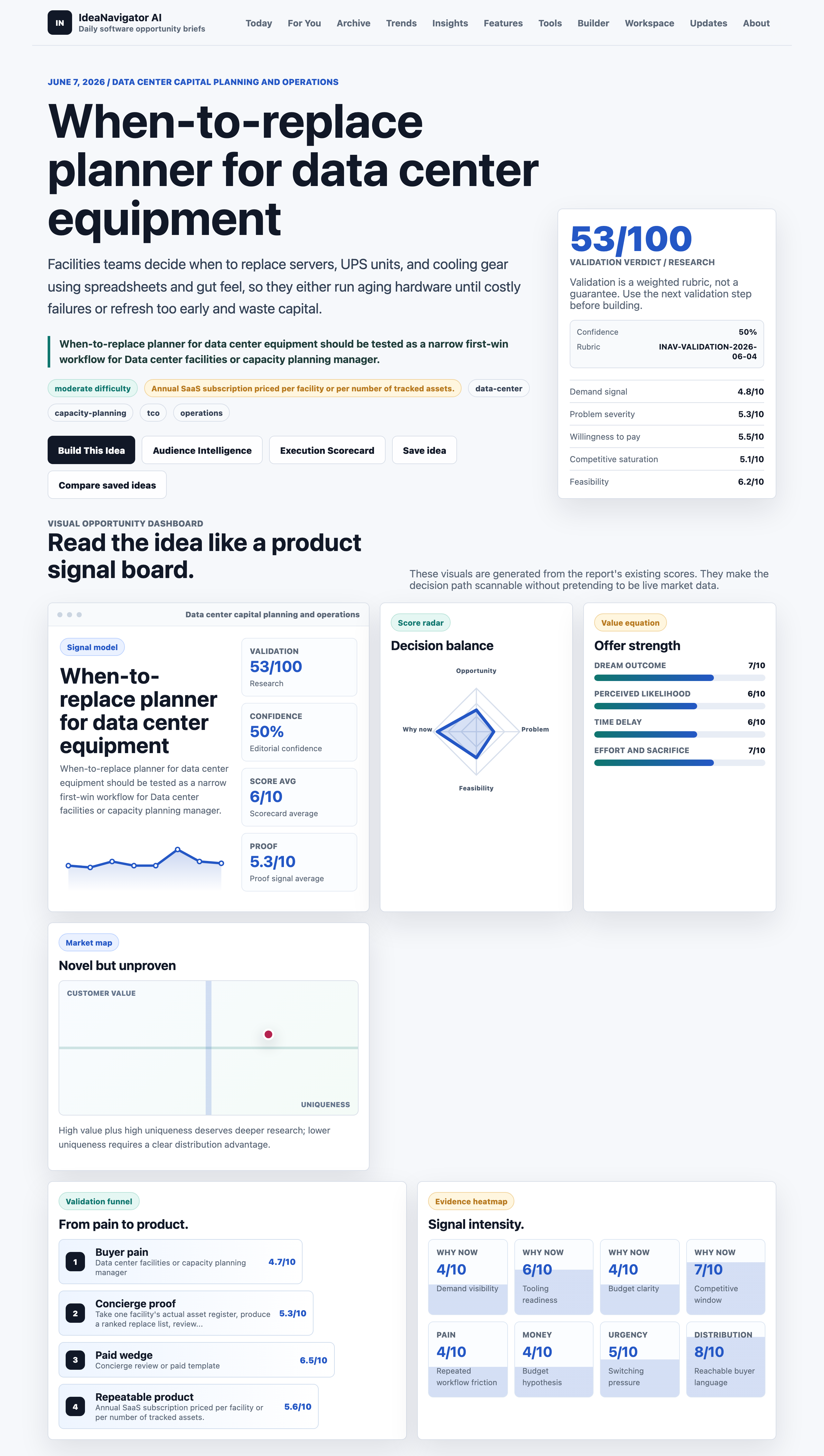
📊 Full opportunity report: When-to-replace planner for data center equipment on IdeaNavigator AI — validation score, market gap, and execution plan.

Get the little things that make your day delivered free with Prime
- Fast, free delivery on millions of items
- Prime Video, Amazon Music and more included
- Member-only deals all year
TL;DR
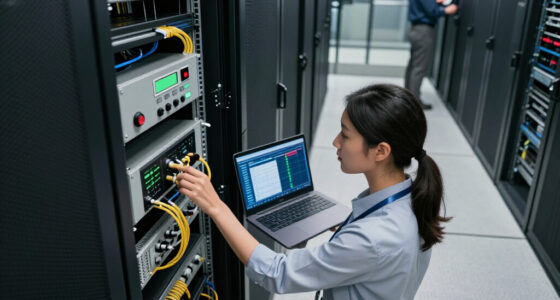
A proposed ‘when-to-replace’ planner for data centers is being tested as a workflow tool to improve asset replacement decisions. It analyzes equipment age, energy, and failure costs to guide upgrades, potentially saving costs and reducing failures.
A new ‘when-to-replace’ planner for data center equipment is being tested as a workflow tool to assist facilities and capacity planning managers in making data-driven replacement decisions. The tool aims to reduce costly hardware failures and optimize capital expenditure amid rising energy costs and hardware efficiency gains.
The proposed planner ingests a facility’s asset list, including data on equipment age, power consumption, and maintenance costs. It then ranks assets based on a calculated score that considers rising energy expenses and failure risks against the benefits of newer, more efficient hardware. The initial validation involves applying the tool to a single facility’s asset register, generating a ranked list of equipment for replacement, and comparing these recommendations with current replacement plans through review with the facility’s capacity manager. The development is led by IdeaNavigator AI, which describes the tool as a minimum viable product (MVP) designed for SaaS deployment. The subscription model would charge per facility or per number of assets tracked. The goal is to provide facilities teams with a reliable, automated decision support system that improves upon traditional spreadsheet-based approaches, which often rely on gut feeling or outdated data.Why It Matters
This development could significantly impact data center operations by enabling more precise, cost-effective asset replacement strategies. As energy costs and hardware densities increase, the ability to optimize hardware refresh cycles becomes critical for reducing operational costs and preventing failures. The tool’s success could lead to broader adoption in data center capacity planning, helping organizations better manage their infrastructure investments.
data center server replacement tools
As an affiliate, we earn on qualifying purchases.
As an affiliate, we earn on qualifying purchases.
Background
Data center facilities currently rely on manual methods, such as spreadsheets and intuition, to decide when to replace equipment. These methods can lead to premature upgrades or costly failures due to aging hardware. Rising energy prices and the availability of more efficient hardware have sharpened the economic trade-offs involved. The idea of a data-driven replacement planner has been discussed in industry circles, but practical testing and validation are still underway.
“The goal is to provide a systematic, data-driven approach to hardware replacement, reducing guesswork and optimizing capital expenditure.”
— an anonymous researcher
UPS maintenance and replacement software
As an affiliate, we earn on qualifying purchases.
As an affiliate, we earn on qualifying purchases.
What Remains Unclear
It is not yet clear how accurately the tool’s recommendations will align with actual operational needs or how much it will improve decision-making compared to traditional methods. The validation process is still ongoing, and user feedback from facility managers will be crucial to refining the product. Broader market acceptance and integration with existing management systems remain to be seen.
cooling unit energy efficiency monitor
As an affiliate, we earn on qualifying purchases.
As an affiliate, we earn on qualifying purchases.
What’s Next
The next steps include completing initial testing on a single facility, gathering feedback from capacity managers, and refining the algorithm. If successful, the developers plan to expand testing to multiple facilities and prepare for wider commercial deployment. Future updates may incorporate more complex factors such as equipment failure history and predictive analytics.
data center equipment lifecycle management
As an affiliate, we earn on qualifying purchases.
As an affiliate, we earn on qualifying purchases.
Key Questions
How does the ‘when-to-replace’ planner determine which equipment to replace?
The planner analyzes asset age, energy consumption, and maintenance costs to generate a score indicating whether to replace or keep each piece of equipment, balancing failure risk against efficiency gains.
Is this tool available for commercial use yet?
The tool is currently in the testing phase and not yet commercially available. It is being validated through pilot projects with select facilities.
What are the main benefits of using this planner?
It aims to reduce unnecessary early replacements, prevent costly failures, and optimize capital spending by providing data-driven recommendations based on facility-specific asset data.
Will this replace existing asset management systems?
The planner is intended as a supplement to existing systems, offering additional insight to inform decision-making rather than replacing comprehensive management platforms.
When can facilities expect wider availability?
If initial testing proves successful, developers plan to expand deployment over the next year, with broader market entry potentially within 12-18 months.
Source: IdeaNavigator AI
Halloween Picks
halloween
As an affiliate, we earn on qualifying purchases.