
Your creative confidence grows from repetition because consistent practice helps you develop skills and reshape your mindset over time. When you repeat activities, your brain forms new pathways, making tasks feel more natural and boosting your ability to take risks. Reflection on your progress turns setbacks into learning opportunities, increasing resilience. As you persist, you’ll see your skills evolve and believe more in your potential. Keep going—there’s much more to discover about harnessing repetition for growth.
Key Takeaways
- Repetition reinforces neural pathways, making creative tasks feel more natural and boosting confidence over time.
- Consistent practice shifts mindset from doubt to belief through gradual mastery and skill development.
- Regular engagement helps reframe failure as a learning opportunity, building resilience and confidence.
- Repetition fosters reflection and learning, which accelerates growth and enhances creative self-assurance.
- Persistent effort transforms tentative skills into reliable abilities, increasing overall creative confidence.
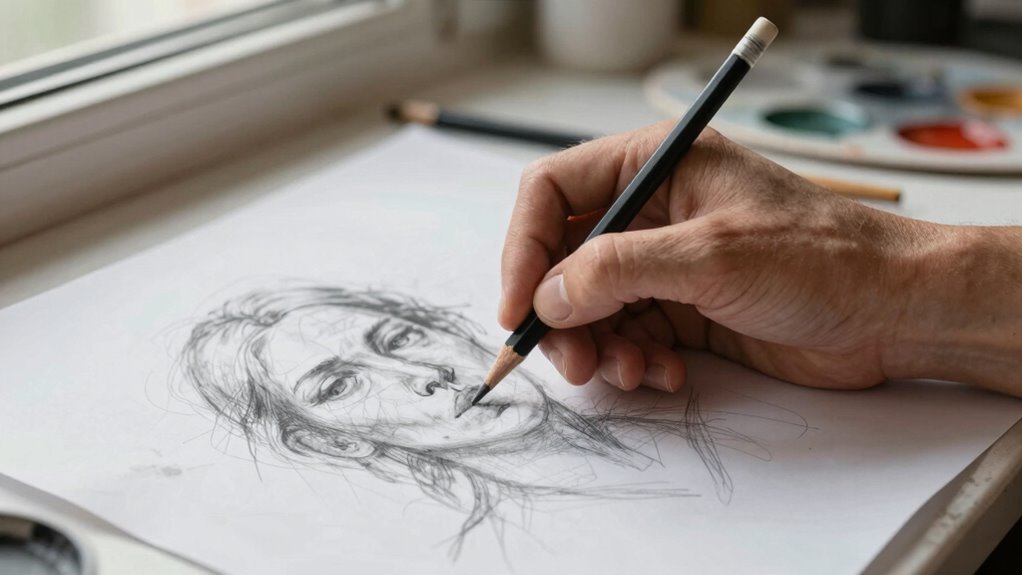
Confidence in your creativity doesn’t develop overnight; instead, it grows through consistent practice. When you commit to regularly engaging in creative activities, you begin to notice subtle shifts in your mindset. These mindset shifts aren’t just about feeling more confident—they’re about changing how you see yourself as a creator. Repetition helps you reframe failure as a natural part of skill development, which is crucial for building resilience and reducing fear of making mistakes. As you persist, you start to recognize patterns in your work, which boosts your understanding of what works and what doesn’t. This ongoing process of refinement feeds your belief that you can improve with effort, making each attempt more intentional and less intimidating.
Repetition is a powerful tool for skill development because it allows your brain to form new neural pathways. When you repeatedly practice a creative task, you’re training your mind to perform it more efficiently. Over time, what once felt difficult becomes second nature. This gradual mastery makes you more willing to experiment and take risks, knowing that your skills are solidifying through practice. As your skill level rises, so does your confidence—each small success reinforcing your ability to tackle bigger challenges. The key is not just doing the same thing over and over but actively reflecting on your work, learning from your mistakes, and applying new insights. This cycle of practice and reflection accelerates growth and cements your belief in your creative capacity.
You also begin to see setbacks differently. Instead of viewing failure as a sign of inadequacy, you start to see it as part of the process of mastery. This shift in perspective is vital for developing a resilient creative mindset. Understanding the importance of repetition] in skill-building can further motivate you to stay committed to your practice. With each repetition, you realize that growth isn’t linear but a series of small, cumulative steps. Over time, your confidence becomes less dependent on external validation and more rooted in your own experience and progress. This internal validation fuels your motivation to keep practicing, knowing that each effort brings you closer to your goals.
Ultimately, the reason your creative confidence grows from repetition is because it’s a deliberate process of transforming effort into expertise. As you persist, your mindset shifts from doubt to belief, and your skills evolve from tentative attempts to reliable competencies. Repetition isn’t just about doing the same thing; it’s about cultivating a mindset that values growth, resilience, and continuous learning. With patience and consistency, you’ll find that your confidence blooms naturally, rooted in the steady rhythm of practice. Moreover, understanding the importance of contrast ratio in visual clarity can help you appreciate the importance of refining your skills to achieve better results.

Mead Primary Journal Creative Story Tablet Composition Notebook, 7.5" x 9.75", Grades K-2, 100 Sheets, Blue (09554)
Journal is appropriate for grades K-2. It contains 100 double-sided, primary ruled sheets that measure 7-1/2" x 9-3/4"
As an affiliate, we earn on qualifying purchases.
As an affiliate, we earn on qualifying purchases.
Frequently Asked Questions
How Does Repetition Differ Across Various Creative Disciplines?
Repetition differs across creative disciplines by shaping muscle memory and skill acquisition uniquely. In music, you develop precise finger movements; in painting, you refine brush techniques. You build confidence as consistent practice makes techniques automatic, reducing hesitation. Whether you’re writing or dancing, repetition helps you internalize processes, making creativity feel natural. Over time, this consistent effort boosts your confidence, enabling you to experiment more freely and push boundaries in your chosen discipline.
Can Too Much Repetition Hinder Creative Confidence?
Too much repetition can be like walking a tightrope—while it strengthens skills, it might also lead to risk aversion and a cautious mindset shift. When you stick to familiar routines, your creative confidence could stagnate, making you hesitant to explore new ideas. Balance is key; embracing varied experiences can nurture your confidence, preventing it from becoming fragile and overly cautious. Keep pushing boundaries without overdoing it.
What Role Does Feedback Play in Repetitive Creative Practice?
Feedback plays a vital role in your repetitive creative practice by guiding your mindset development and reinforcing your skills. When you receive constructive input, you identify areas for improvement, which boosts your confidence and encourages a growth-oriented mindset. This ongoing process helps you refine techniques, build resilience, and develop a stronger belief in your creative abilities, ultimately making repetition more effective and fostering sustained creative confidence.
How Long Does It Typically Take to See Growth From Repetition?
You’ll likely start noticing growth from repetition in about 21 to 66 days, depending on your habit formation skills. Don’t expect instant mastery; patience is your best friend. As you persist, your creative confidence will subtly grow, transforming effort into skill mastery. Keep at it, and soon, what once felt overwhelming becomes second nature. Remember, slow and steady wins the creative race—repetition is your secret weapon.
Are There Specific Techniques to Make Repetition More Effective?
To make repetition more effective, focus on consistent practice and deliberate effort. You can build muscle memory and reinforce habit formation by breaking tasks into smaller steps and practicing regularly. Using cues or triggers helps embed routines into your daily life. Tracking your progress keeps you motivated, while varying exercises prevents boredom. Over time, these techniques strengthen your skills and boost your creative confidence through steady, intentional repetition.

Grabie Trace and Color Drawing Kit, Beginner Friendly All-in-One Tracing Art Set with Acrylic Dual Tip Markers, 15 Pre-Printed Designs, Vellum Paper, Creative Hobby Kit, Artist Collaboration Yeti
THE ANTIDOTE TO BLANK PAGE SYNDROME Experience instant creativity with our intuitive trace-and-color system. This all-in-one kit is…
As an affiliate, we earn on qualifying purchases.
As an affiliate, we earn on qualifying purchases.
Conclusion
So, remember, building your creative confidence is all about embracing repetition—like tuning a vintage radio until the signal comes through crystal clear. Each attempt, whether a flop or a hit, refines your skills and boosts your belief in your ideas. Don’t shy away from practicing regularly; even the greatest inventors needed their “repetition” to get it just right. Keep at it, and soon you’ll find your own creative symphony, echoing across time like a timeless tune.

How to Think – Creative Thinking Puzzles: Brain-training puzzles to improve innovative thought
As an affiliate, we earn on qualifying purchases.
As an affiliate, we earn on qualifying purchases.

30-Day Self-Love and Growth Reflection Workbook: A Mindful Challenge for Personal Transformation
As an affiliate, we earn on qualifying purchases.
As an affiliate, we earn on qualifying purchases.