
🔍 Read the full analysis: How AI Automation Tools Can Fit Into Small Business Workflows on ThorstenMeyerAI.com

Get the little things that make your day delivered free with Prime
- Fast, free delivery on millions of items
- Prime Video, Amazon Music and more included
- Member-only deals all year
TL;DR
A supplied source roundup compares 15 books that can help small-business owners learn about AI automation across marketing, sales, customer service and operations. The roundup presents the books as learning resources, not software platforms, and does not establish specific integrations or results.
A roundup in the supplied source material compares 15 books on AI automation for small businesses for owners seeking to streamline marketing, sales, customer service and routine operations. The roundup identifies a broad practical guide as its top overall pick, but stresses that the books teach automation rather than provide software to run it.
The supplied roundup names AI Automation for Small Businesses: A Practical Guide to Automating Marketing, Sales, Customer Service, Operations, and Everyday Work as its best overall choice, citing the range of business functions named in the title. It presents that breadth as useful for owners who want to explore more than one workflow, while noting that a wide-ranging guide may be less focused than a step-by-step introduction.
For readers seeking a more guided entry point, the roundup highlights AI Automation Made Simple for Small Business, whose title signals a no-code approach, and ChatGPT for Business: The 10X Playbook, which the roundup says emphasizes workflow ideas readers can adapt. The roundup also frames other titles in the list around themes such as everyday tasks, structured plans and business growth. It does not provide enough detail to verify specific chapters or exercises for every title.
The comparison, as described in the source material, is based on titles, stated audiences and promised formats, rather than hands-on tests of the books or automation software. The roundup advises buyers to check descriptions or sample pages for the actual level of instruction and confirm whether a proposed workflow fits their existing apps. It does not establish that a particular book delivers measurable savings or business growth.
The 15 picks
- 1
 Smart AI for Small Business: 50 Simple Hacks to Grow Revenue, Cut Costs, and…View on Amazon →
- 2
 The Small Business Owner’s AI Handbook: How to Use Artificial Intelligence to…View on Amazon →
- 3
 AI Tools for Small Business: A Practical Guide to Automation, Saving Time, an…View on Amazon →
- 4
 AI-Powered Automation and Workflows for Small Business OwnersView on Amazon →
- 5
 ChatGPT for Business: The 10X Playbook — 100 AI Workflows to Save Time, Grow…View on Amazon →
- 6
 AI Automation for Small Businesses: Build Smarter Workflows, Save Time, Reduc…View on Amazon →
- 7
 Claude AI Made Practical: A Beginner’s Guide to Everyday Work, Small-Business…View on Amazon →
- 8
 AI Automation for Small Businesses: A Practical Guide to Save Time, Work Smar…View on Amazon →
- 9
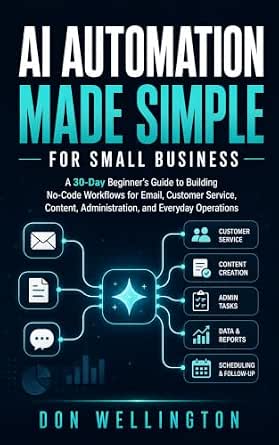 AI Automation Made Simple for Small Business: A 30-Day Beginner’s Guide to No…View on Amazon →
- 10
 AI Automation for Small Business: Simple AI Workflows for Everyday TasksView on Amazon →
- 11
 AI Automation for Small Business: A Practical Guide to Automating Marketing,…View on Amazon →
- 12
 AI for Small Business, Volume I: Getting Started — Set It Up Yourself, No Tec…View on Amazon →
- 13
 AI for Small Business: From Marketing and Sales to HR and OperationsView on Amazon →
- 14
 AI Automation for Small Businesses: Build Semi-Passive Income Systems Without…View on Amazon →
- 15
 AI for Entrepreneurs and Small Business Owners: How to Compete with Larger Bu…View on Amazon →
Choosing a Guide Before a Tool
For a small business, the practical decision is not simply whether to use AI; it is which repetitive process to address and how much guidance the owner needs to implement a change. The supplied roundup’s distinction between broad guides and books positioned for beginners or no-code use may help readers identify a starting point, but it does not verify the depth of instruction in those books.
The distinction between advice and working software matters. A book can offer ideas for handling inquiries, drafting follow-ups or preparing reports, but it does not itself connect a business’s email, calendar, customer database or payment system. Owners still need to select and configure tools, test the workflow and decide which outputs require human review, especially when customer communications or business records are involved.
Products Worth Considering

Therabody SmartGoggles 2nd Generation Heated Eye and Temple Massager

Levoit Core 300S-P Smart Wi-Fi Air Purifier

BowFlex Results Series 552 SelectTech Adjustable Dumbbells (Pair)
As an affiliate, we earn on qualifying purchases.
How the 15 Books Were Compared
The supplied roundup describes its selection as a comparison of business learning resources, not a review of functioning AI products. It says it prioritized practical workflow coverage, accessibility for nontechnical owners and relevance to common functions including marketing, sales, service and operations. It also distinguishes general guides from titles that signal a particular tool, no-code setup or structured learning plan.
The roundup says its criteria are based on limited information: it relied on titles and stated scope because fuller details were not supplied. Its rankings should therefore be read as an attempt to match the apparent focus of each book to readers’ needs, not as proof of instructional quality, compatibility or results.
What Buyers Still Need to Verify
The supplied source material does not give a complete title-by-title account of the 15 books, publication dates, prices, sample-page findings or independent assessments. It also does not confirm which software platforms, integrations or technical steps each guide covers. A title suggesting a beginner plan or no-code setup is a clue about its positioning, not confirmation of its contents.
The source provides no measured evidence about time saved, costs reduced or revenue gained. Results from automation will also depend on a business’s process, software and review practices. Before purchasing, owners can check the publisher’s description and available samples, then verify integration details with the relevant software providers.
Start With One Repeatable Task
The supplied roundup recommends identifying a repetitive task that consumes time, such as sorting inquiries, drafting follow-ups or preparing recurring reports. Owners can note how often it occurs, who handles it and what a successful result should look like. Establishing those steps first can help prevent automation from reproducing an inconsistent process.
From there, readers can match a book’s stated scope to their technical confidence and current software. A sensible next step is to test one low-risk workflow, check its outputs and set approval rules before using automation for customer-facing messages or sensitive information. The supplied material names no launch schedule or forthcoming evaluation; actual tool coverage and outcomes remain matters for readers to verify.
Key Questions
Do these books provide AI automation software?
No. The supplied roundup describes them as learning resources. Readers still need to choose and configure software that carries out any workflow.
Which book does the roundup rank highest overall?
It names AI Automation for Small Businesses: A Practical Guide to Automating Marketing, Sales, Customer Service, Operations, and Everyday Work as its best overall pick, citing the range of functions in its title.
What options does it suggest for beginners?
The roundup points to AI Automation Made Simple for Small Business for its no-code framing and ChatGPT for Business: The 10X Playbook for workflow ideas. Those descriptions do not confirm how detailed the instructions are.
How should a business choose a book?
Start with a specific repetitive task, then check whether the book’s scope and instruction level fit the business’s needs. Verify software compatibility separately and set human review rules for outputs that could affect customers or records.
Source: ThorstenMeyerAI.com