
📊 Full opportunity report: A Workflow-First Social Media Workspace For Creators And Agencies on IdeaNavigator AI — validation score, market gap, and execution plan.

Get the little things that make your day delivered free with Prime
- Fast, free delivery on millions of items
- Prime Video, Amazon Music and more included
- Member-only deals all year
TL;DR
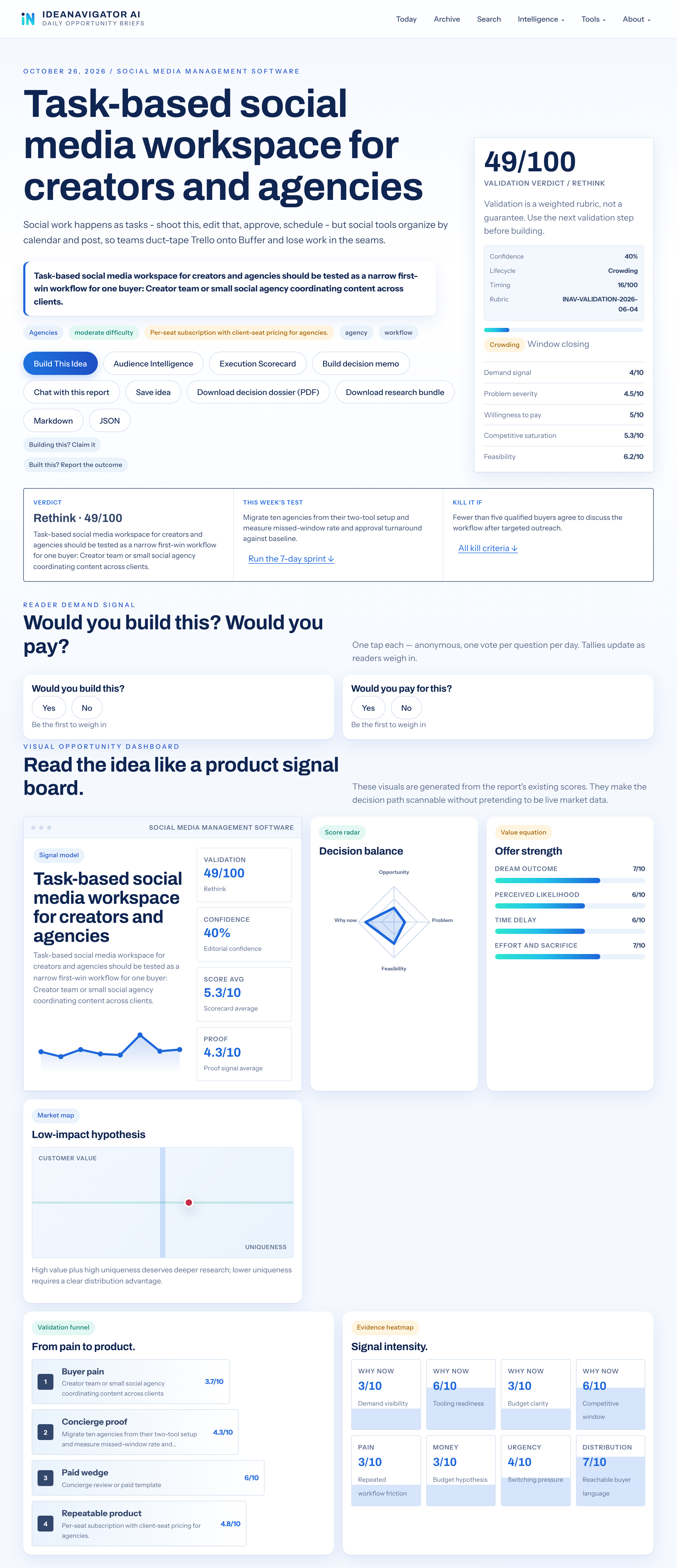
A product concept proposes a workflow-first social media workspace for creator teams and small agencies, where each post moves from brief to publication. The proposal recommends testing it with 10 agencies against their current tools; no product launch or validation results are reported.
IdeaNavigator AI’s proposal outlines a task-based social media workspace for creator teams and small agencies, combining post briefs, asset handling, editing, client approvals and scheduling in one workflow. The proposal does not describe a launched product. Its suggested next test is to move 10 agencies from their existing two-tool setups and compare approval times and missed publishing windows with a baseline.
In its proposal, IdeaNavigator AI targets teams coordinating social content across clients. The proposal argues that the work involves linked tasks—such as shooting, editing, approving and scheduling—while many social media tools are organized around calendars and posts. It says teams may use a general project-management tool alongside a social scheduler, creating handoffs where work can be lost or delayed.
IdeaNavigator AI’s suggested minimum viable product would treat each post as a task moving through stages: brief, asset, edit, approval and scheduled. The proposed features also include client-facing approval links and asset versioning, with a post scheduled natively once approved. The stated aim is a single pipeline from idea to publication rather than a workflow split across services.
The proposal suggests a per-seat subscription, with a separate pricing approach for agency clients who need access to review or approve work. It provides no pricing, technical specifications, launch timing or evidence that prospective customers have committed to using the product.
Testing the Workflow Gap
IdeaNavigator AI’s proposal raises a practical coordination question for small teams: whether keeping creative production and publishing in one system can reduce delays and missed handoffs. If the concept works as intended, agencies could manage briefs, revisions, client sign-off and scheduling without asking staff to keep a project board and a social publishing tool in sync.
That potential benefit remains a product hypothesis, not a demonstrated outcome. The proposed pilot would measure two indicators: missed-window rate and approval turnaround compared with each agency’s baseline. The proposal gives no results and does not define the baseline period or how a missed window would be counted.
The proposal also describes a commercial test. Agencies may value a workflow designed around posts and client review, but willingness to pay for another workspace is not established. The suggested per-seat and client-seat pricing would need to account for how many people participate in each account and whether the tool replaces, rather than adds to, existing subscriptions.
Products Worth Considering

Oral-B iO Series 5 Rechargeable Electric Toothbrush with Travel Case and 3 Brush Heads, Black

Theragun Mini 3rd Generation Massage Gun – Travel Essential (Black)

Levoit Eleva 300X HEPA Air Purifier for Home and Bedroom
As an affiliate, we earn on qualifying purchases.
From Calendars to Production Tasks
IdeaNavigator AI situates the concept in the social media management software market. Its premise is that publishing calendars and post schedulers address when content goes out, while the work required to produce and approve it often happens elsewhere. The proposal says generic project tools can track tasks but may not represent the particular stages and assets involved in preparing social posts.
IdeaNavigator AI frames the timing around rising content-velocity expectations, which it says have multiplied team workflows. It also argues that established scheduling tools have left the work-management layer to general-purpose project platforms. These are the proposal’s market rationale; it includes no market-size figures, customer interviews, competitor comparisons or independent evidence establishing how widespread the problem is.
The proposal recommends starting with a narrow audience: creator teams and small social agencies coordinating content across clients. Rather than build for every kind of social media operation at once, it suggests testing one recurring workflow and assessing whether the handoffs between production and publishing are sufficiently costly.
Pilot Evidence Still Needed
The IdeaNavigator AI proposal identifies no product name, developer, release date or active pilot. It is also unclear whether any agencies have agreed to participate, which platforms the workspace would support, or how native scheduling and client approval links would work in practice.
The proposal reports no test findings. A comparison would need a clearly defined baseline, consistent measures across participating agencies and a way to distinguish product effects from changes in workload, staffing or client response times. The proposal also leaves open whether asset versioning and client access would be included in an initial build, and how client seats would be priced.
Ten-Agency Test Proposed
IdeaNavigator AI proposes migrating 10 agencies from their current two-tool arrangement and measuring missed publishing windows and approval turnaround against baseline performance. The proposal does not say when the test would begin or how long it would run.
Until a pilot is reported, the workspace remains a product concept. Any later assessment will depend on whether participating agencies complete the workflow in the new system, whether the measurements show a meaningful change, and whether teams consider the proposed subscription model worth adopting.
Source: IdeaNavigator AI proposal
Key Questions
Has the social media workspace launched?
No launch is reported in IdeaNavigator AI’s proposal. It describes a product concept and a suggested pilot, not an available service.
Who is the proposed workspace for?
IdeaNavigator AI initially targets creator teams and small social agencies coordinating content across multiple clients.
What would the product include?
The proposal’s suggested MVP would track each post through a brief, asset, editing, approval and scheduling pipeline, with client-facing approval links, asset versioning and scheduling after approval.
How would the idea be tested?
IdeaNavigator AI recommends moving 10 agencies from their existing two-tool setups and comparing missed-window rates and approval turnaround with baseline measures. The proposal provides no test results or schedule.
Source: IdeaNavigator AI