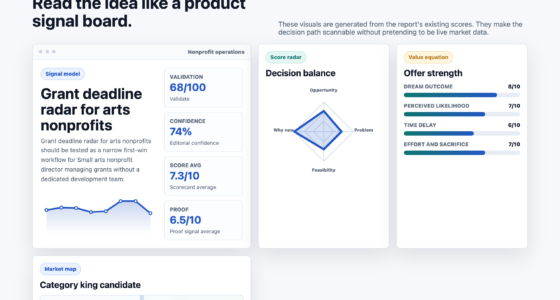
📊 Full opportunity report: Planning The Switch: Open-source Tools For Nonprofit Operations on IdeaNavigator AI — validation score, market gap, and execution plan.

Get the little things that make your day delivered free with Prime
- Fast, free delivery on millions of items
- Prime Video, Amazon Music and more included
- Member-only deals all year
TL;DR

A proposed nonprofit IT service would start by auditing software subscriptions at small nonprofits, then offer fixed-fee migrations to a managed open-source bundle with training and ongoing support. The plan recommends testing demand with 20 audits and five paid migrations; it does not report that the service has launched or that savings have been verified.
IdeaNavigator AI has proposed a service to help small nonprofits assess software subscriptions and, where practical, move to managed open-source tools. The concept pairs a software-cost audit with a fixed-fee migration, staff training and continuing support, but there is no reported launch, customer data or verified savings yet.
The proposal is aimed at executive directors of small nonprofits facing a collection of software subscriptions paid from constrained budgets. It identifies the main obstacle not as a lack of open-source software, but as the staff expertise needed to compare options, move information, configure replacements and maintain them over time.
The suggested first step is a stack audit that lists an organization’s current tools and estimates which costs may be replaceable. A service would then offer a migration to a managed bundle covering customer relationship management, forms, email and documents. Training and an affordable support subscription are part of the proposed package, rather than treating installation as the end of the work.
The proposed revenue model combines fixed-fee migrations with recurring managed-hosting and support subscriptions. IdeaNavigator AI recommends testing the model by auditing 20 nonprofits, publishing average savings and converting five organizations into paid migrations. Retention would be tracked for a year, though the plan provides no findings from that test.
The Cost of Switching Tools
For a small nonprofit, software costs compete with program spending, and several recurring subscriptions can add up across fundraising, communications and internal administration. The proposal addresses a practical gap: an organization may know that open-source alternatives exist but lack the time or technical capacity to decide whether a change is suitable and carry it through.
A managed service could shift some of that work to an outside provider. If the approach proves workable, nonprofits might have another way to control software expenses without relying on staff to maintain every tool themselves. But lower costs are not yet established. Migration labor, hosting, support, data cleanup and staff training all affect the total cost, and the proposal reports no measured results or customer experiences.
The plan also makes support central to the offer. Open-source software may be available without a license fee, but it still requires configuration, upkeep and reliable access. Whether a bundle is less costly or more useful will depend on each nonprofit’s existing systems, requirements and capacity to adapt.
open-source CRM software for nonprofits
As an affiliate, we earn on qualifying purchases.
As an affiliate, we earn on qualifying purchases.
Why Nonprofits Face Switching Costs
The concept describes nonprofits as paying for stacked SaaS subscriptions while open-source equivalents are available. It says tighter grants and rising SaaS prices create a reason to review those costs, while mature open-source options and managed hosting may make alternatives easier to use than before. Those points are the rationale for the proposal, not independently quantified market findings in the available information.
Changing systems involves more than choosing replacement software. Organizations may need to transfer records, preserve access, adjust forms and workflows, and train staff. The proposal’s emphasis on an audit, guided migration and ongoing support reflects those demands. It does not identify specific products, hosting providers or technical requirements, so the suggested bundle remains a general outline rather than a detailed implementation plan.
As an affiliate, we earn on qualifying purchases.
Savings and Service Details
No savings figures have been established, and the proposed audit sample has not been reported as completed. It is also unclear which software products would be included, how a provider would price hosting and support, or what level of service organizations would receive after migration.
The plan does not specify how it would handle sensitive donor or client information, integrations with existing systems, accessibility needs, data retention or security responsibilities. Nor does it report whether five nonprofits have agreed to participate in paid migrations. Those details would affect both the feasibility of the service and whether a switch makes sense for a particular organization.
nonprofit software migration support services
As an affiliate, we earn on qualifying purchases.
As an affiliate, we earn on qualifying purchases.
Testing Demand With Nonprofits
The next step in the outlined plan is to conduct 20 software-stack audits and publish average potential savings. The concept then calls for converting five organizations into paid migrations and tracking customer retention for 12 months. Those measures could show whether organizations will pay for the service and continue using it, but they are proposed milestones rather than scheduled or completed work.
Until those results are available, the idea remains an unvalidated service concept. Nonprofits considering a switch would need to compare the full cost and operational demands of their current tools with the migration, hosting, training and support offered by any replacement provider.
Source: IdeaNavigator AI
staff training for open-source tools
As an affiliate, we earn on qualifying purchases.
As an affiliate, we earn on qualifying purchases.
Key Questions
What service is being proposed?
A service that would audit a nonprofit’s software subscriptions and offer a fixed-fee move to a managed open-source bundle, with training and ongoing support.
Which tools could be included?
The concept names CRM, forms, email and document tools, but it does not specify products or providers.
Have the savings been verified?
No. The proposal recommends auditing 20 nonprofits and publishing average savings, but no audit results or verified savings are reported.
How would the service make money?
The proposed model combines one-time fixed-fee migration work with recurring managed-hosting and support subscriptions.
What is the proposed test of demand?
Audit 20 nonprofit software stacks, seek five paid migrations and track retention for a year. The plan does not say those steps have been completed.
Source: IdeaNavigator AI
NFL season / tailgating Picks
team gear
As an affiliate, we earn on qualifying purchases.